


The second judicial intervention in politics



The "absolute nullity" ruling in the CHP is not the first example of judicial intervention in politics during this government's tenure. In 2016, dissidents in the MHP had succeeded in convening an extraordinary congress; however, the Ankara 3rd Civil Court of First Instance cancelled the convention and deemed all decisions invalid. The aftermath is well-known: Devlet Bahçeli expelled all his rivals, including Meral Akşener, and subsequently formed an alliance with the AKP.
There is no doubt that the cancellation of the CHP's 2023 convention will also leave deep marks on political history. Such a significant political development raised many questions from the very first moment. There were questions regarding the procedure to be followed, the formation of the Party Assembly (PM), the clique Özel mentioned, and many others. However, on the evening of the ruling, the journalists attending Özgür Özel's press conference settled for very few questions. Fortunately, in the following days, journalists were better prepared and were able to ask questions directly targeting the core of the issue.
The pro-government media, on the other hand, had no need to ask questions; the ruling was enough for them. A festive atmosphere immediately took hold in the pro-government media. Even before the ruling was officially served, they had already removed Özgür Özel from the chairmanship on their screens. CNN Türk wrote "CHP Manisa Deputy"; yet, before the convention, Özgür Özel was not only a deputy but also the "CHP Group Chairman."
While Ensonhaber mocked Özel by saying, "He spoke with a tearful voice" and "He still thinks he is the chairman," the newfound love for Kılıçdaroğlu in Yeni Akit was reflected in the headline "Great shame for Kılıçdaroğlu at CHP Headquarters," and in Yeni Şafak with the headline "Great cleanup in the CHP."
The pro-government writers who were happy with the ruling also felt a surge of affection for the CHP. Mahmut Övür wrote, "Absolute nullity could be an exit door for the CHP in a dead end," Fuat Uğur wrote, "This is a purification case for Turkish politics," Yücel Koç wrote, "Absolute nullity is an opportunity to save the CHP," and Melih Altınok wrote, "A great cleanup begins in the CHP," interpreting the ruling as a development in favor of the CHP.
It was also significant that Kemal Kılıçdaroğlu announced his first assessment via TGRT. In fact, throughout the process, reports about "Kılıçdaroğlu's inner circle" were mostly published by this channel. It was also TGRT Ankara Representative Fatih Atik who announced in advance that an "absolute nullity" ruling had been made and would be uploaded to the UYAP system on Friday.
The pro-government media continued to side with Kılıçdaroğlu during the police intervention at the CHP Headquarters. Events at the Headquarters were reported in a one-sided manner on pro-government TV channels—including TRT; those inside were portrayed as those resorting to violence, while those outside were portrayed as those trying to solve the problem through dialogue.
While the pro-government media reported the police breaking down the door from the outside as an "evacuation tension," a small number of reporters from the opposition media were exposed to tear gas by the police inside. These channels, which broadcast footage from inside the building, also followed Özgür Özel's march to the TBMM and his speech from the bus from start to finish. Some pro-government channels entered the building and started live broadcasts from there once they had left.
The polarization in the media also manifested itself in the news and commentary regarding the judicial intervention in the CHP and the police's use of force to enter the CHP Headquarters. These were important crossroads for journalism in terms of its contribution to democracy and political life...
Influencers as role models at the Faculty of Communication

Last week, an unprecedented event took place at the Ankara University Faculty of Communication; social media celebrities known as "influencers" were guests at the school. Moreover, the arrival of the influencers was announced as "An inspiring meeting with the beloved names of social media."
The poster prepared for the May 15 event, under the headline "Influencers at ILEF," stated, "Q&A, experience sharing, and more await you." The photos of influencers Nisa Saraçoğlu, Batın Dönmez, Yiğit Çelebi, Efe Parlakdemir, and Muhammed Serçe were listed.
I do not know what kind of experience was conveyed to the journalism candidates at the event organized by the New Media and Communication Department. But a short video shared on Instagram by Efe Parlakdemir, one of the influencers who attended that event, gives enough of an idea about that event.
In the video he titled "LVBEL C5 TEACHER," Parlakdemir uses a classroom in the faculty as a setting; he also makes the students act. He enters the classroom with a smirk, saying "Come on, come on," and leans into the camera saying, "I love girls, my loves." Then a student says, "Teacher, I couldn't solve this"; he scribbles on their notebook. After that, he repeats again, "I love women, men," and the female students respond by shouting in unison.
That is all. It is a display of crude humor, an image to be looked at and passed over. How could a person who does not show the slightest sign of knowledge in the footage they shot have conveyed any experience to the Faculty of Communication students?
ILEF, from which I also graduated, used to host experienced journalists and writers as guests in the past, ensuring that successful names who had proven themselves in their fields became role models for the youth. Now, it is trying to ensure that such influencers "inspire" the youth.
For a faculty that aims to train journalists, television broadcasters, public relations specialists, and communicators to present people whose entire experience consists of shooting empty but entertaining videos to students, calling them "inspiring" just because they are famous, is a denial of itself. It means ignoring the courses, science, and history taught at that faculty to this day...
It seems someone at ILEF intends to decorate the dreams of the youth with the "teachings" (!) of influencers. But this is not "New Media," nor is it media...
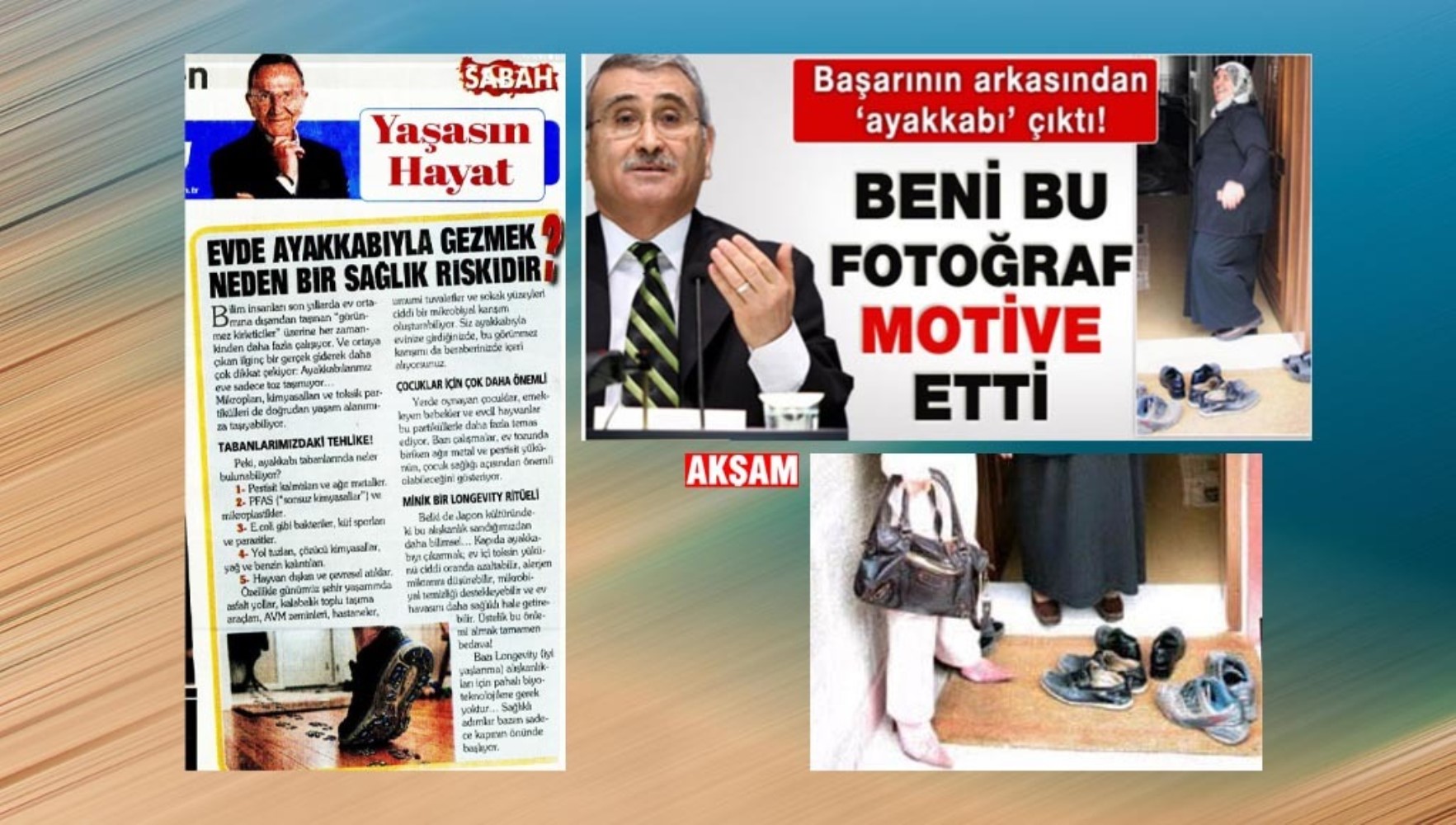
Taking off shoes is a Japanese culture!
Prof. Dr. Osman Müftüoğlu's health articles must really be attracting people's interest, as his space in the Sabah newspaper is gradually expanding, and his airtime on NTV is also increasing.
His article last week in the "Long Live Life" column, titled "Why walking around the house with shoes on is a health risk," was also written in simple language about daily life. He listed shoes, which he stated can carry pesticides, bacteria, chemicals, heavy metals, environmental waste, and germs into homes, among "invisible pollutants." Then he brought the subject to the Japanese culture of taking off shoes at the door:
"Perhaps this habit in Japanese culture is more scientific than we think. Taking off shoes at the door can significantly reduce the indoor toxin load, lower the amount of allergens, and make the indoor air healthier."
Well, the tradition of taking off shoes at the door exists in our culture too. Explaining the benefits of not entering the house with shoes on to the people of this country not through the tradition in Anatolia, but through Japanese culture, smells like a translation error. If it is not, and it is a conscious choice, it is an alienation from the culture of this country.
You may remember that the Akşam newspaper photographed the shoes in front of the door of Durmuş Yılmaz's house when he was appointed Governor of the Central Bank. It was talked about for a long time as a symbol of his lifestyle and Anatolian culture. Müftüoğlu seems to have forgotten those photos too...
News without memory
Reports on the capture of Wilhelmus Adrianus Leijdekkers, the brother of Johannes Leijdekkers, nicknamed 'Bolle Jos' (Fat Jos), the leader of the "Cheroke" gang, Europe's most dangerous drug gang, were presented as a success story.
Reports of "MIT brought the Cheroke fugitive to his knees" followed one another, but these reports ignored what happened in Turkey regarding the Cheroke gang and previously published news.
The gang leader, nicknamed "Fat Jos," had fled the Netherlands and arrived in Turkey on July 4, 2020, and had obtained two separate residence permits, one with a fake name and one with his real name. He then sought ways to become a "Turkish citizen"; but when a "Red Notice" was issued for him, he fled to Abkhazia by private jet in May 2021 without encountering any obstacles.
Journalist Timur Soykan, who compiled the list of international drug barons who settled in Turkey in his book "Baron Invasion," had reported on the Turkey adventure of "Fat Jos" for three consecutive days in BirGün two years ago.
At that time, I had also criticized some journalists for reporting on "Wanted" posters hung on poles in Edirne as if they were real, for the filming of a short film about international mafia barons taking refuge in Turkey.
The media, which did not question the scandal of the gang leader being able to continue his activities in Turkey despite being wanted and being able to flee without any intervention, is now presenting the capture of his brother as a success; this is journalism without memory.
The journalist's wardrobe is always the same
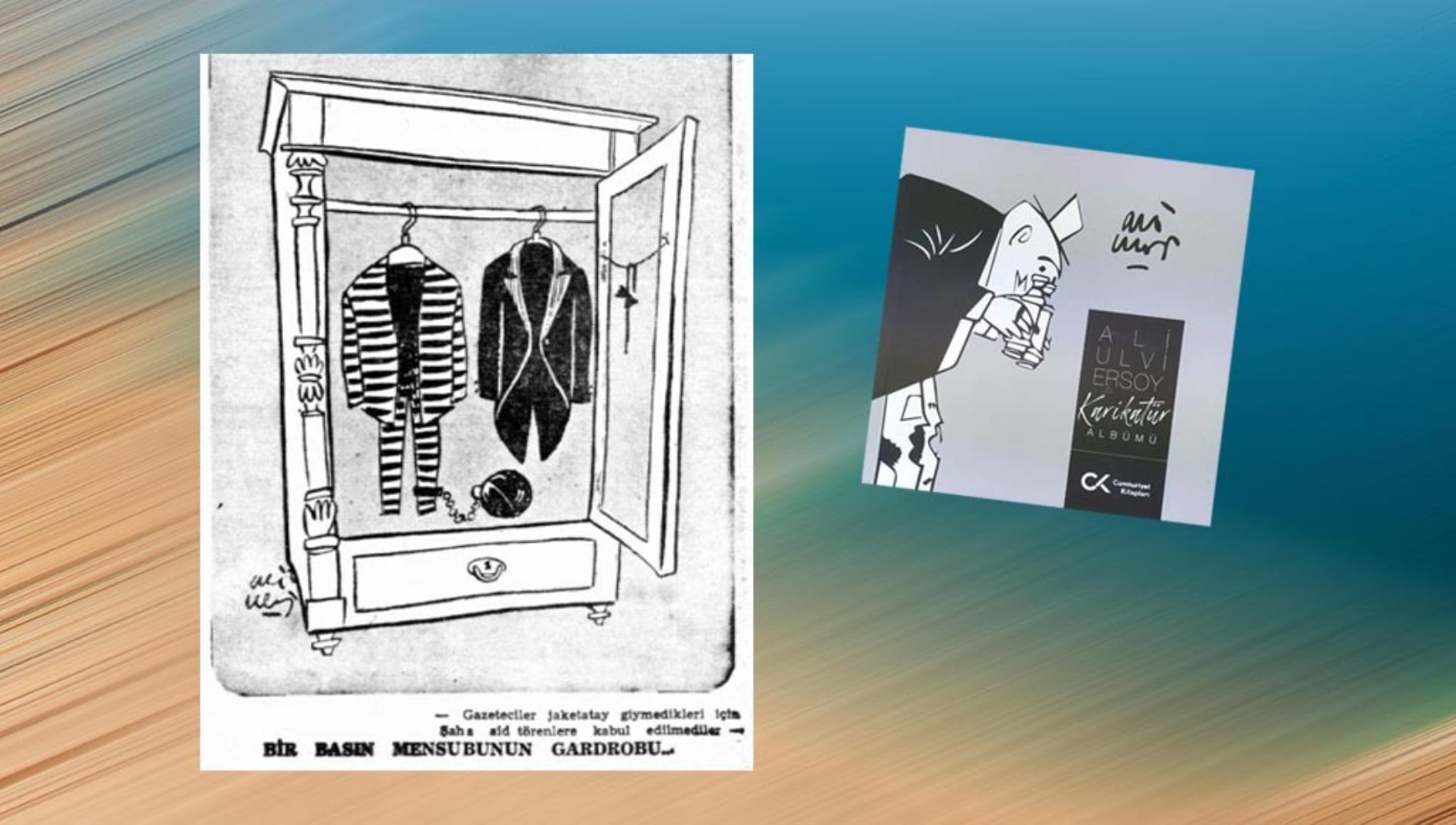
Under the cartoon drawn by the famous cartoonist of the period, Ali Ulvi, in the Cumhuriyet newspaper in 1956, it says, "The wardrobe of Turkish journalists." In the wardrobe, a tuxedo and a prison uniform with shackles on its feet are visible.
Emre İlkan Saklıca, Turkey Program Director of the International Press Institute (IPI), found this cartoon in the IPI archive. He showed it at the "Turkey Journalism Summit" held on the occasion of the 75th anniversary of the founding of IPI. Journalism in Turkey has mostly been reflected in the IPI archive with arrests, pressures, and interventions in press freedom.
Unfortunately, journalism is in the same state today. 70 years have passed, but the wardrobes of critical and independent journalists have not changed.
In a single sentence:
•On the day Yeni Akit criticized the IMM for placing advertisements in Karar, Milli Gazete, BirGün, Evrensel, Sözcü, and Cumhuriyet on May 19, advertisements for the AKP-run Kocaeli Metropolitan Municipality were published in 10 pro-government newspapers, including Akit.
•Halkbank provided financial support by placing advertisements in 14 pro-government newspapers for its anniversary, and Ziraat Bank in 12 pro-government newspapers on the grounds of congratulating Trabzonspor.
•The AKP banned ministers from speaking to journalists in the TBMM Group Meeting hall, one of the rare places where opposition journalists have the opportunity to ask questions. Most recently, Süleyman Soylu had blocked a journalist.
•Oksijen's interview titled "You should be able to feel good even if you enter a store and buy nothing" was a promotion for the second branch of a store selling luxury goods.
•Akşam published an advertisement for the AKP-run Körfez Municipality, Sabah for the Sakarya Metropolitan Municipality, and Yeni Şafak for the Trabzon, Bağcılar, and Ümraniye municipalities as if they were news.
•A 10-episode program titled "Truth Ambassadors" was prepared in cooperation with CNN Türk by the European Union Delegation to Turkey for the purpose of "combating disinformation."
•It was stated on Halk TV that "RTÜK imposed a broadcast ban" for the news of the attack in Tarsus where six people died, but RTÜK was only conveying the court decision.
•NTV reported the earthquake news in Malatya in a loud, very excited language as if a major disaster had occurred, in a way that would create panic and anxiety in the viewers.
•The sales campaign for the building that Okan Holding built in Miami began in Sabah with Dilek Güngör's news, "It will wave the Turkish flag in the heart of Miami."
•Hürriyet did not give the name of the hospital in Elazığ in its news, "Record fine for private hospital."
FOR YOUR CRITICISM, COMPLAINTS, AND SUGGESTIONS: [email protected]
Would you like to get notifications about new developments and save news?
- NotificationsNew developments and breaking news
- SaveNews is stored in the app
Most Read
Video response to Kim Jong-un claims
Murat Ağırel’s police statement has been revealed
Azerbaijan issues arrest warrants in absentia for 7 people living in Turkey

The Orionid meteor shower will be visible from Turkey!
The penalty for Ronaldo, who left the national team camp, has been announced

Fatoş Seğmen reveals the cause of her daughter's death
Latest status in the race between AKP and YENİ Party revealed
Injury shock at Liverpool: He may miss the Fenerbahçe match

Who authorized the concert held in a parking garage?
From brotherhood to a distant partnership...