


'Western media' and the divide in our media



In Sabah, Hilal Kaplan, while criticizing The Wall Street Journal's report titled "Photos of hunger in Gaza tell a thousand lies," stated, "The Gaza genocide has stripped the veneer not only from Western democracies but also from the Western media."
Fatih Selek, in his column in the Türkiye newspaper, emphasizes, unlike Hilal Kaplan, that the Western media is "confessing its sins these days," and provides examples:
"British and American newspapers are drawing attention to the tragedy with photos of hunger. Time, The New York Times, The Guardian, Daily Express, and Independent have carried the hunger in Gaza to their front pages. The Washington Post listed the names of nearly 20,000 children killed by Israel across two pages."
The examples provided in the two articles show that not all media in these countries share a common stance on Gaza, and that there is a shift occurring regarding the issue. It is not accurate to speak of "Western media" as a single block or to claim that all of them are tools for Israel's lies.
Admittedly, the mainstream media in Turkey follows Israel's brutality in Gaza day by day and keeps the news at the top of the agenda. However, we must admit that the examples Selek provided from the West are more striking than ours. That is why Selek began his article with "Turkish newspapers should do more than the Washington Post" and ended it with the same sentence. He is right. Media and journalism organizations in Turkey should also be able to carry out creative actions.
However, for joint publications and actions to take place under the leadership of the Directorate of Communications, the Journalists Association, and professional organizations as Selek suggests, the division must first end. We must stand in solidarity regarding human rights, fundamental freedoms, and professional issues and standards.
Unfortunately, we are very far from such solidarity. The Journalists Association of Turkey (TGC), Reporters Without Borders (RSF), the Journalists Union of Turkey (TGS), and DİSK Basın-İş held a "Support for Palestinian journalists" protest in front of the Israeli Consulate in Istanbul on July 29. They condemned Israel for "killing 225 Palestinian journalists in violation of international rules of war and humanitarian law principles" and called on the international community to impose deterrent sanctions on Israel. They stated, "Israel is killing the truth by starving journalists in Gaza."
However, this joint action by the four professional organizations could only be reported on a few sites such as Bianet, Evrensel, and T24. It is sad, but the pro-government media did not report on this action. I also did not see it in the opposition media, for instance in Cumhuriyet or Sözcü.
In such an environment of indifference and division toward professional organizations, how can our media engage in joint action?
Erdoğan's "tane" (piece) reference to martyrs
Language and literature worker Attila Aşut has written and warned many times that the word "tane" (piece/unit) should not be used for people. This time, he took issue with President Tayyip Erdoğan and CHP Chairman Özgür Özel referring to martyrs as "tane," and rightly titled his article in BirGün, "The 'tane' martyr discourse is very hurtful."
Aşut states that the Anadolu Agency served Erdoğan's words exactly as they were, but some agencies and newspapers corrected the phrase "tane martyr" before publishing; he referred the matter to me by saying, "Did they have the right to do this? I leave the evaluation of this dimension of the matter to our Media Ombudsman Faruk Bildirici."
When Erdoğan said in 2020, "We have a few 'tane' martyrs in Libya," this approach was heavily debated and criticized. But he continues the same mistake without being affected at all. At that time, I also objected to the media's stance on Erdoğan's linguistic errors and teleprompter accidents:
"When the reader/viewer is not informed about (Erdoğan's) teleprompter accidents and incorrect expressions, and when the incorrect expressions are not reported and corrected, it is presented as if Erdoğan never makes mistakes in his speeches, which is contrary to the facts."
I must reiterate the same view for the "tane martyr" error that Aşut mentioned. Our fundamental principle is our obligation to convey the truth; as journalists, we cannot convey errors. Whoever makes a mistake, we correct it when reporting.
However, Erdoğan is a politician, a public figure, and also the president. Therefore, we should not only correct Erdoğan's linguistic (or factual and discursive) errors, but we must also inform the reader and viewer that we have corrected them. Otherwise, we reduce ourselves to the position of a public relations officer who cleans up Erdoğan's mistakes, presents him incompletely, and hides information from the public.
The "third Turk to go to space" confusion
The Anadolu Agency's report "The third Turk to go to space has been determined" and subsequently Akşam's report "The crescent and star in space gave courage" announced that businessman Gökhan Erdem was the "third Turk to go to space."
When I saw these reports, I remembered the "third Turk to go to space" reports published in many places last year. In that report, which İHA released on April 21, 2024, it was said, "He exceeded the sales quota and won the prize to go to space! He will be the third Turk to go to space." It was reported that a real estate consultant named Ahmet Temel had completed his distance education and would go to space within 2024. This good news was published on news sites and in newspapers like Hürriyet and Yeni Şafak. Cem Küçük also announced it to viewers on his program on TGRT.
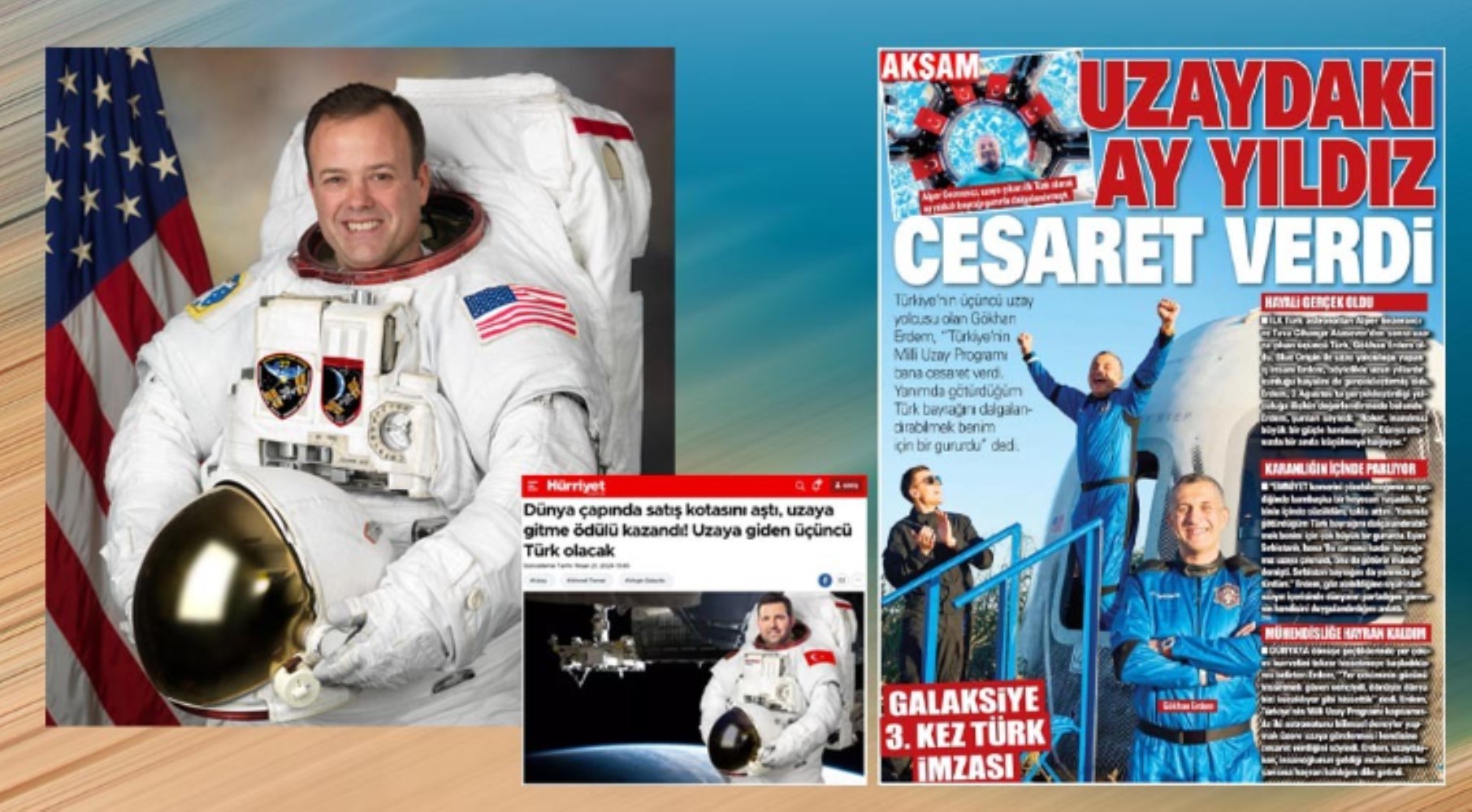
However, 2024 passed, we are in the middle of 2025; Gökhan Erdem went to space and came back; but Ahmet Temel is still in Istanbul! I found his account on Instagram and asked, "What happened? When will you go to space?" He replied, "There are currently 700 people in line to go to space. I will probably go by the end of 2027." I asked for a document or proof showing he would go to space; he sent edited images. In one of them, he had photoshopped his own head onto Ronald J. Garan's astronaut suit.
That is the situation. Ahmet Temel could not go to space, but he showed off quite a bit thanks to the news. I suppose those who wrote the news that Ahmet Temel would go to space are also aware of this situation. I hope they learn a lesson; they should not believe and publish news just because someone says, "I am going to space."
Interview questions should provide clarity
The allegation that Deputy Minister of Transport and Infrastructure Ömer Fatih Sayan deleted information regarding his four university diplomas from his personal website following the exposure of an e-signature fraud rightly drew attention; it became news in the opposition media.
Burak Doğan from the pro-government Yeni Şafak also called Sayan to ask about these reports. Sayan denied the allegation that he deleted his Anadolu University graduation information, and then added;
"This information is completely false. My resume is still on our Ministry's official website as it is. If I had something to hide, why would I add it to my publicly available resume?"
Sayan later made a similar statement while answering Ahmet Hakan's questions; he repeated this narrative at an awards ceremony he attended.
Shouldn't the journalists interviewing him have also asked Sayan, "If you have nothing to hide, why don't you put the information that is on the ministry's website on your personal site?" Because Sayan's words do not clarify the reports, they even raise suspicions.
When a journalist conducts an interview, there should be no unanswered questions left. Unless, of course, the goal is not to exonerate a government official...
The lust for suicide news
Unfortunately, our media cannot give up on suicide news. And despite all the drawbacks, they do not refrain from reporting the method and details of the suicide in an almost lustful language.
The reports "Former Foça Mayor's son Kerem Dirim found dead" were again about a suicide, and information about the method was also provided. These reports also saddened journalist Zeynep Yüncüler, a relative of the family. She made an effort to at least have those details in the reports cleaned up; when she felt helpless, she appealed to her colleagues on X:
"Kerem Dirim is my sister's husband, my niece's father, my dear brother. We are experiencing a pain we cannot describe. Having to write this because of these reports is causing a separate pain right now.
I am not questioning your journalism, everything is clear right now. When suicide is painful enough, why do you give details? I have a request. I don't have the strength to call those who made these reports one by one. Those I called didn't answer. My friends, my colleagues, those who see this post, can you help me? Let them correct these reports. I will delete this post later. I am asking for help."
Journalist friends shared this post, and eventually, the reports were corrected slightly. In fact, those reports should have been removed entirely. I have written many times before; suicide news is contagious. Research shows that suicide news causes suicides to spread.
Therefore, suicide news should not be published at all, except for suicides of famous and public figures; suicides that are exceptional in nature, such as those intended to clear one's name against accusations, those intended as a protest, or those stemming from social and criminal causes.
In 2002, under the management of Mehmet Yılmaz, Milliyet had decided not to publish suicides that "do not stem from social causes, where the person is not well-known to the public, or that stem solely from a personal mental disorder." Hürriyet had also come to this line since the 2010s. Now I see that Milliyet and Hürriyet also know no bounds in suicide news. In fact, Milliyet publishes old photos of women who committed suicide on the internet as an "album."
Unfortunately, we are regressing in journalism standards and the application of ethical principles...
In a single sentence:
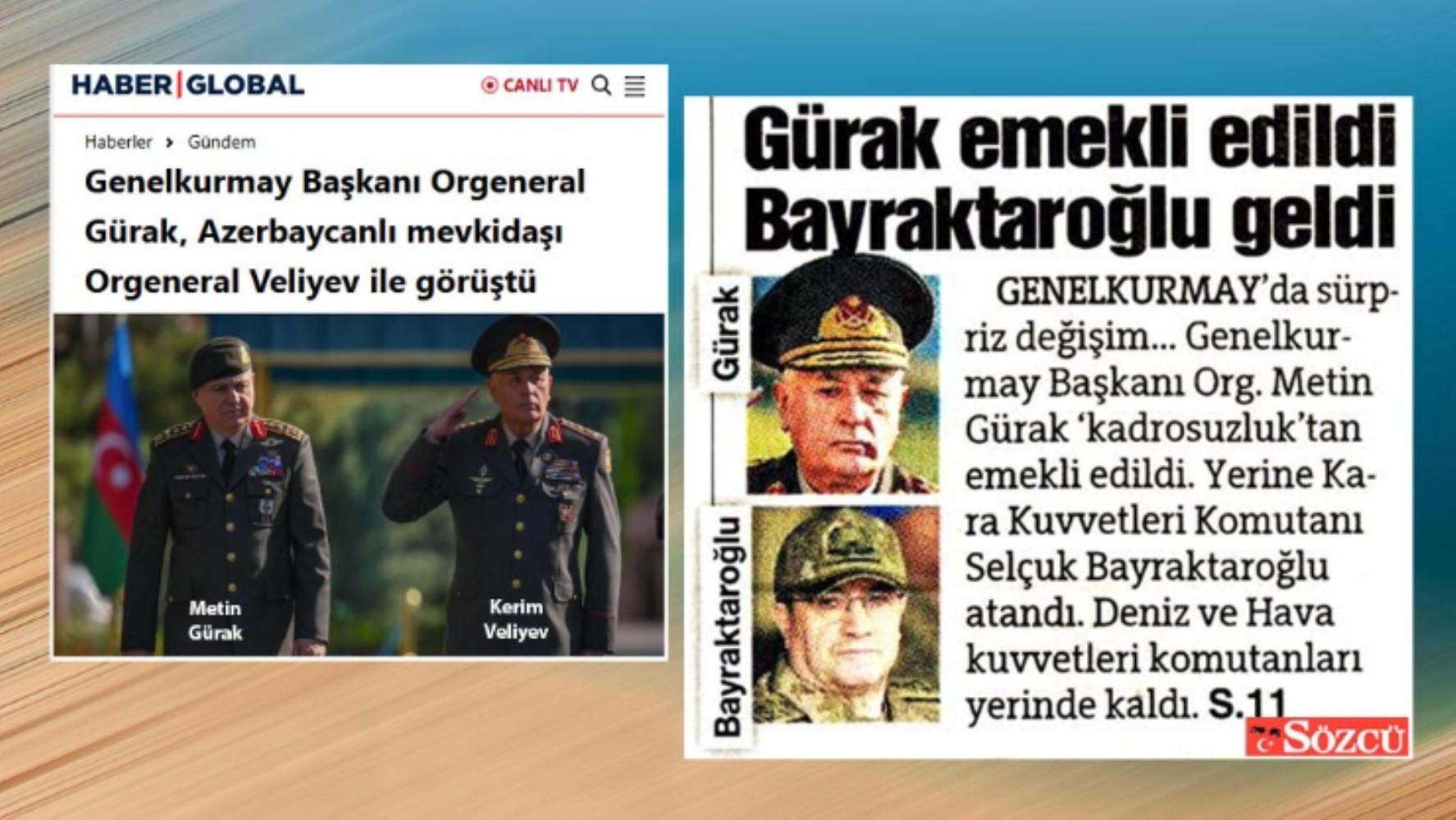
• Sözcü confused General Metin Gürak with Azerbaijan Chief of General Staff Colonel General Kerim Veliyev, who visited Ankara some time ago, in its report "Gürak retired, Bayraktaroğlu arrived"; it used Veliyev's photo instead of Gürak's.
• Hürriyet and CNN Türk, which ignored the protests against the demolition of the Archaeology Museum building, one of the symbols of cultural heritage in Antalya, published a praise piece for the demolition with the headline "Antalya Museum is being renovated."
• THY took Aydın Türkmen from Akşam, Gülistan Alagöz from Hürriyet, Vahap Munyar from Ekonomim, Şükrü Andaç from Milliyet, and Ersin Çelik from Yeni Şafak to London to promote the flights Ajet started between the TRNC and London, and they wrote promotional articles.
• Türk Telekom took Mustafa Kartoğlu from Akşam and Okan Müderrisoğlu from Sabah to Budapest as guests to promote the work of its subsidiary company in Hungary; a report with content similar to what they wrote was also published unsigned in Milliyet.
• Akşam promoted Van Yüzüncü Yıl University and the AKP-run Kayseri and Meram municipalities under the name "Preference Guide" but did not include a statement indicating that this was paid content.
• Haberler.com publishing the footage of the moment of the murder with the headline "15-year-old child killed his village guard uncle like this" was "violence pornography."
• Davut Kayacı, who writes under the pseudonym Salih Tuna in Sabah, mistakenly wrote the name of author Berrin Sönmez, who took off her headscarf to protest the Diyanet's sermon on clothing, as "Zerrin."
• A photo of Jennifer Lopez taken while she was walking in a shopping mall in Istanbul was published on all magazine pages, but it was not clear who took the photo; there was no signature on any of them.
• Karar had put the headline "Waters receded, the highway appeared" to the news; but the road that appeared when the waters receded in the Aktaş Dam was not a highway, but the old İzmir-Çeşme road.
FOR YOUR CRITICISM, COMPLAINTS, AND SUGGESTIONS: [email protected]
Would you like to get notifications about new developments and save news?
- NotificationsNew developments and breaking news
- SaveNews is stored in the app
Most Read

Video response to Kim Jong-un claims

Murat Ağırel’s police statement has been revealed

The Orionid meteor shower will be visible from Turkey!

Fatoş Seğmen reveals the cause of her daughter's death

Latest status in the race between AKP and YENİ Party revealed

Injury shock at Liverpool: He may miss the Fenerbahçe match

From brotherhood to a distant partnership...

Who authorized the concert held in a parking garage?
Acting mayor of Üsküdar has been determined
Good news from Izmir, may Istanbul be next