


The political economy of the Republic: From where to where?



We are celebrating the 102nd anniversary of our Republic. However, today, we have moved very far away from the founding philosophy and ideals of our Republic.
The vision put forward by Gazi Mustafa Kemal Pasha, while establishing a new state, the Republic, was essentially to carry society into the 20th century. The goal of the Republic and the revolutions was a move to transform from an ummah to a nation, from being subjects of a sultan to the equality of citizens before the constitution and to becoming free individuals. It was to reach and surpass the level of contemporary civilization.
İsmet İnönü, the Commander of the Western Front of the War of Independence, explained in his speech at the unveiling of the Atatürk Statue in İzmir that the order "Armies, your first target is the Mediterranean" was not merely a goal to end a war, but a major economic objective. Let us quote from a conference given by Prof. Dr. Bilsay Kuruç on Lausanne.
“10 years after Lausanne. İsmet Pasha is unveiling the Gazi Statue in İzmir. He says the following: The Mediterranean has been a basin of civilization for thousands of years. The order 'Armies, your first target is the Mediterranean'… This expression is not a target expressing the result of a pitched battle, but the goal of taking our rightful place in Mediterranean politics and Mediterranean civilization. The Turkish nation was wanted to be distanced from the Mediterranean civilization that had existed for thousands of years; with the national struggle, it reclaimed the civilization in the Mediterranean as well. I came to Lausanne with the Mediterranean civilization behind me.”
We can say that the Republic and the revolutions were primarily based on three fundamental pillars.
The first is the creation of the legal structure of the newly established state... Regulations regarding economic and social life, such as the Constitution, the abolition of the caliphate and sharia laws, the civil code, the penal code, the closure of madrasas, the Law on Unification of Education, and the transition to the Latin Alphabet, are examples of the establishment of the superstructure institutions of the Republic.
The second pillar of the Republic's construction is the industrial move... It is an independent and planned development model based on its own resources, with the capitulations torn up and discarded.
The third pillar of the Republic and the Enlightenment Revolutions is to carry society into the 20th century. 85 percent of the population lived in rural areas. They were peasants but not farmers. The goal of the revolution was to bring society together with the Republic through the Land Reform Law and education (Village Institutes). The target was to turn the peasant into a farmer, to save them from primitive agriculture, and to increase productivity in agriculture. Unfortunately, this third move was blocked by the counter-revolution, and the Enlightenment Revolutions remained incomplete. It would not be an exaggeration to say that the root cause of the problems we face today is the closure of the Village Institutes.
For Gazi Mustafa Kemal Pasha and the founding cadres of the Republican Revolution, the fundamental principle of economic policies was a planned development model based on their own resources, freed from capitulations. The model was a statist economic model that also included the private sector. In the Populism Declaration presented by Gazi Mustafa Kemal to the Grand National Assembly in September 1920 and accepted by the assembly, it is recorded that the duty of the TBMM (Grand National Assembly of Turkey) was to fight against the exploitative policies of imperialism and capitalism. In his 1922 assembly opening speech and his speeches at the 1923 Turkey Economic Congress, he also emphasized that statist policies would be followed in the economy. The private sector was also in the model, but there was no national bourgeois class, nor a private sector with sufficient capital accumulation and knowledge in the middle.
In 1934, the First Five-Year Industrial Plan was implemented. Sümerbank became the fortress of industry, and Etibank became the fortress of mining.
The First Five-Year Industrial Plan covered the textile (cotton, wool, hemp), mining (iron, coal), cellulose (paper, carbon, cellulose, artificial silk), ceramic (bottle, glass, porcelain), and chemical (sulfuric acid, chlorine, caustic soda, superphosphate) industries. In sector selection, the fastest results that could be obtained for import substitution were effective. Imports in these sectors met approximately half of total imports. It was a major goal under the conditions of that period. At the end of the article, I present the map in Appendix No. 6 of the First Five-Year Industrial Plan. If the map is examined carefully, you will see that the development move was distributed to all corners of the country and the importance given to maritime transport. I thank my dear friend, economic historian Dr. Serdar Şahinkaya, for the maps.
Before the plan period ended, upon things going more successfully and faster than expected, the Second Five-Year Industrial Plan, which would come into effect after 1939, was prepared. The goals here were heavy industry, capital goods industry, and large energy and irrigation facilities. However, when the Second World War broke out, the plan could not be implemented.
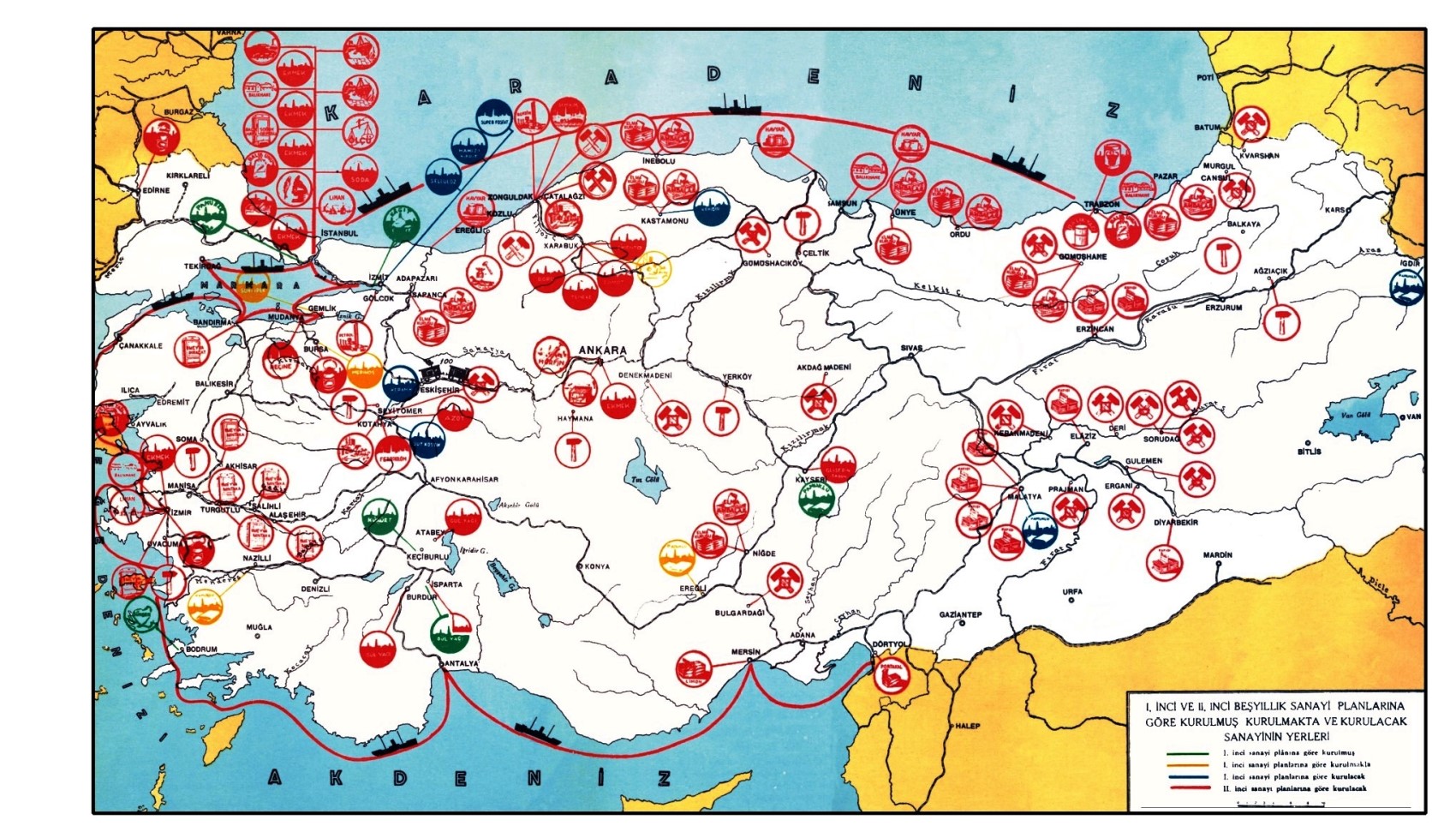
And of course, the "Railway Policy," as it was called at the time, is important. Every year, with pickaxes and shovels, an average of 300 kilometers of railway was built. The Republic inherited 3714 km of railway from the Ottoman Empire. These railways belonging to foreign companies were nationalized by paying their value, and on top of that, 4645 kilometers of railway were built until 1939.
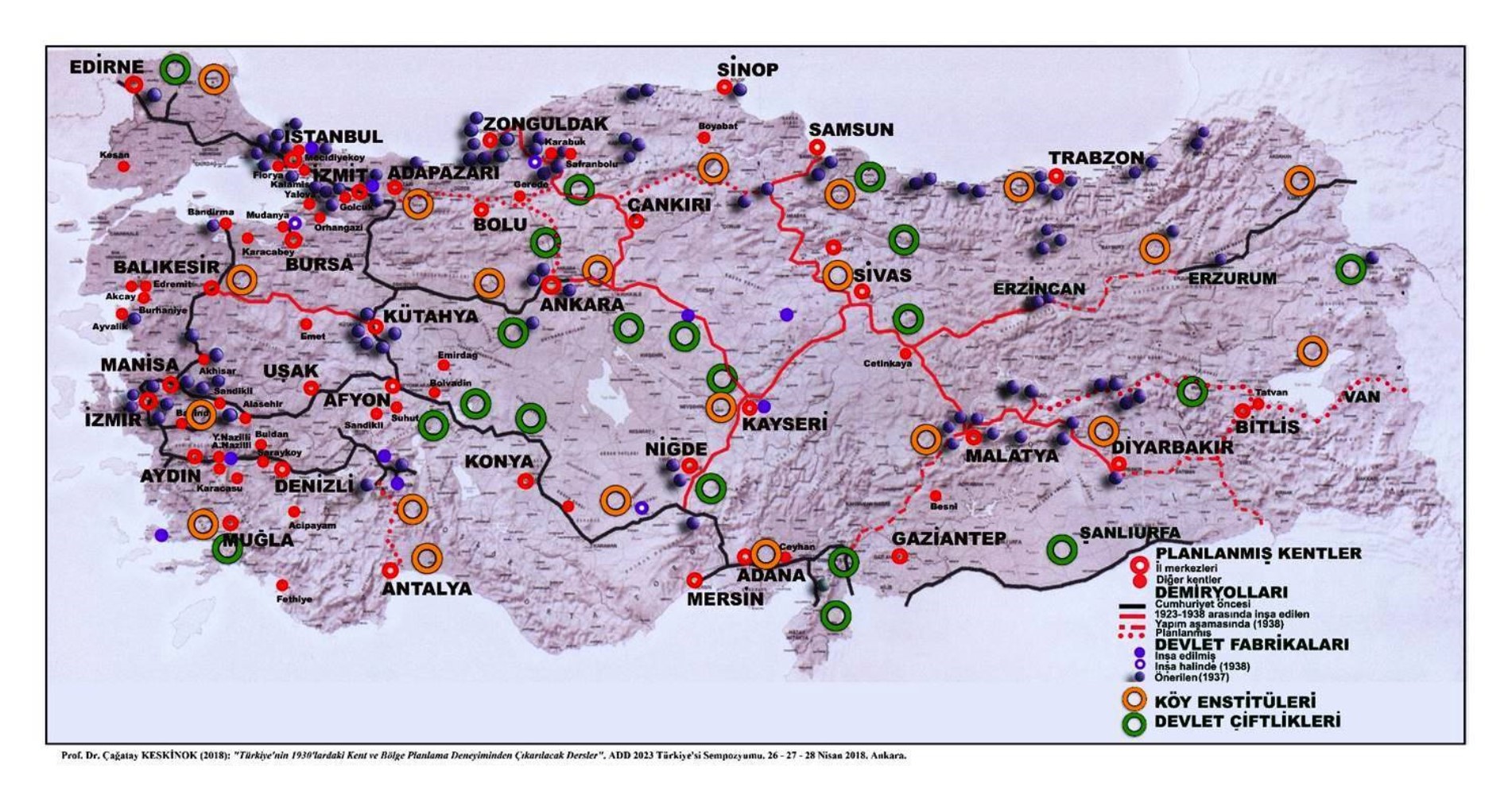
In the second map, we will see very clearly that a great development move was initiated all over Turkey, not only with factories built and to be built by the state, but also with planned cities, State Farms, railways, and village institutes. However, unfortunately, the counter-revolution prevented this development move, education, urbanization, and the peasant becoming a farmer as a strong producer.
Independence is the development of the economy with its own resources. Like the Ottoman Empire, borrowing for every current expenditure is avoided. In this period, foreign debt was resorted to only three times. However, no borrowing was of a nature to compromise the independence of the economy. First, 10 million dollars were taken from a Swedish businessman for the purpose of establishing the Central Bank, and with this money, 6 tons of gold were placed in the vault of the Central Bank. In return for this loan, the trade of matches and flint was granted for 25 years. Second, it is the 8 million dollars (16 million Turkish Liras) taken from the Soviet Union for the machines and benches of the factories included in the industrial plan. This agreement is the first clearing (barter) agreement in history. The debt was paid with Turkey's agricultural product exports. The third loan is 2 million 745 thousand Pounds Sterling (17 million TL) taken from England for the Karabük Iron and Steel Factory. This debt was also paid with Turkish export products. In Lausanne, it was accepted that the Ottoman Customs Regime would be valid until the end of 1928. With the new customs regime coming into effect, after 1928, between 1929 and 1947, the young Republic never had a foreign trade deficit and always had a foreign trade surplus.
Another fundamental principle of the Republican cadres is the balanced budget-sound money policy. During the Atatürk era, the budget had a surplus until 1939, except for 1925-1926 (due to internal rebellions such as Sheikh Said) and the years 1930 and 1932, when there was a drought.
We can briefly summarize the political economy of Gazi Mustafa Kemal Atatürk and the Republican Cadres as follows.
The goal is the level of contemporary civilization. This level is not fixed; it is in constant development. Therefore, reason and science are important. Continuous revolution in parallel with developments in the light of science is essential.
Economy-Education-Public Works (Economy, education, and urbanization-development-railways) go in parallel with each other. Economic independence cannot be compromised. The statist mixed economic model is essential. Planned development based on own resources and fair distribution (Populism principle) is essential. A sound money and balanced budget policy is implemented. Behind the saying "The peasant is the master of the nation" lies a great agricultural development and social transformation claim and move. Unfortunately, this leg of the revolution remained incomplete. And again, unfortunately, the independence of the economy and the planned industrialization model based on its own resources were abandoned starting from 1947.
The point we have reached today is summarized as follows.
The economy is stuck in a debt trap. The wheels in the economy do not turn without finding foreign debt. With the loss of independence in the economy, the weight of imperialist states is also felt in the decision-making process of foreign policy. The country's resources are not spent for development to increase the welfare of society, but for the wealth of a handful of people. As a result, 70 percent of the population lives below the poverty line, and 15 percent lives below the hunger line.
The goal of the Republican revolutions was to transform the Turkish society, which had remained in the Middle Ages during the Ottoman period, from being subjects of the sultan into free individuals, to transition from an ummah to a nation-state, and to carry society into the 20th century. Today, the first quarter of the 21st century has been left behind. Let alone entering the 20th century, we are rapidly drifting into the darkness of the Middle Ages along with the education system and social decay.
After the political economy that prioritized independent and planned development, which was designed to reach and surpass the level of contemporary civilization, the one-sentence summary of the political economy we have reached today is very painful:
“Keep them hungry so they obey, keep them ignorant so they submit.”
Would you like to get notifications about new developments and save news?
- NotificationsNew developments and breaking news
- SaveNews is stored in the app
Most Read
Video response to Kim Jong-un claims

Murat Ağırel’s police statement has been revealed
Azerbaijan issues arrest warrants in absentia for 7 people living in Turkey
The Orionid meteor shower will be visible from Turkey!
The penalty for Ronaldo, who left the national team camp, has been announced

Fatoş Seğmen reveals the cause of her daughter's death

Latest status in the race between AKP and YENİ Party revealed

Injury shock at Liverpool: He may miss the Fenerbahçe match

Who authorized the concert held in a parking garage?

From brotherhood to a distant partnership...