



We present the final installment of our four-part series, in which we examine Homer's Odyssey—which has recently come back into the spotlight—through our short narratives and interpretations. You can access the previous articles via the links below.
https://12punto.com.tr/yazarlar/sefa-taskin/odysseusun-yolculugu-1-151301
https://12punto.com.tr/yazarlar/sefa-taskin/odysseusun-yolculugu-2eve-giden-yol-insandan-geciyordu-152047
https://12punto.com.tr/yazarlar/sefa-taskin/odysseusun-yolculugu-3-insanin-sinandigi-deniz-152787
You can reach them at these addresses.
___________________________________________
Twenty years had passed since he set out from the shores of Anatolia.
Ten years at war in Troy.
In the shadow of blood and death...
Ten years among raging waves...
In the scent of salt, in the roar of the winds...
With the wrath of Poseidon, god of the seas...
In the embrace of various adventures...
Many of Odysseus's comrades had lost their lives in the quest to reach their homes...
Now he was on his island, in Ithaca!
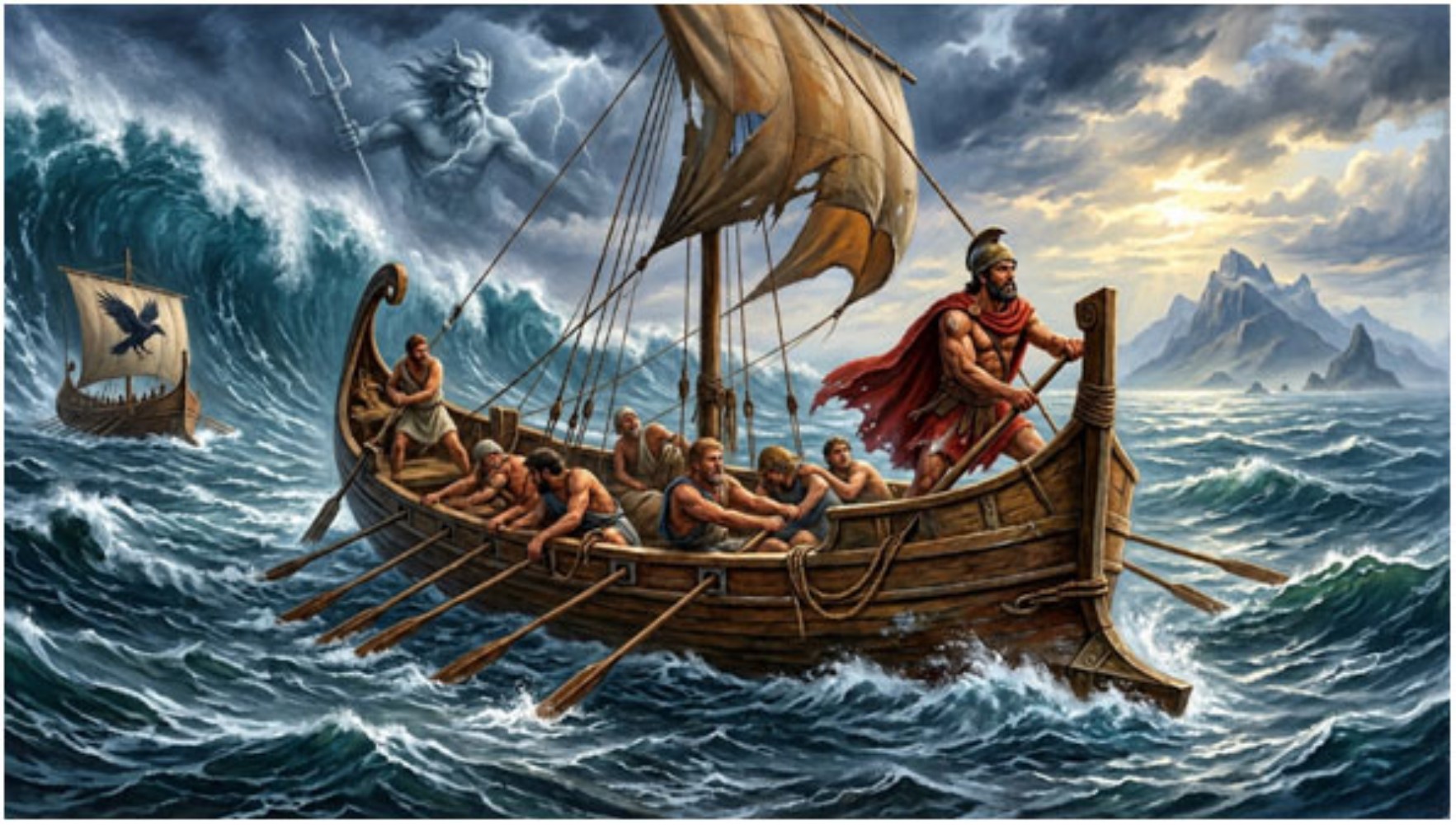
(Odysseus's journey. Representative image. Artificial Intelligence)
***
After arduous journeys, Odysseus had finally returned to Ithaca.
But there were other men in his palace, his home.
One hundred and eight suitors who wanted to marry his wife, Penelope...
Odysseus had been gone for twenty years.
They thought he would never return, that he was dead.
Becoming Penelope's husband was not just about marrying a beautiful and noble woman.
It also meant seizing Odysseus's wealth and his power in Ithaca.
“As if taking someone's place meant also possessing their power...”
They were consuming his property and assets...
Slaughtering his livestock...
Drinking his wine.
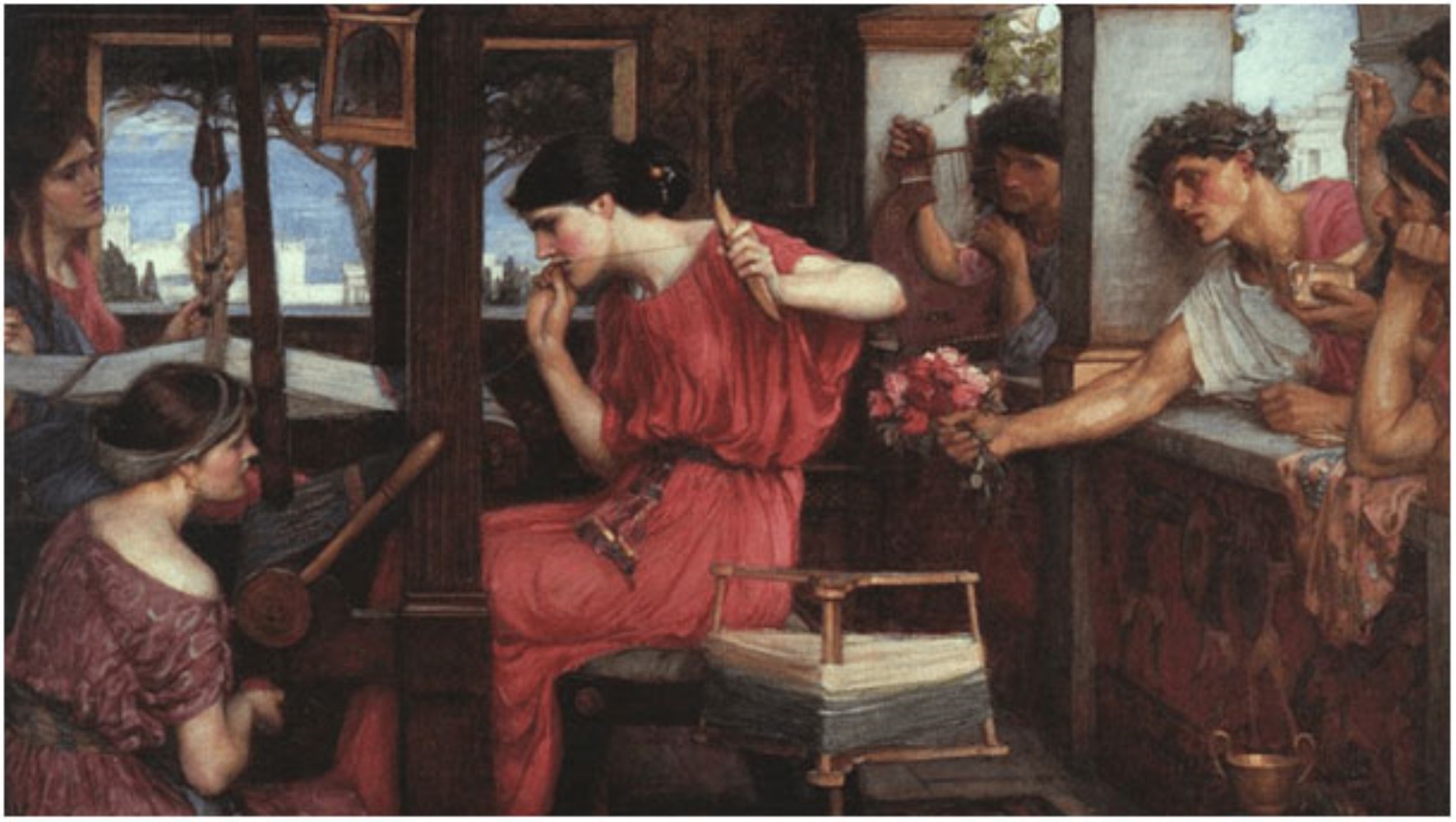
(John William Waterhouse. Penelope and the Suitors. 1910)
***
Penelope had stalled them for years.
She had said she was weaving a shroud for her elderly father-in-law, Laertes...
And that she would marry one of the suitors once the shroud was finished.
Yet she would weave by day...
And unravel the shroud by night.
For three years.
She was stalling them.
Eventually, one of her maids revealed this secret to the suitors.
Penelope's time was running out.
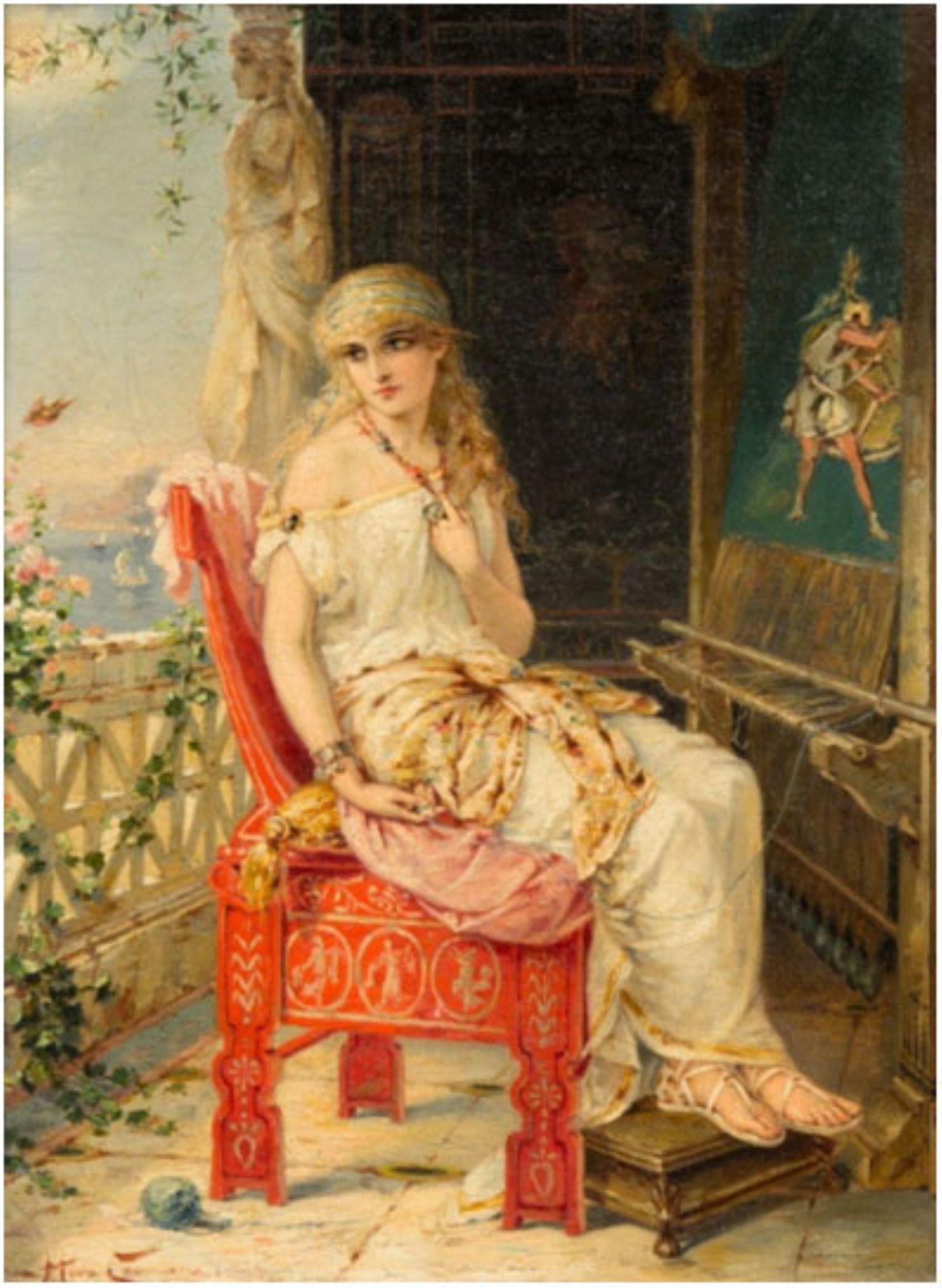 (Sidney Harold Meteyard (1868–1947). Penelope at her loom)
***
By this time, Odysseus's son Telemachus was no longer a child.
When Odysseus left for Troy, he had entrusted him to his trusted friend Mentor.
In the epic, Athena would also occasionally take on Mentor's form to guide Telemachus.
Over time, the name Mentor would cease to be just a proper noun and would come to mean a person who guides and advises with their experience.
Telemachus was young, but he stood resiliently by his mother's side.
He did not want to give up Odysseus's throne easily. The throne was his right.
He had traveled to Pylos and Sparta on the Peloponnese peninsula in mainland Greece to search for his father...
He had spoken with his father's fellow commanders, Nestor and Menelaus, the brother of King Agamemnon...
He had gathered news that Odysseus was alive.
He was hopeful that he had not died.
Athena, his father's guardian goddess, watched over Telemachus through the traps set along his path and brought him back to Ithaca.
After Odysseus woke up on the shores of Ithaca and regained his composure, he arrived at the hut of Eumaeus, the swineherd who had always remained loyal to him and whose eyes had gone blind from old age; he received information about the situation in the palace from the shepherd, who did not recognize him.
Father and son met in the hut of the swineherd Eumaeus.
At first, Telemachus did not believe that the old beggar before him was his father.
Goddess Athena changed Odysseus's appearance.
And twenty years later, father and son embraced.
But they had no time to cry.
Together, they made a plan to take back the palace.
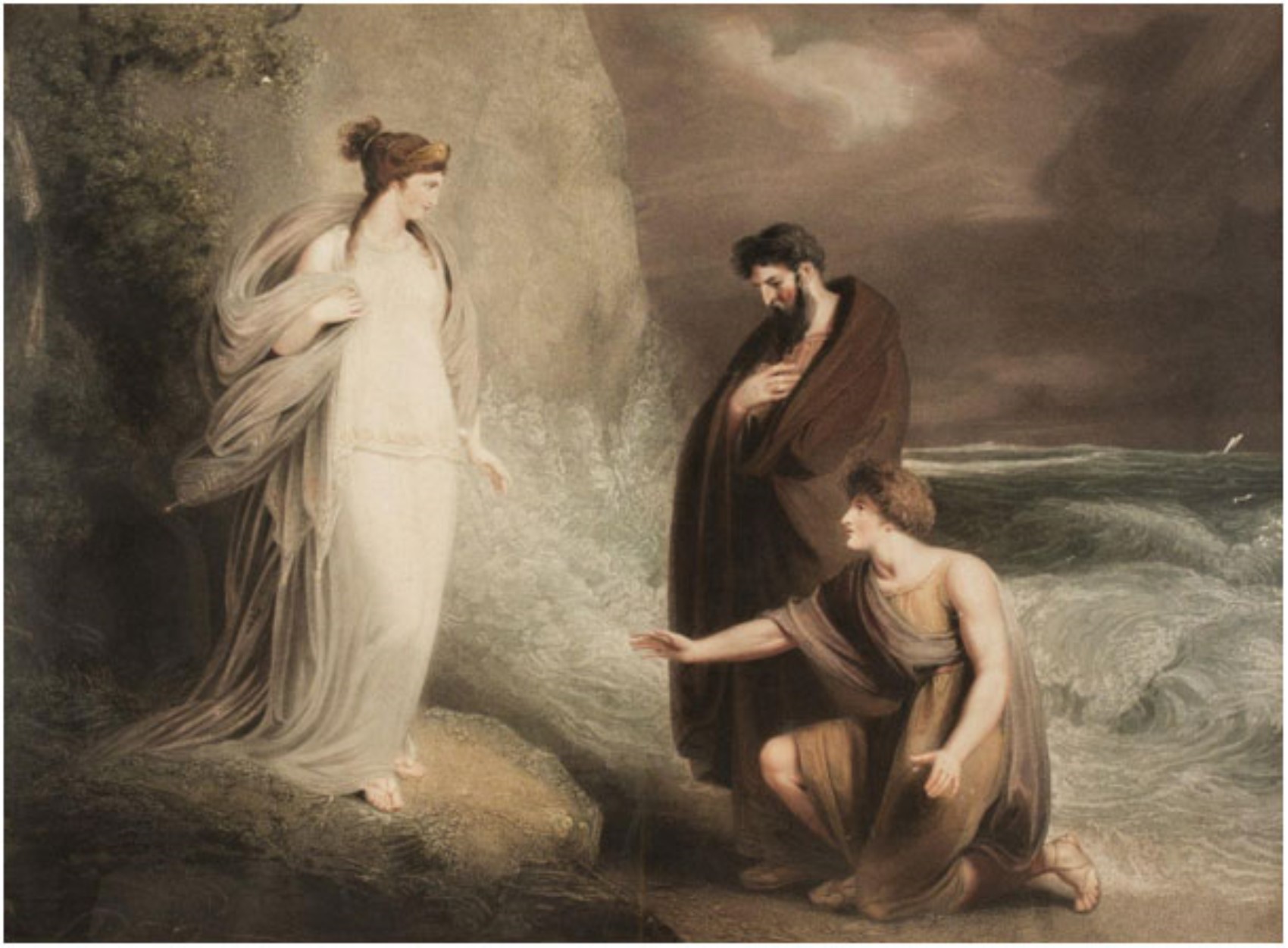 (Richard Esthall. 1810. Telemachus, Mentor and Athena)
***
Odysseus entered his own palace in the guise of an old beggar.
No one recognized him.
But there was an old dog lying in the courtyard.
Argos.
He was very small when Odysseus left for Troy.
Now he was old...
He had been neglected.
He lifted his head.
He recognized his master.
He wagged his tail.
But he did not have the strength to go to him.
Odysseus hid his tears.
Argos died after seeing that his master had returned.
The people in the palace had not recognized Odysseus.
The dog had recognized him.
This meant that love, even if it came from an animal, did not succumb to the years.
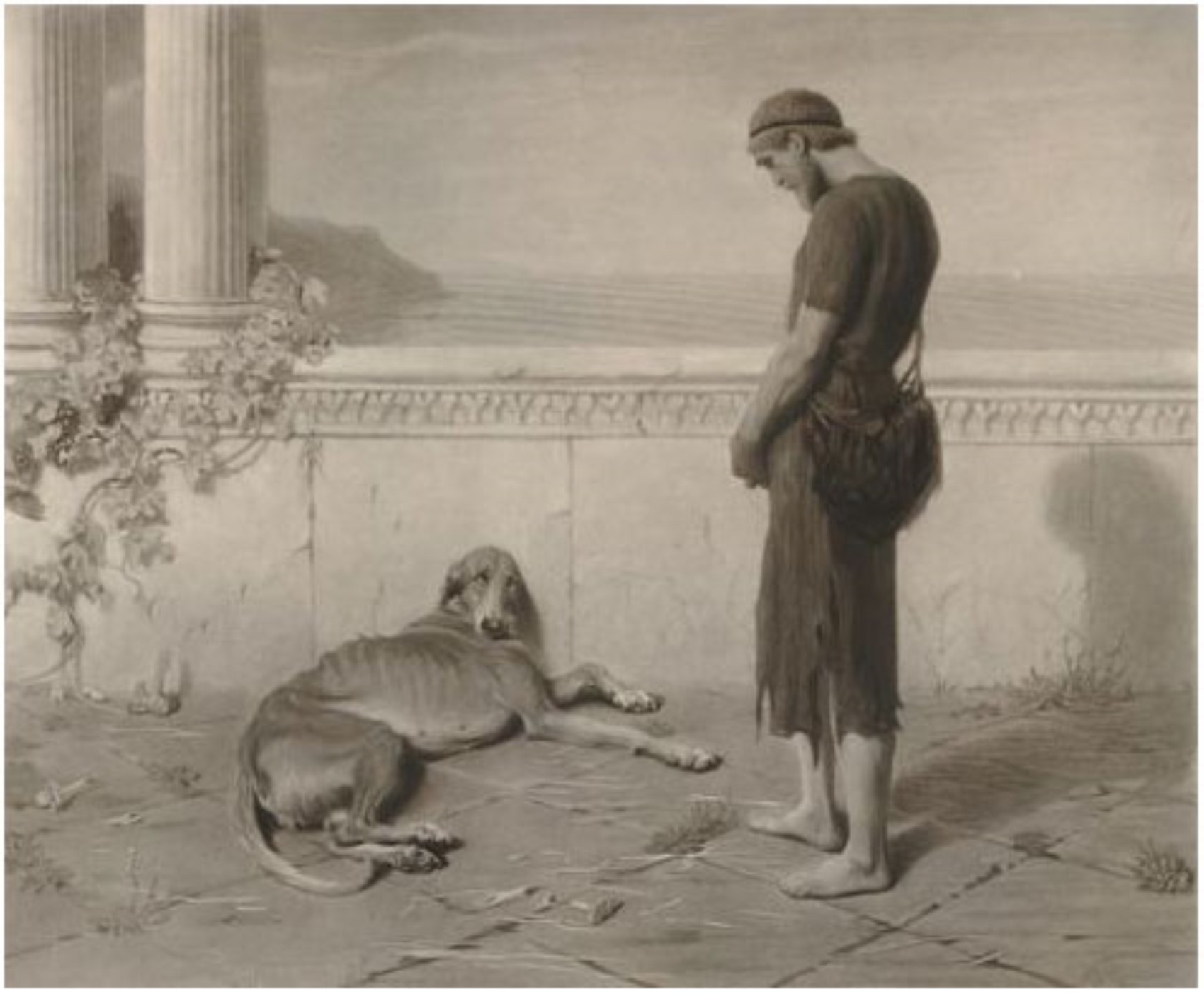
(Briton Rivière (1840–1920). Argos and Odysseus. 1885)
***
Odysseus, who entered the palace in the guise of a beggar, was humiliated by the suitors gathered in the hall.
“What was this filthy beggar looking for in the palace!”
Hearing this, Penelope took an interest in the guest.
The arrival was a stranger.
Hospitality was the most important virtue.
Moreover, she thought he might know something about Odysseus.
She ordered the stranger to be hosted.
At night, the old servant Eurycleia washed the stranger's feet.
She saw the old scar on his leg.
It was a wound inflicted by a wild boar during a hunt he had gone on in his youth.
Eurycleia had known Odysseus since his childhood.
He had practically grown up in her hands!
In an instant, she understood the truth.
She was about to scream.
The beggar before her was her master, Odysseus.
Odysseus silenced her.
No one was to know yet.
Odysseus could change his face.
He could change his clothes.
He could hide his name.
But he could not erase the mark that his past had left on his body.
Time cannot cover everything!
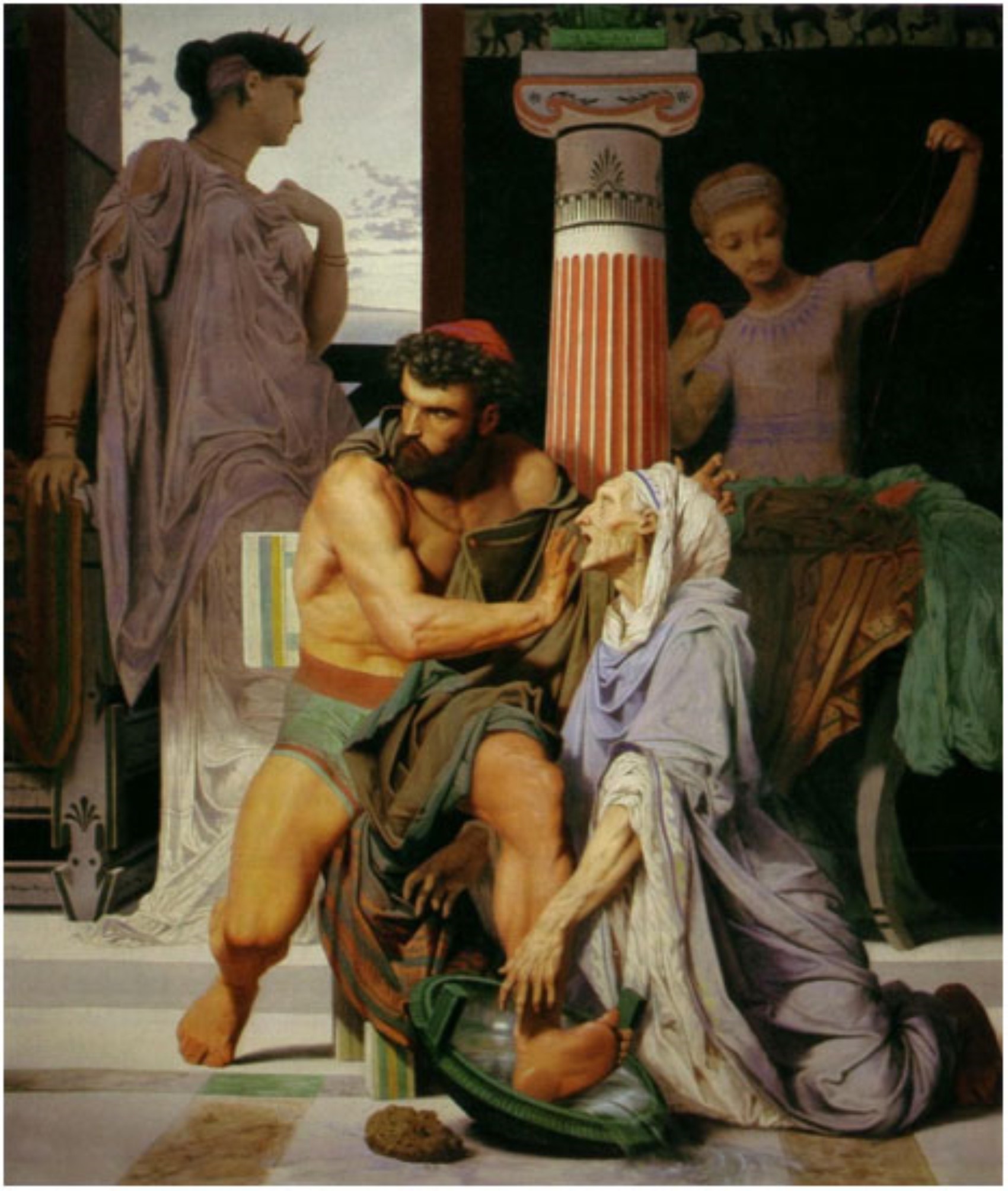
(Gustave Boulanger, Eurycleia recognizes Odysseus by the scar on his leg, 1849)
***
Penelope, however, still did not know the truth.
She prepared one final test to get rid of the suitors.
She, too, was tired of weaving shrouds.
She had to put an end to this situation.
Odysseus's bow would be brought.
She would marry the man who could string the bow and shoot an arrow through twelve axe heads.
“Let the contest begin!”
The scene was set in the great hall of the palace.
The suitors tried one by one.
They failed.
They could not string Odysseus's bow.
Just as some of them began to suspect that there was a trap involved, the old beggar who was present asked for the bow.
They laughed. They mocked him.
“Would this old man string such a stiff bow, something all these young men could not do!”
But when Odysseus took the bow in his hand, he strung it easily.
Years had passed, but the bow had not forgotten its owner; there was a bond between them.
He fired the arrow.
He shot through the twelve axes.
Then he turned the bow toward the suitors.
The first arrow went to Antinous, one of the suitors.
He was the ringleader of the rot in the palace.
Antinous was struck in the throat while drinking wine.
The wine spilled onto the floor.
The leader of the suitors was dead.
In the name Antinous, there was also the word “noos”—meaning mind, intellect, or perception—which we had previously encountered in the name of the Phaeacian King Alcinous.
However, the “anti” at the beginning of his name added a sense of opposition.
His name roughly meant “thinking against” or “having a mind that opposes.”
It is as if Homer was playing a little poetic game with words here as well.
But Antinous had failed to grasp the most important thing:
That Odysseus could return and who the old beggar standing before him really was.
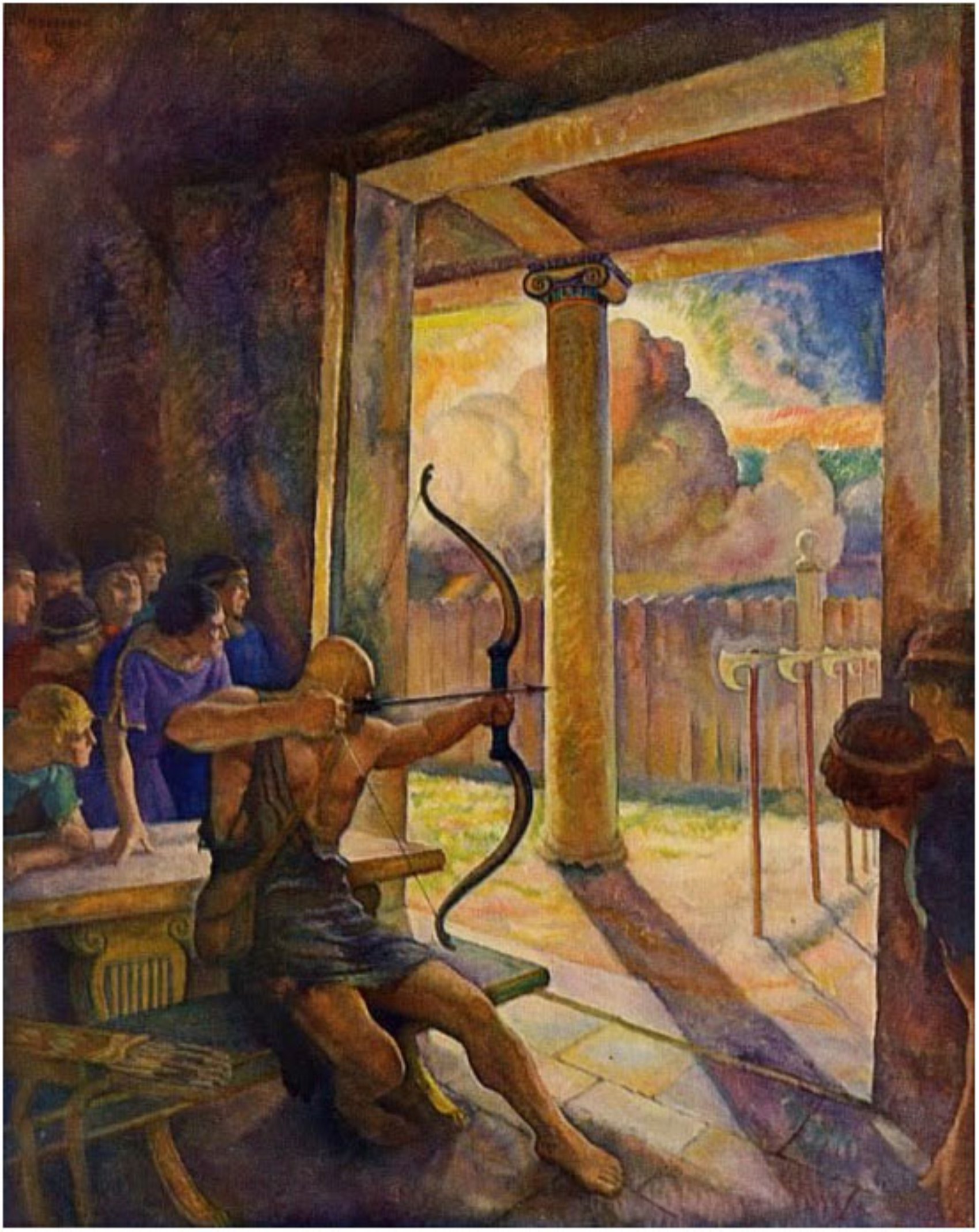
(N.C. Wyeth. Odysseus and the Bow. 20th century. Philadelphia Museum of Art)
***
The civil war began.
Telemachus was by his father's side.
Eumaeus the swineherd and Philoetius the cowherd were also with them. They were loyal to their master.
Melanthius the goatherd, another of his servants, was on the side of the suitors. He was carrying weapons to the suitors during the fight. He was a traitor.
All the suitors were killed.
Odysseus had reclaimed his home.
But a more difficult test remained.
Penelope.
While all this was happening, she was sleeping in her room upstairs.
Telemachus had taken his mother upstairs after the archery contest.
Athena had cast her into a deep sleep.
While Odysseus was staining his own palace with blood downstairs, Penelope heard nothing.
When she woke up, everything would be over.
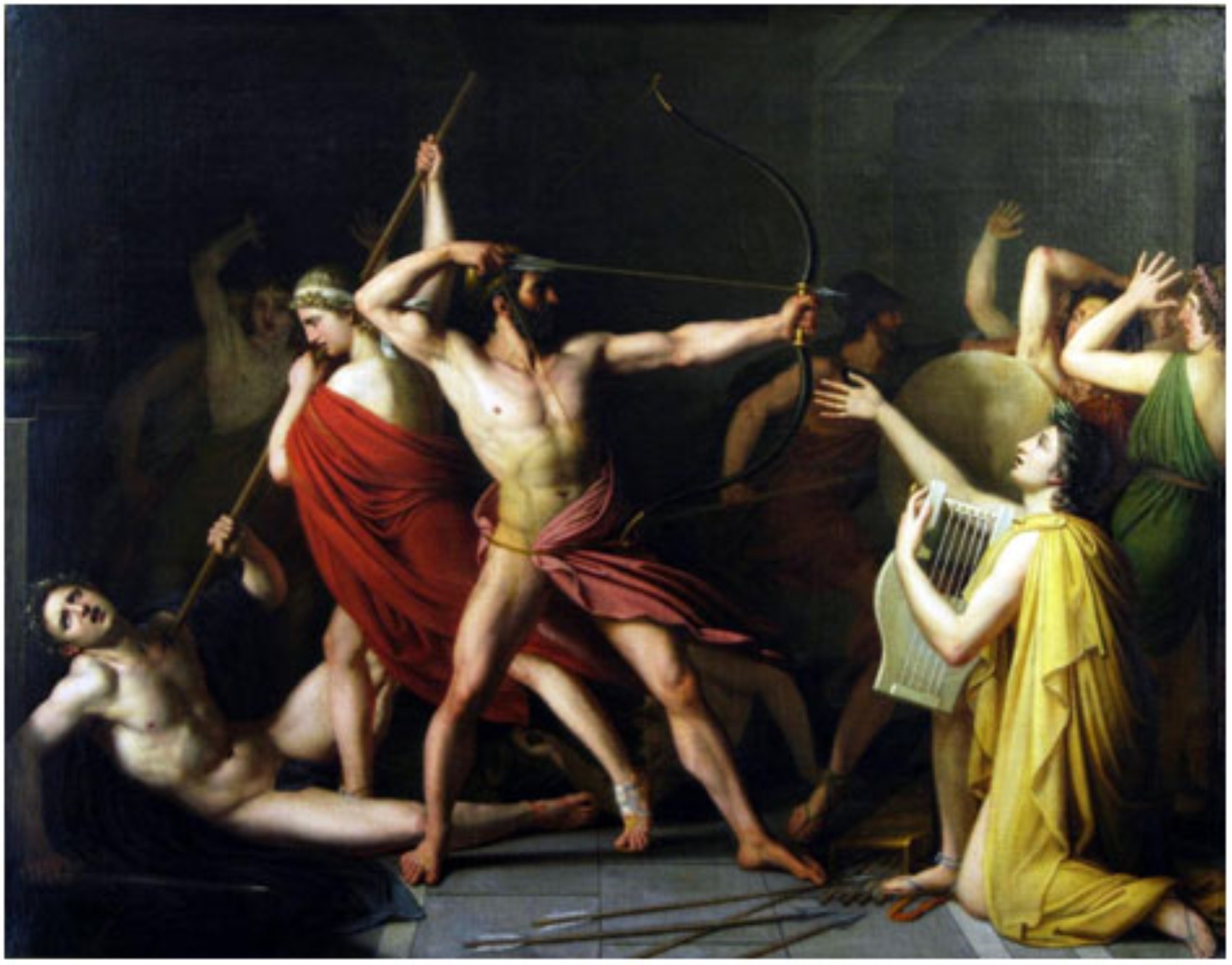
(Joseph-Benoît Suvée. The Battle in the Palace. 1812)
***
The maid Eurycleia went upstairs.
She told Penelope that Odysseus had returned.
Penelope did not believe her.
She described the scar.
She still did not believe.
She went downstairs.
The man she had been waiting for for twenty years was standing before her.
But she could not recognize him.
She did not embrace him immediately.
Time had changed Odysseus, who had experienced so many adventures, far too much.
What hardships the man had endured!
Telemachus was angry with his mother.
They had been waiting for this moment for so many years.
Penelope, however, wanted her own proof.
A very powerful sign.
A secret known to no one else, shared only between the two of them.
Because for twenty years she had hoped...
She had waited...
She had been deceived.
Doubt is not a lack of love.
Sometimes a person acts with great caution regarding what they value most.
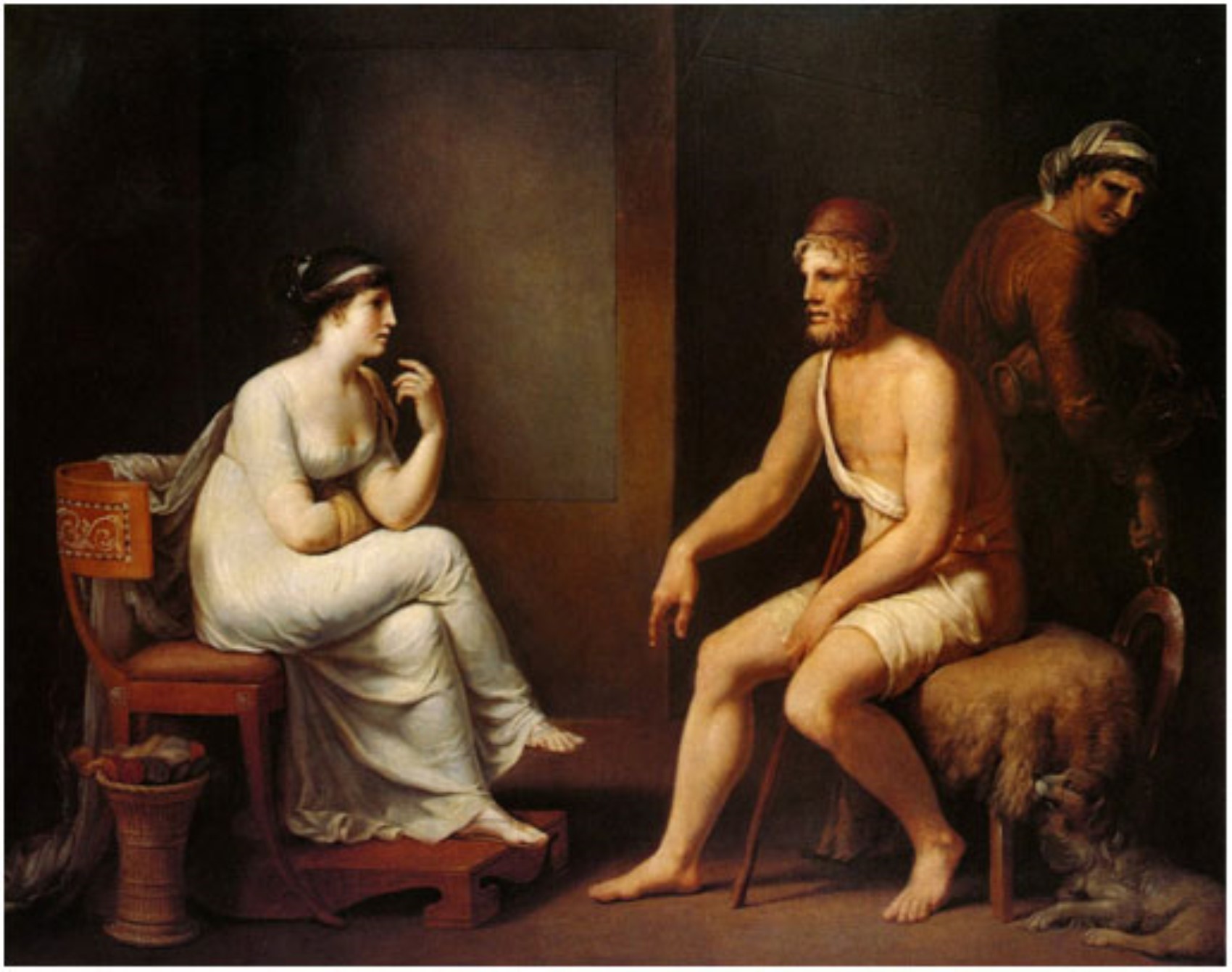
(Johann Heinrich Wilhelm Tischbein. Odysseus and Penelope. 1812)
***
Penelope was going to test Odysseus: Was it him, or not?
She told the servants to take Odysseus's bed out of the room and place it elsewhere.
A strange request?
Odysseus was angered.
That bed could not be moved.
Because he had built it with his own hands around the trunk of a living olive tree.
He had not cut the tree from its roots...
He had built the house around it...
He had made its trunk one of the legs of the bed.
Homer seemed to be turning the olive tree into a symbol once again.
The olive tree was home: its fruit, its oil, its leaves, its shade, its branches...
Its roots were tied to the earth, its trunk to their bed. It was in that bed that their lineage had continued!
Only the two of them knew this.
For years, Penelope had been hopeless.
Now she was certain.
The man before her was Odysseus.
Her husband, her lover; the man for whom she had slept alone for years, the man for whom she could not sleep.
The one for whom her tear ducts had run dry!
Others might see the scar on his foot.
But only the two of them knew the secret of the olive tree.
It was understood at last!
The twenty-year separation ended there.
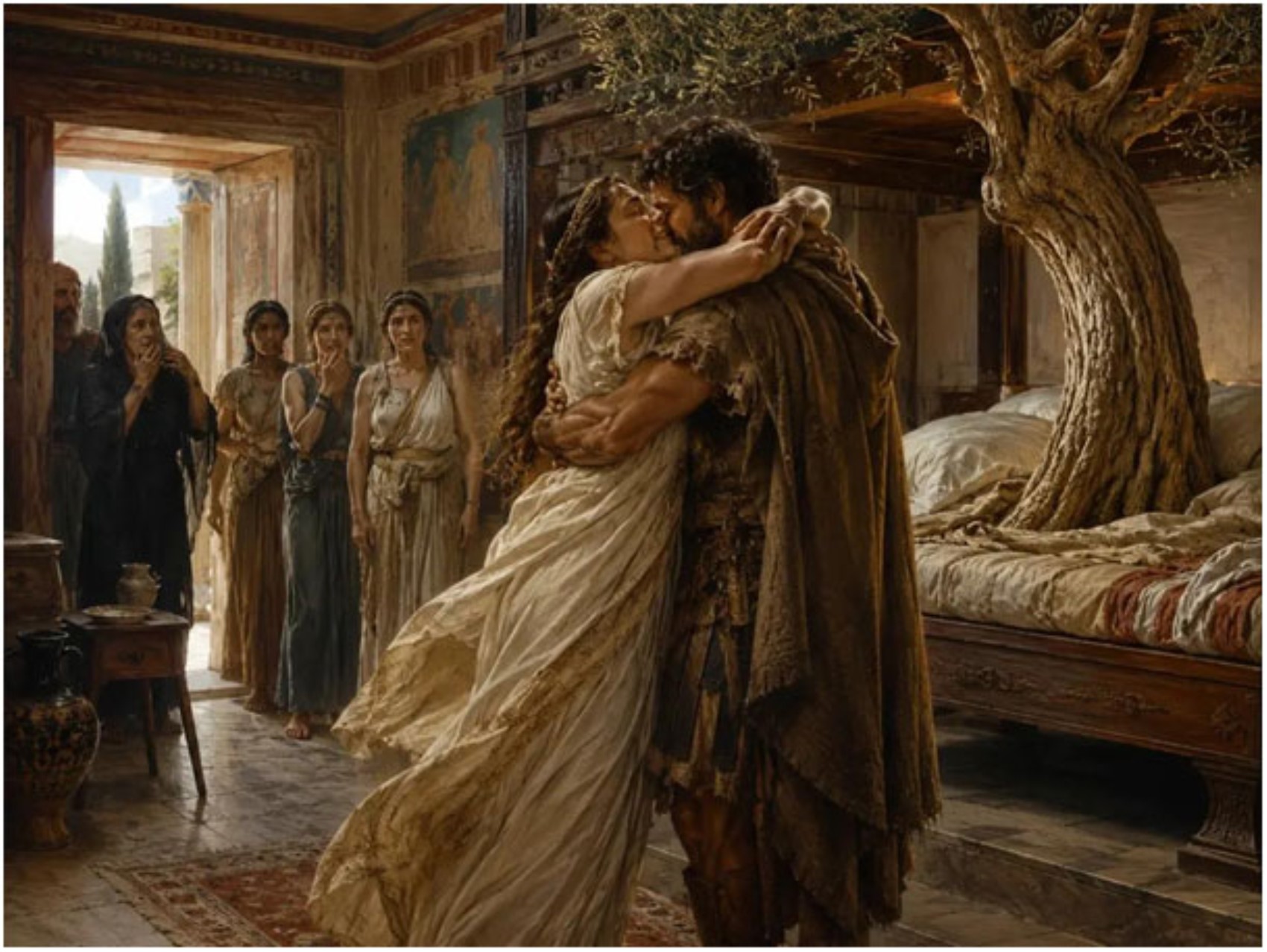
(Penelope and Odysseus. In front of the bed with the olive tree. Representative image. Artificial Intelligence)
***
Homer describes this reunion with a beautiful simile.
“Like a man whose ship has been wrecked at sea...
Who has struggled against the waves...
Just as land is precious to a person who has finally managed to reach the shore...
So was Penelope to Odysseus.”
But there is a small and very beautiful irony in Homer's simile.
The person who reaches the land is not Odysseus.
It is Penelope.
For Penelope, seeing her husband is like escaping death at sea and reaching the shore.
Yet, it is Odysseus who has been wandering the seas for years.
But this time, it is Penelope's emotion that reaches the shore.
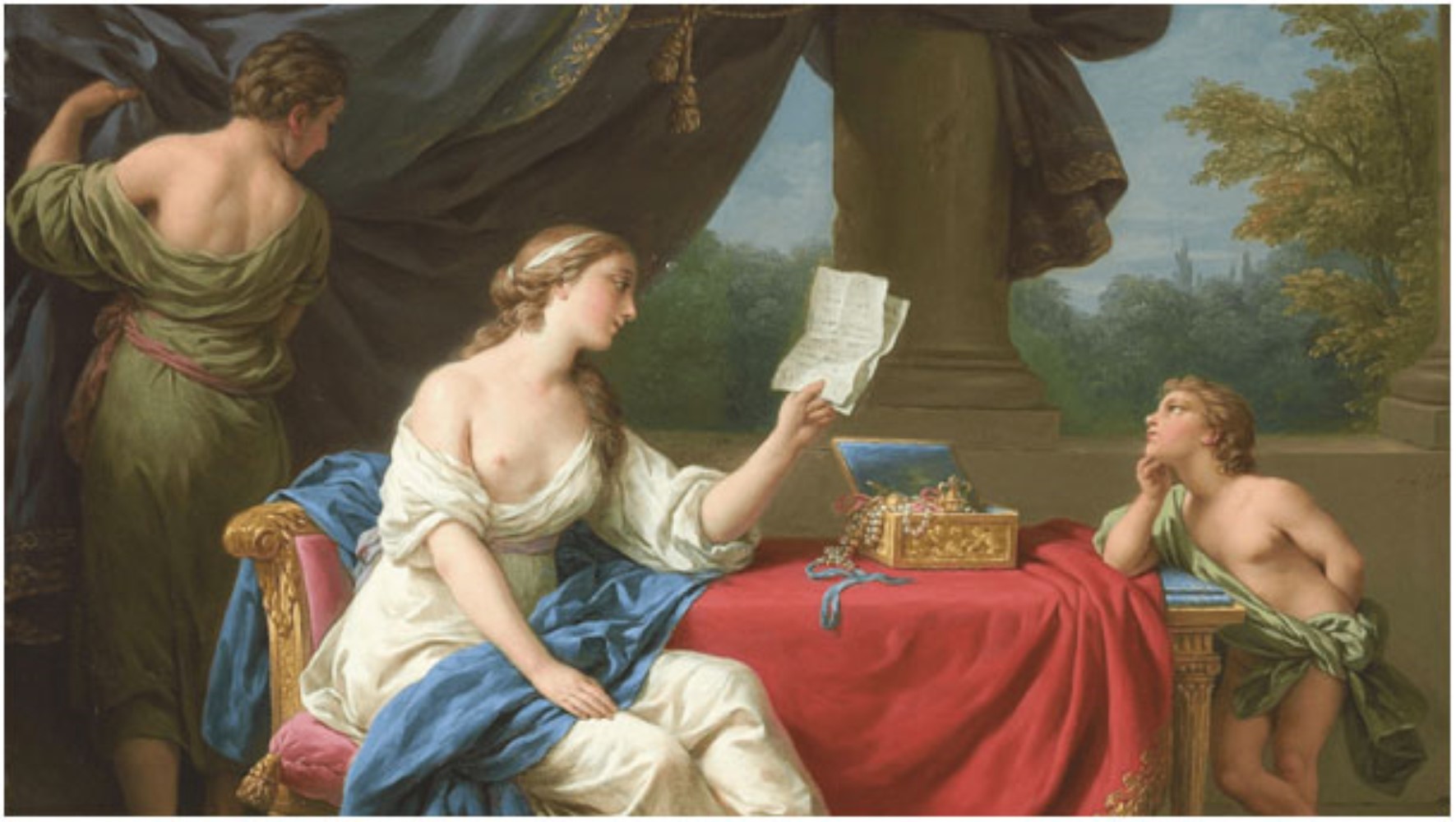
(Louis-Jean-François Lagrenée. Penelope Reading Odysseus's Letter)
***
The poem “Desperate Penelope,” written by contemporary Greek poet Yannis Ritsos (1909-1990) in 1968 during the Greek military junta, while he was in a political prisoner camp on the island of Leros during his darkest days, looks at this reunion from a completely different perspective.
Ritsos reinterprets the waiting, which Homer ends with a reunion, through the lens of disillusionment.
Ritsos points to a different aspect of the human condition.
In the translation by Cevat Çapan:
“….
was it for this man that she had spent twenty years waiting and dreaming?
dreaming?
for this poor, blood-stained stranger with the white beard?
….”
Penelope, who waited for twenty years, realizes at the moment of reunion that the man she waited for and the man standing before her are no longer the same.
Ritsos seems to say: A person can return home, but they cannot return to the time they left behind.
Because twenty years have changed not only Odysseus but also Penelope, who was waiting for him.
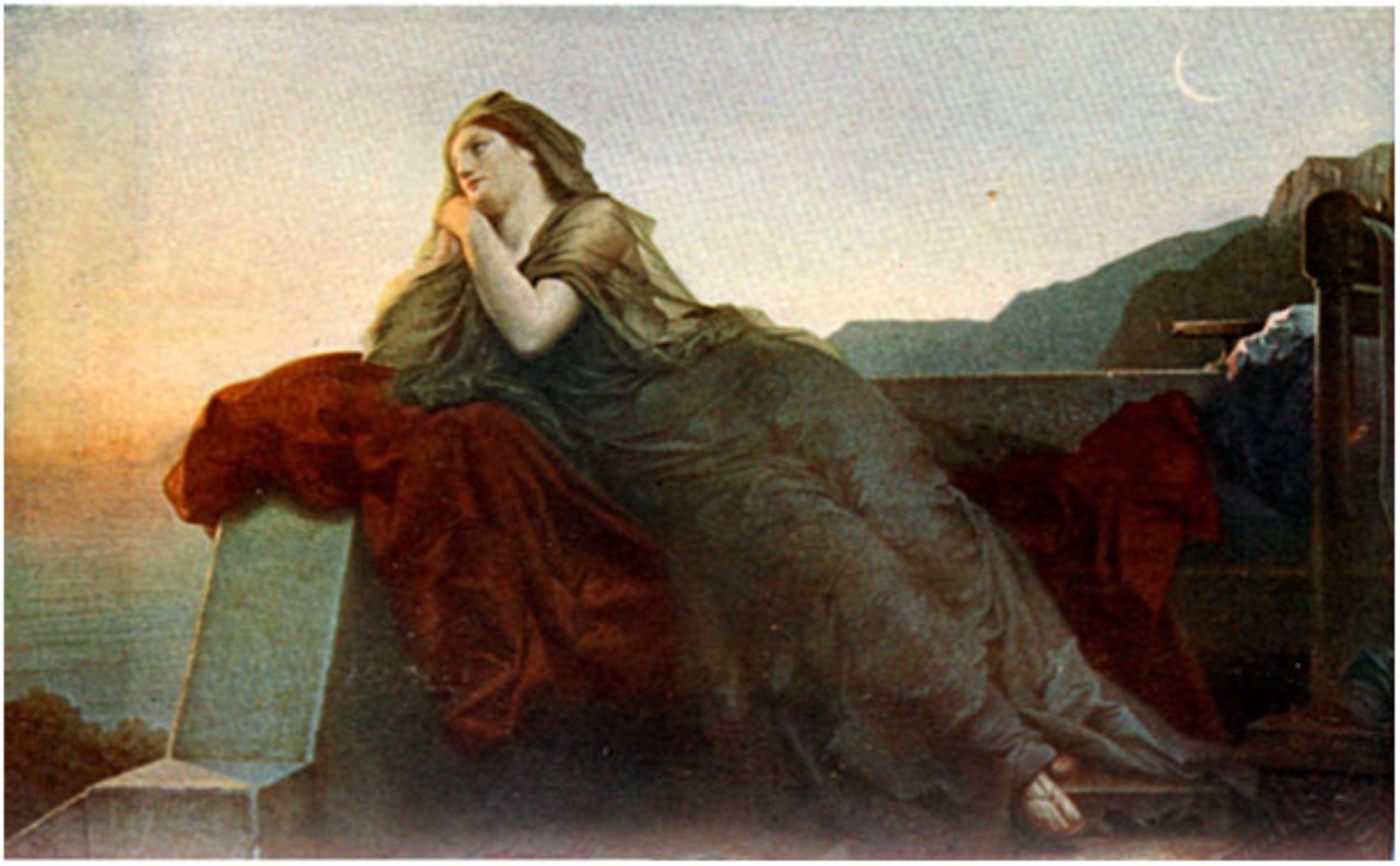
(Eduard Julius Friedrich Bendemann. Desperate Penelope, 1877)
***
The next morning, Odysseus went to his father Laertes' farm.
But he did not reveal his identity to him immediately either.
Finally, he could not hold back.
“Father, I am the man you are looking for,” he said. “Your son!”
Laertes also needed proof.
So many years had passed.
Odysseus showed him his scar.
Then he counted the trees his father had given him when he was a child:
Thirteen pear trees...
Ten apple trees...
Forty fig trees...
And the vines in the vineyard...
Laertes recognized his son.
Penelope had recognized him by the olive tree...
And Laertes had recognized him by the trees they had counted together years ago.
The scar was the proof on his body.
The trees, meanwhile, were the still-living memory of the past.
Odysseus was not just returning to a home.
He was returning to the people who knew him.
In a sense, he was rediscovering who he was.
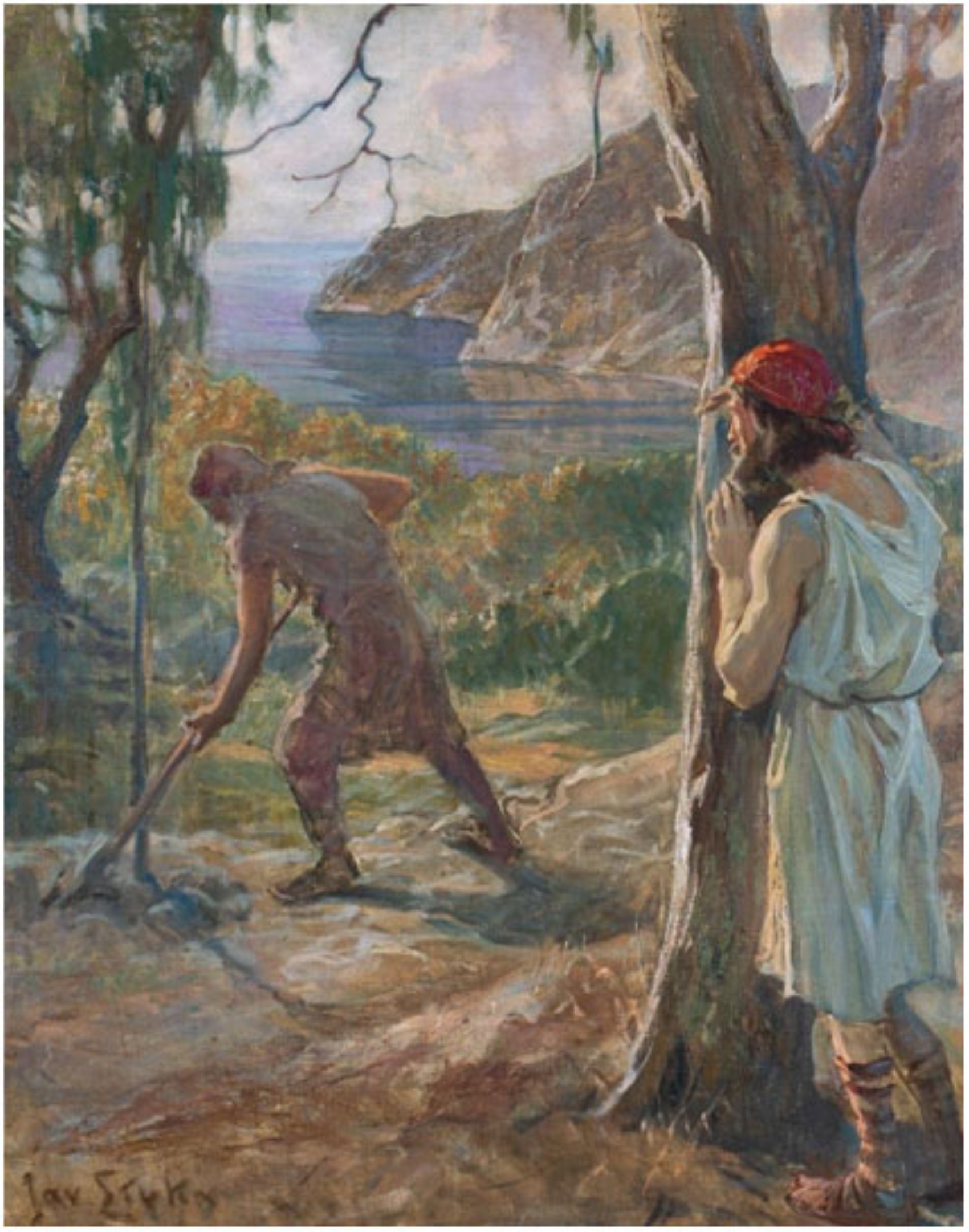
(Jan Styka. Odysseus at his father Laertes' farm. 1901)
***
But the problem was not over.
There were the families of the one hundred and eight suitors killed in the palace.
Antinous's father, Eupeithes, gathered the people.
Their sons and relatives had been killed!
They wanted revenge.
They armed themselves.
They marched to the farm of Odysseus's father, Laertes.
The war began anew.
Laertes threw his spear.
Eupeithes died.
The suitors had been killed...
Now their relatives had begun to be killed.
Then their relatives would come.
There was no end to this.
It was right here that Zeus, the king of the gods, intervened.
He told his daughter Athena to stop the war.
Athena, the goddess of wisdom, stepped between the two sides.
Weapons were laid down.
Reason always desires peace!
Thus, the Odyssey ended not just with the defeat of an enemy...
But with the cessation of revenge.
Homer placed not a new war at the end of the epic...
But peace.
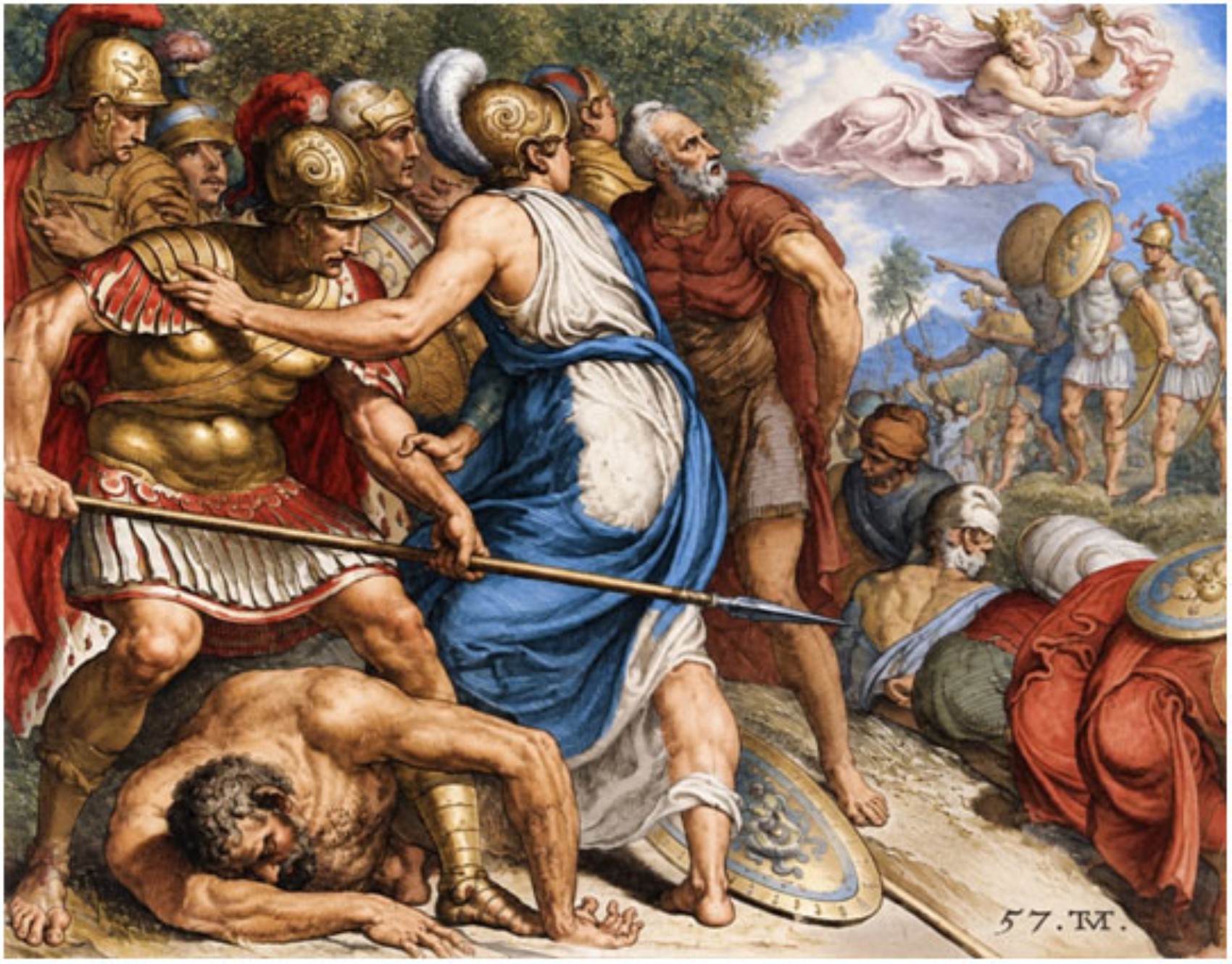
(Theodoor van Thulden (1606–1669). Engraving of Laertes killing his enemies (162) colorized by AI.)
***
But a prophecy from the seer Teiresias in the Land of the Dead still lay in the future.
One day, Odysseus would take a ship's oar on his shoulder...
He would walk away from the sea...
He would walk until he reached a land of people who did not know what a ship was...
He would plant his oar in the ground...
And he would offer a sacrifice to Poseidon.
Then he would return to Ithaca...
And grow old...
And he would die a peaceful death.
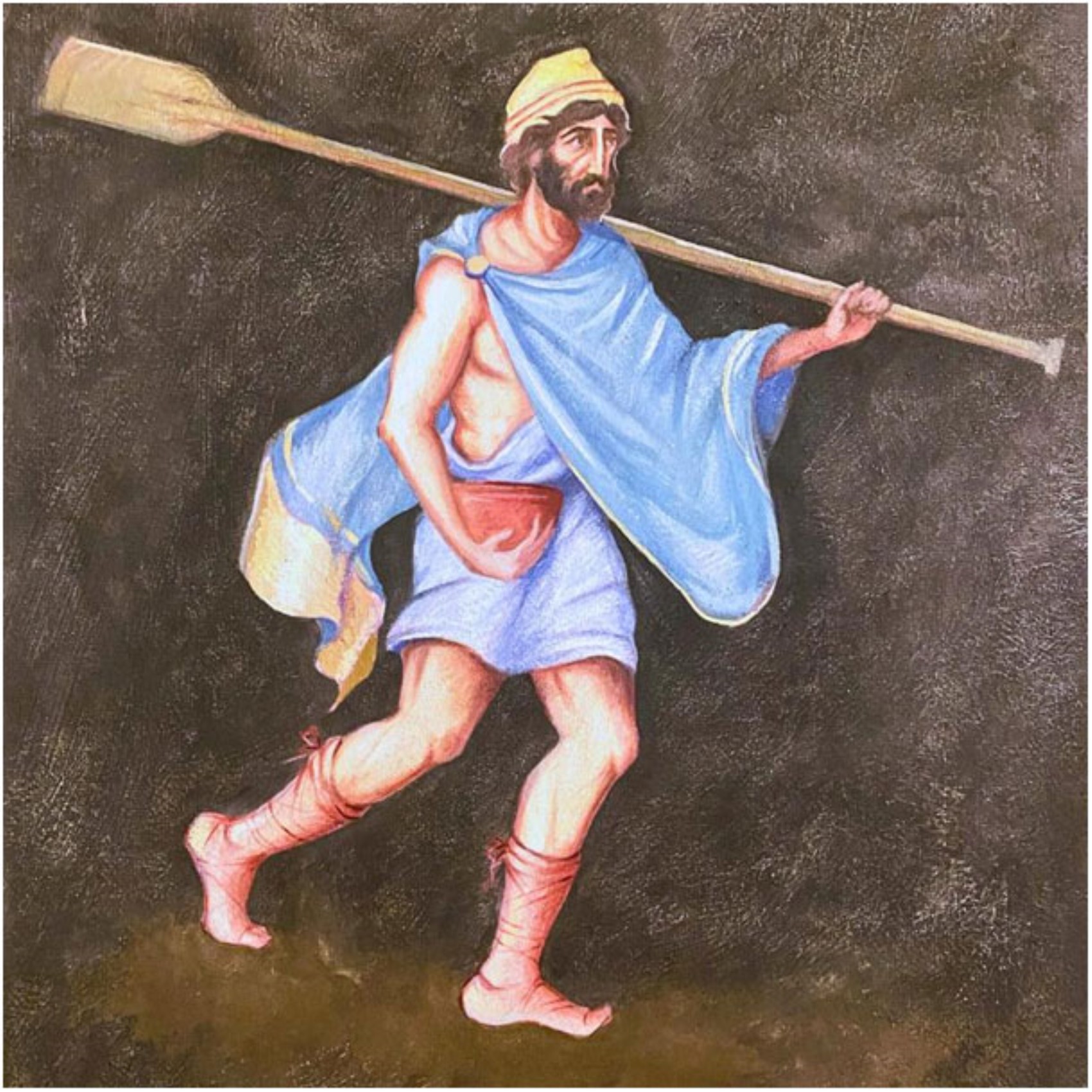
(Odysseus walking away from the sea, carrying his oar on his shoulder. Studio de Sa. Modern illustration.)
***
Homer does not tell us whether these things actually happened.
The Odyssey does not recount Odysseus's death either.
The later ancient Greek epic tradition, however, continues the story.
The collection of eight epics, including the Iliad and the Odyssey, which tell of the events before, during, and after the Trojan War, is known as the Epic Cycle.
The final link in this chain, the now-lost Telegony, recounts the later life and death of Odysseus.
According to this later narrative, Telegonus (meaning 'born far away'), the son of Odysseus and the sorceress Circe, with whom he stayed on her island for a year, set out to find his father.
When he arrived in Ithaca, he did not know that the man before him was his father.
In the ensuing clash, he wounded Odysseus with a spear tipped with the poisonous spine of a stingray.
Odysseus died.
Odysseus had survived the sea.
He had overcome Poseidon's wrath and finally reached Ithaca.
But years later, death had come to him from the sea once again.
With the poisonous spine of a stingray...
The ancient narrative does not say this was Poseidon's doing.
But it is hard to imagine a more striking ending for Odysseus's story.
Telegonus only learned that the man he had killed was his father afterward.
But it is not Homer who tells these things.
Homer leaves us in Ithaca.
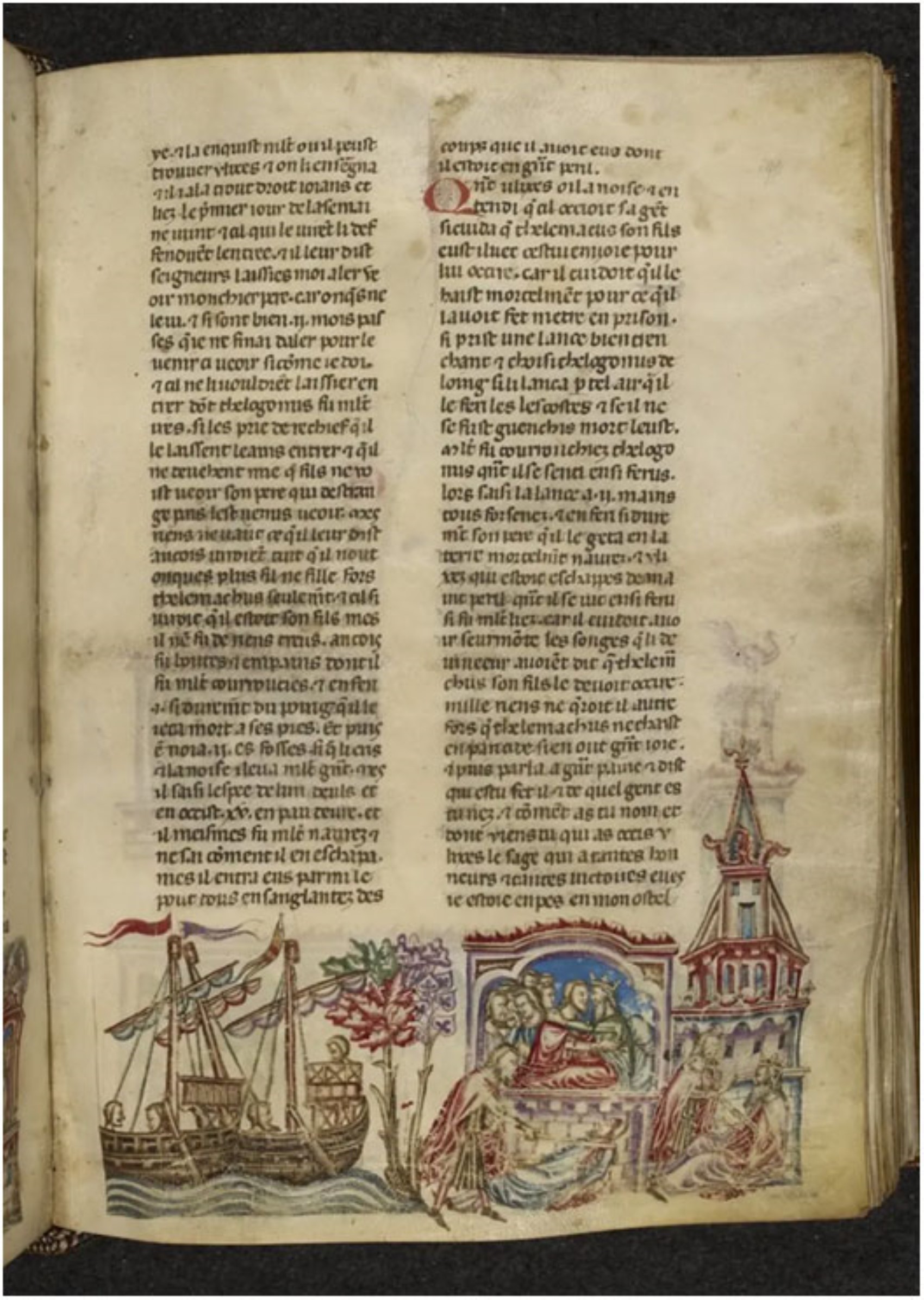
(Telegonus mortally wounding Odysseus. Miniature on parchment, Histoire ancienne jusqu’à César, circa 1330–1340. Royal MS 20 D I, British Library.)
***
Centuries passed.
In the early 20th century, the Greek poet from Alexandria, Constantine Cavafy (1863-1933), who shared the same birth and death day, looked at Odysseus's island once more.
He left us an unforgettable poem: Ithaca.
In the translation by Cevat Çapan:
“When you set out on your journey to Ithaca,
pray that the road is long,
full of adventure, full of knowledge.
do not fear the Laestrygonians,
nor the Cyclopes, nor the angry Poseidon.
…
as long as you do not carry them within your soul,
as long as your soul does not set them before you
….
after all the experiences you have passed through, you have become so wise,
that you surely know by now what Ithacas mean.”
Perhaps this is the reason Odysseus has lived for three thousand years.
The forms of the monsters he encountered have changed.
There may not be a Polyphemus on our path.
The Sirens may not sing.
Poseidon may not stir the seas.
But
But hubris still exists.
Insatiability exists.
Fear...
Curiosity...
Desire...
Forgetting...
Loving...
Losing...
The desire to return home exists...
And the fight to defend one's homeland...
When Odysseus arrived in Ithaca, he was not the same man who had left for Troy.
The journey had changed him.
Perhaps all human journeys are a bit like this.
We set out to reach a destination.
But along the way, we transform into someone else.
Ithaca is important.
Because for a person to set out on a journey, they need an Ithaca.
But the journey is also important.
Because the path that leads a person to Ithaca...
Also leads them to themselves.
It teaches them who they are.
It teaches them about humanity and the human condition!
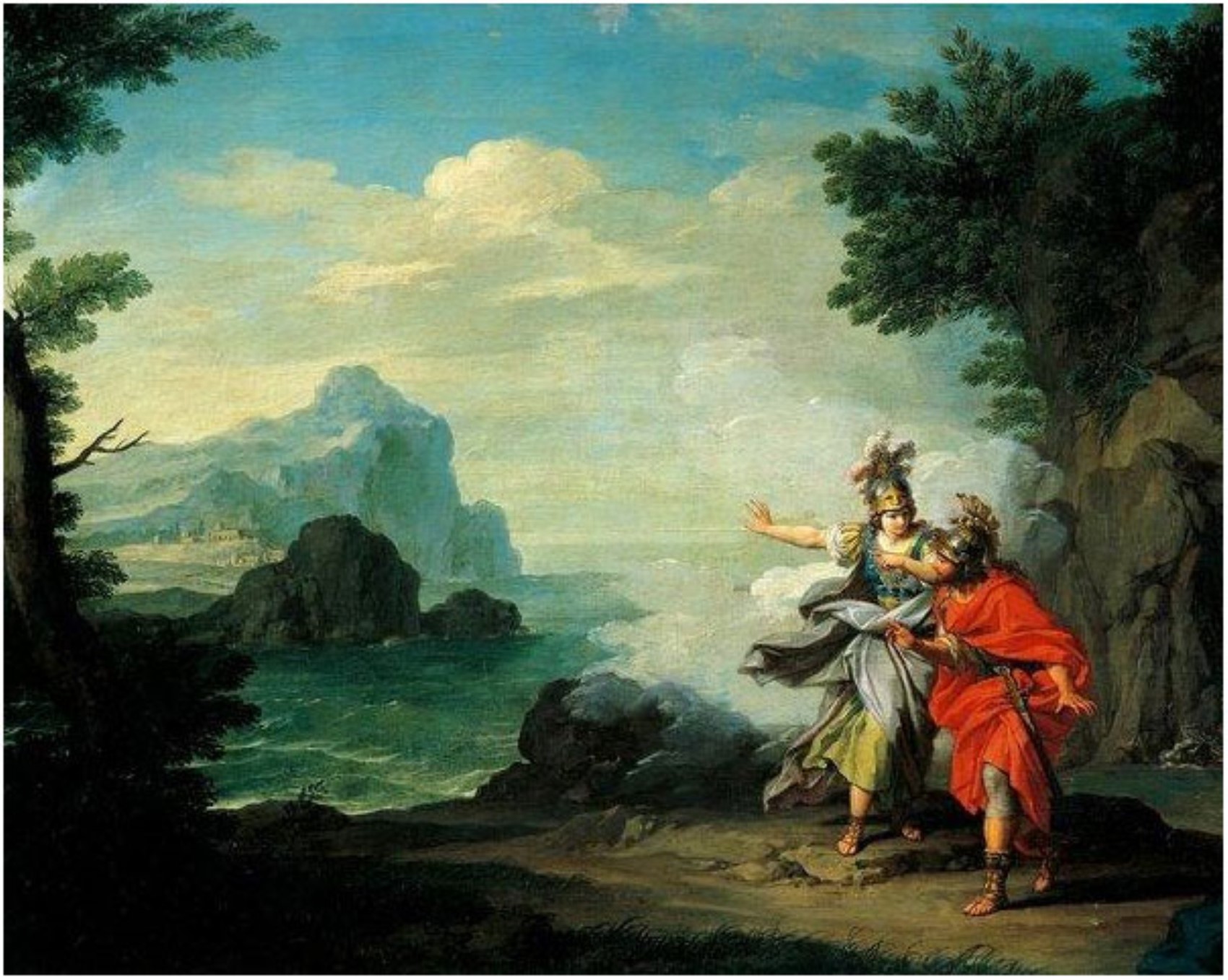
(Giuseppe Bottani — Athena Showing Ithaca to Odysseus, 18th Century)
***
Odysseus arrived in Ithaca.
Homer fell silent.
But the journey did not end.
Because since that day...
Every person continues to journey toward their own Ithaca.
This is why Homer of Smyrna, who tells of all these things, of humanity and life, is immortal.
Note: In this and previous articles, the original Ancient Greek text of Homer's Odyssey was used as a basis; comparative use was made of various Turkish and foreign language translations and sources. Some short quotes and Turkish phrasings in the text were created by me based on the original text. Main source: Homer, Odyssey, Ancient Greek text and English trans. A. T. Murray, Vol. I–II, Loeb Classical Library, London: William Heinemann – New York: G. P. Putnam's Sons, 1919; Perseus Digital Library. Images were obtained from internet sources.
Sefa Taşkın
27.09.2026
Dikili/İzmir
Most Read

Turkish citizen Cansu faces risk of death in Afghanistan

Amine Cansu Çelik has resigned from the CHP

The closed-period list of the mysterious fund has emerged
Arda Güler asked for water, a fan sent it in a plastic bag!

YENİ Party Spokesperson Zeynel Emre reveals the AKP figure involved in the fund scandal

Fund allegations against Fatma Betül Sayan Kaya infuriate even AKP members

Odysseus's Journey-4. Ithaca: Returning home is not enough!

Illegal gains, impoverished citizens...

Mansur Yavaş responds to a citizen who said 'We will vote'

Lavrov: Europe is preparing to fight us