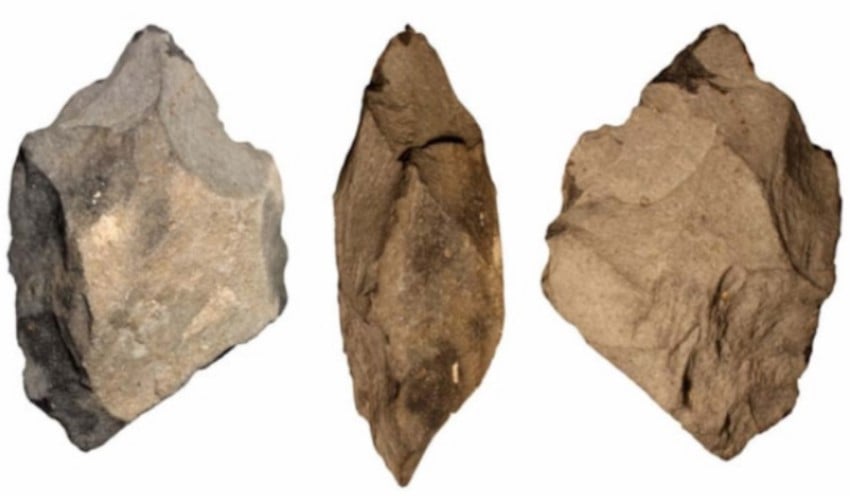
Japanese scientists, who joined the Üçhöyük excavation in the Bolvadin district of Afyonkarahisar with the hope of finding the lost city of "Purushhanda," are working meticulously with Turkish academics to uncover the secrets of the region.
The Üçhöyük rescue excavation, which began in 2020 under the coordination of the Afyonkarahisar Museum Directorate with the permission of the Ministry of Culture and Tourism and under the scientific consultancy of Prof. Dr. Özdemir Koçak, a faculty member of the Selçuk University History Department, was granted regular excavation status this year by presidential decree.
The excavation, which continues with the support of the Selçuk University Rectorate, the Bolvadin District Governorate, and the municipality, involves 48 academics from universities in Turkey, as well as archaeologists from Japan's Rikkyo and Hirosaki universities, Prof. Dr. Satoshi Urano, Prof. Dr. Yukinori Fukatsu, and Prof. Dr. Naoto Koiwa.
Turkish and Japanese scientists are working together on the excavation at the Üçhöyük site, where they began work this year, as well as on the classification and evaluation of the findings.
WE WILL BE TOGETHER FOR MANY YEARS
Koçak told an AA reporter that the 50-hectare Üçhöyük excavation site, where the Eber Lake and the Akarçay River meet, was one of the largest settlements in Anatolia and the Eastern Mediterranean inhabited during the Bronze Age.
Stating that scientists have focused in recent years on the possibility that this settlement is the same place as Purushhanda, which is mentioned in written documents related to the Akkadian Empire around 2350 BC, Koçak said, "These documents describe how the Akkadian King Sargon, at the request of a merchant, made a sudden raid on the city of Purushhanda, captured the city, and had depictions of himself and the king of Purushhanda carved onto the city walls. We are trying to prove that the city mentioned in these documents and Üçhöyük are the same place. This city was an important marketplace that managed commercial organization in Anatolia around 2000 BC. In our excavations, we reached seals dating back to 2300 BC. The definitions and documents point to this place being Purushhanda. The data we have already supports this."
Stating that they are trying to align their work with the claims that the area could be the "City of Purushhanda," Koçak noted the following:
"Being granted presidential-permitted excavation status pushed us toward a different working method. Our team expanded to reach a scientific delegation of 51. There are academics from 15 scientific fields in our work. 15 universities from Turkey and 2 from Japan have joined here. Last year, we met a Japanese team working in Turkey. We reached a consensus that we could work on the Üçhöyük excavation with them. They joined our team this year and strengthened us."
Koçak emphasized that new academics from different branches in Japan will join the work over time to uncover the ancient city together.
Stating that the archaeological materials and findings they have obtained in the 4 years they have been conducting excavations at Üçhöyük provide them with data indicating that this was an important settlement in the past, Koçak said:
"There are findings from the Iron Age, Hellenistic, and Roman periods in certain parts of the Üçhöyük settlement. Our Japanese archaeologists will also generally work on these subjects. Together, we will make evaluations regarding which direction the excavation area leans toward for these periods. We are making interpretations on the same findings. We generally make evaluations that support each other. The other day, we discussed how the roads in the region changed. This year, we will work together for about a month. As we get to know each other better in the coming years, different collaborations will emerge. We will be here with Japanese scientists for many years."
HOPE FOR FUNDING FROM JAPAN
Archaeologist Prof. Dr. Satoshi Urano also expressed that he had taken part in excavation works in Antalya and Muğla in Turkey.
Noting that they joined the Üçhöyük excavation in Afyonkarahisar upon the invitation of the excavation head, Satoshi Urano said, "This area is the most important place in the Akarçay Basin. There are many archaeological settlements in the areas around here. We will try to bring funding from the Japanese government for our work here. If we succeed in getting this funding, we will be able to bring students here. Working together here will make us all very happy; furthermore, we are also preparing a preliminary report of an academic article here this year."
Provincial Culture and Tourism Directorate Branch Manager Mevlüt Üyümez stated that the excavation work at Üçhöyük will contribute to world and Anatolian archaeology with a multi-participatory scientific delegation from Turkey and Japan.
News Source: AA