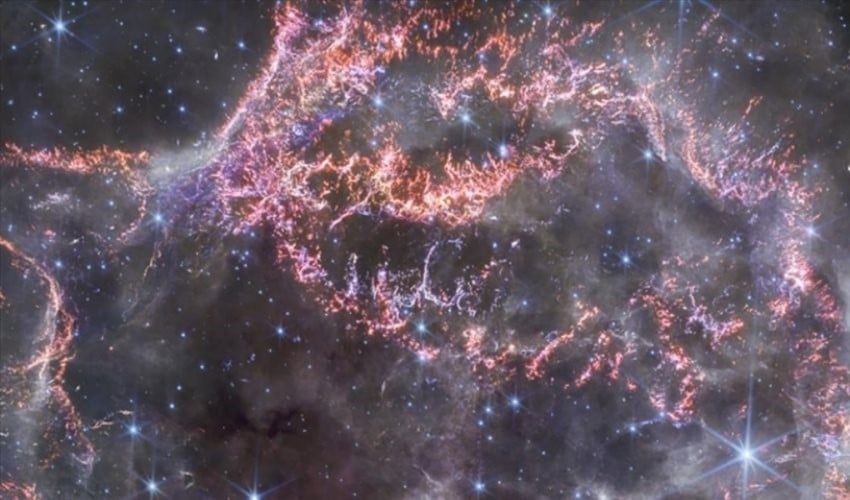
According to a report by CNN, the captured image is the most detailed ever taken of the supernova remnant known as "Cassiopeia A (Cas A)," which was formed by the explosion of a star.
Astronomers used Webb's "Near-Infrared Camera" (NIRCam) to view the supernova remnant in light wavelengths different from those used in previous observations.
Danny Milisavljevic, an astronomer and professor in the Department of Physics and Astronomy at Purdue University, stated, "We have never seen an image of an exploded star like this before. Supernovae are the fundamental drivers of cosmological evolution. There is so much to learn about supernovae, such as their energy and chemical richness. This is the closest look we have at a supernova in our own galaxy."
Noting that with the resolution of NIRCam, it is possible to see how a dying star shattered when it exploded and left behind thread-like formations resembling tiny shards of glass, Milisavljevic stated that the images provide insight into how this star exploded.
EXTENDS FOR 96.6 TRILLION KILOMETERS
Cas A, which consists of swirls of gas and dust left over from a star that exploded 10,000 years ago to become a supernova, was found 11,000 light-years away in the Cassiopeia constellation.
While the light from Cas A first reached Earth approximately 340 years ago, the remains of this celestial body, which is the youngest known supernova in the Milky Way Galaxy, extend for 10 light-years or 96.6 trillion kilometers.
COLORS INDICATE ELEMENTS
The image captured by NIRCam shows unprecedented details of the interaction created by the supernova as it collides with the gas the star ejected into space before the explosion. In the new NIRCam image, orange and light pink glows resulting from the interaction dominate the interior of the supernova remnant.
These colors indicate gaseous elements such as oxygen, argon, neon, and sulfur that the star ejected. In April 2023, the Webb Telescope's Mid-Infrared Instrument (MIRI) also recorded an image inside Cas A resembling a "green monster." Scientists studying the supernova remnants named the bright green ring in the images the "green monster," inspired by Fenway Park in Boston.
News Source: AA