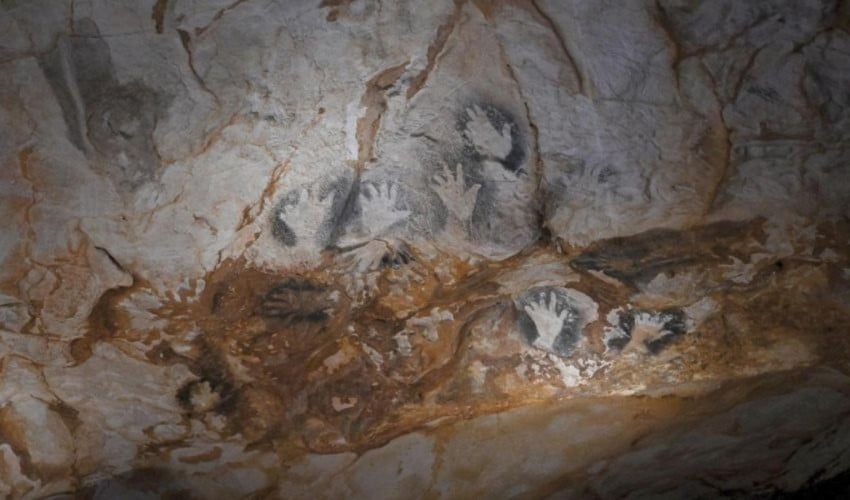
Researchers who noticed that fingers were missing in at least 200 of the hand stencils in the caves had previously attributed this to the artist's interpretation or to gangrene resulting from hardships such as frostbite during that period.
FINGERS MAY HAVE BEEN INTENTIONALLY AMPUTATED
According to the report by Independent Türkçe, scientists led by archaeologist Mark Collard from Simon Fraser University in Vancouver have revealed that the truth may be much more unpleasant. Speaking to The Guardian, Collard stated that many different societies have intentionally cut off their fingers at various times:
There is compelling evidence that these individuals intentionally cut off their fingers in rituals held to seek help from supernatural beings. Many societies even today encourage finger amputation, and this has been the case throughout history.
Pointing to the Dani tribe in the highlands of New Guinea, Indonesia, as an example, Collard noted that women there cut off at least one finger when they lose a loved one. He announced that it is believed that Europeans in the Old Stone Age, who had different belief systems, performed a similar act:
We do not think this necessarily had to be a routine practice, and we believe it occurred at different times in history.
When Collard and his team first proposed this thesis a few years ago, some scientists objected, arguing that amputating fingers under the harsh conditions of that era would have been catastrophic. There were also those who suggested that these drawings might be related to sign language or a counting system.
Subsequently, continuing his work on this subject with doctoral student Brea McCauley, Collard found new evidence supporting the amputation thesis.
In addition to the caves in France and Spain, they observed parallels regarding severed fingers in drawings at 4 archaeological sites in Africa, three in Australia, 9 in North America, 5 in South Asia, and one in Southeast Asia. While explaining their latest findings, they stated the following:
This practice was clearly invented independently and repeatedly in various places. Such acts of self-mutilation have been practiced on all continents where humans have settled. It is also seen in some recent hunter-gatherer societies. As we can see with the Dani, this behavior is still being maintained.
Reminding of some current rituals such as fire-walking and body piercing, Collard emphasized that such acts have an effect that increases intra-group cooperation:
Finger amputation may be a more extreme version of these rituals.
News Source: 12punto