


Solomon's grimoire: Clavicula Salomonis Expurgata



Is the instinct to interfere with the course of life a curse of humanity, or one of our most precious inner drives that enables our development? Our nature, which refuses to accept helplessness, makes us the protagonists of both ignorance and science at the same time.
Humans, who invented the wheel because they struggled to carry heavy loads from one place to another, can also decide collectively to sacrifice a young virgin in the village to the gods to end a drought.
So, where is the balance point of this scale? How can rationality and ignorance, bigotry and modernity exist at the same time? In a world where communication tools are so widely used and access to information is so easy, how can people's reasoning regarding the same events differ so much?
THE COMMON HISTORY OF WORLD HUMANITY ON CONCEPTS
What we know is that world humanity shares a common history; even if we speak different languages, our concepts are more or less equivalent. We live in a world subject to the same laws of physics. Although we do not experience development and progress simultaneously, the stones on which humanity trips and pauses are the same everywhere. Our country has not yet been able to clear from its path the stones that Europe tripped and stumbled over in the 17th century. Or, some stones that are no longer a problem for our country, which we have removed from our path, still block the paths to rationality for an African tribe.
LEIPZIG MAGICA COLLECTION
Leipzig University library archive
Europe has chosen a very appropriate venue to exhibit a collection of manuscript magic texts that it tripped and stumbled over in its past: the Bibliotheca Albertina, the university library of the city of Leipzig.
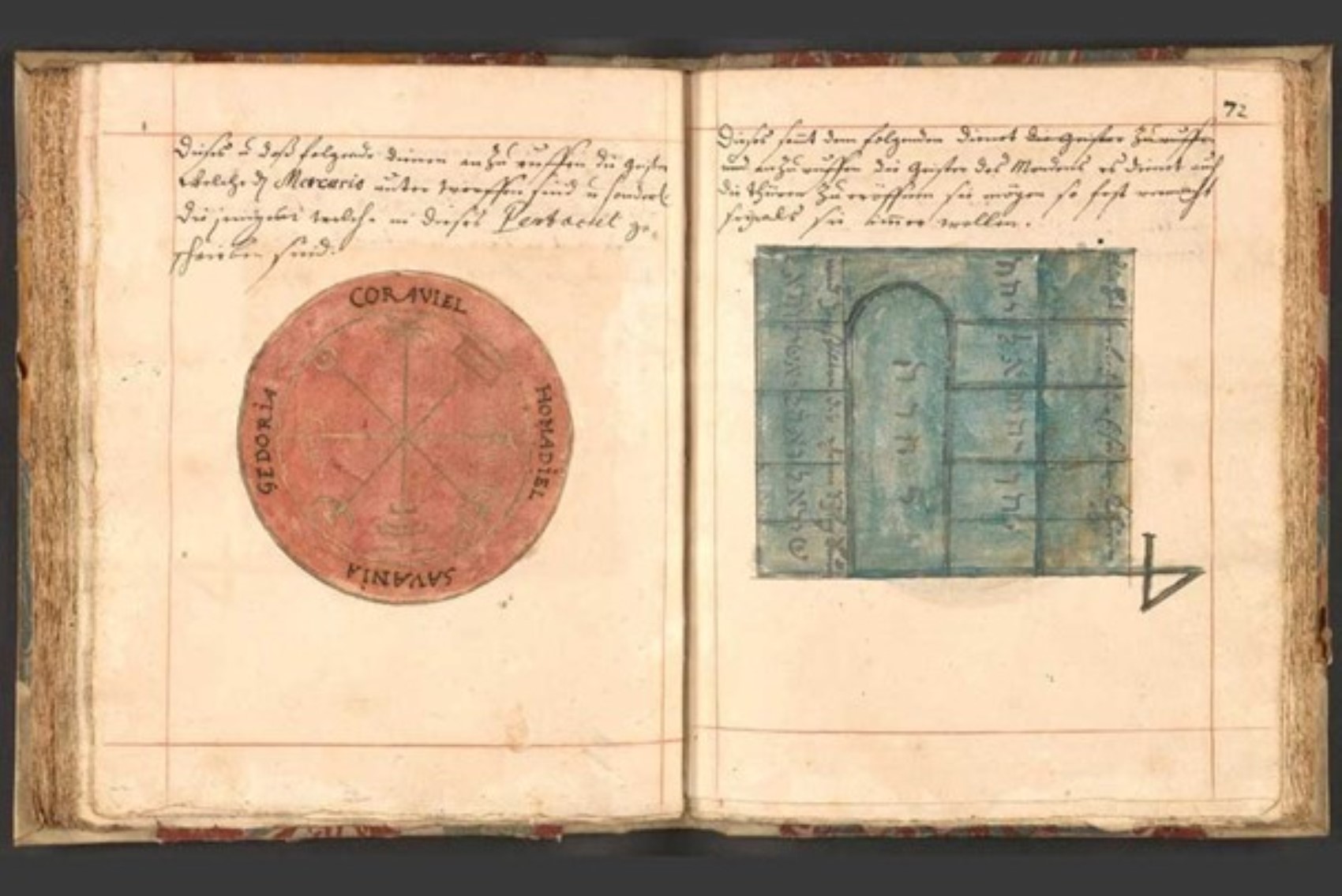
The name of the collection is "Magic Books in the Shadow of the Early Enlightenment, Leipzig Magica Collection".
It is a subtle irony that texts containing manuscript magic practices are being exhibited in a university library, the symbol of science, with the pride of having overcome ignorance. The magic collection, which consists of 140 manuscripts and was purchased in Leipzig in 1710 for a remarkable sum of 4000 Reichstaler, has the distinction of being the highest quality and largest collection of its kind in the world. The fact that a library could purchase such a collection is also a subject that deserves further reflection.
1 Reichstaler corresponds to approximately 18 grams of silver; 4000 times 18 = 72,000 grams, which means 72 kilograms of silver. Finding the purchasing power of 72 kilograms of silver in those years requires a more detailed investigation, but since 1 kilogram of silver is 710 Euros at today's exchange rates, 4000 Reichstaler corresponds to approximately 51 thousand Euros.
In 1710, the Leipzig University Library purchased manuscript works describing a thousand ways to perform magic using methods such as sorcery, alchemy, hermeticism, kabbalah, and astrology, bringing them to a platform where humanity's irrational behavioral practices could be analyzed by scientists, psychologists, theologians, and sociologists.
The analyses conducted on these works have both proven that magic practices have no scientific basis and no effect on people, and have prevented these texts from being secret knowledge and spreading among people with fear.
The path of enlightenment passes through analyzing darkness with scientific methods. If mankind could not correctly analyze the darkness in which it lived, it would be impossible to find ways to get rid of this darkness. Telling a person who believes in magic, genies, fairies, and the power of amulets not to deal with such ignorant things will not be enough to stop them from their behavior or beliefs.
What is striking is that among the authors of the magic books are doctors, teachers, lawyers, and theologians. We must not forget that it is impossible for people who grow up within theatrical charlatanisms such as magic, fortune-telling, and astrology not to be affected by this dark world. In the early 18th century, which is accepted as the beginning of the Enlightenment, Enlightenment thinkers were in the minority, and the traditional world they lived in and were at war with was fighting exactly these issues.
MANUSCRIPTS COMPILED FROM THE BEGINNING OF THE 18TH CENTURY
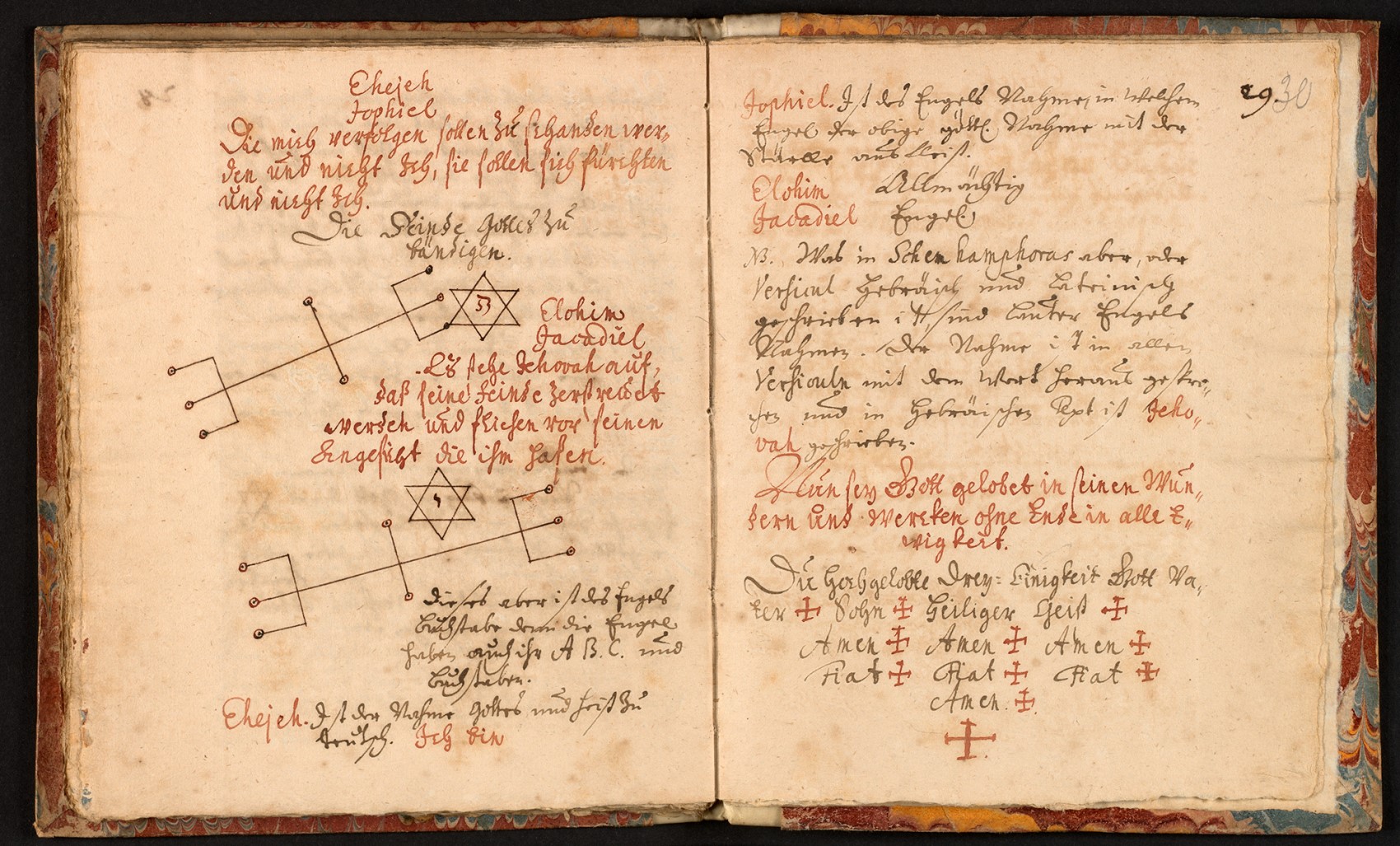
In these manuscripts, compiled by an anonymous person from the beginning of the 18th century, magic is divided into different categories: magic for summoning magical and powerful beings such as angels, demons, and genies and assigning these beings to a task; magic for binding these beings to a person or removing them from that person's body; potions prepared with plants and magic sentences, love potions, anger and revenge spells; the collection contained magic texts of various creativity and variety, such as spells written to rule over nature spirits. While one of the most interesting spells was the Clavicula Salomonis Expurgata - The Purified Key of King Solomon, another was a very detailed magic recipe explaining how to marry a fairy.
Leipzig University library archive
INTERVIEW WITH PROF. DR. MARCO FRENSCHKOWSKI: MARRYING FAIRIES AND THE RELATIONSHIP OF MAGIC WITH RELIGIONS
Prof. Dr. Marco Frenschkowski, who gave a seminar as a curator during the days the collection was opened to the public, answers the question "Is it possible to marry fairies?" in an interview as follows:
"We included this topic in the catalog," says Frenschkowski, "But the real question is, why would a person want to do this and how do they come up with this idea? This is not an erotic fantasy that people want to realize. The point is that Nymphs, that is, fairies, are thought to possess knowledge about nature that humans do not have. The human's real goal with this magic is to find a way to reach knowledge."
To the question "Is there a relationship between magic and religions?", Prof. Dr. Marco Frenschkowski replies: "Yes, of course, religions are closely related to magic. Studies on magic research constitute a very important part of religious studies within the Church."
What should be understood from this should certainly not be the idea that priests in the church write evil eye amulets and grow plants for love potions in the church garden.
To understand the relationship of the Christian religion with science, it would be sufficient to remember Saint Augustine (354-430) or Saint Thomas Aquinas (1225-1274).
Augustine, known for his works on Christianity, had a great influence on Western philosophy by trying to place Christian theology on a rational basis and through the relationship he established between reason and faith.
Thomas Aquinas, one of the most important representatives of scholastic philosophy, tried to integrate Aristotle's works with Christian theology and aimed to build a bridge between science and religious faith with the idea that the universe could be examined rationally.
Augustine and Aquinas contributed to the establishment of a dialogue between reason and faith, clearing the dogmatic obstacles in the mental maps of religious scientists and thinkers. Thus, they made a significant contribution to the shaping of the ideas of the Enlightenment period.
In a world based on such a foundation, where faith and rationality do not conflict, one should not be surprised that Copernicus (1473-1543), a canonical priest, paved the way for the scientific revolution of the Enlightenment with his Sun-centered universe model (Heliocentrism), or that Gregor Mendel (1822-1884), an Augustinian monk and accepted as the father of genetics, created a revolution in biological science by discovering how heredity works through his studies on pea plants.
INTERVIEW WITH A THEOLOGY PROFESSOR IN 2023
In an interview with a theology professor in our country in 2023, the following question is asked: "Why does space remain in darkness while the Sun illuminates our world?"... It would not be right to give the gentleman's name, of course.
Answer: “The Sun illuminating our world happens when sunlight hits the day that exists in our world. Night and day are two separate entities. Night has no indicator, that is why there are bright nights in polar regions; day has an indicator, therefore there are no dark days. As if that were not enough, we were the first to put this forward, many scientists in the world are waiting for our article on this subject to be finished," he says.
Shouldn't a theology professor at least have known about Olbers' paradox, which has been popularly mentioned since 1823?
While it has been approximately 500 years since Priest Copernicus (1473-1543) enlightened science on this subject with his Sun-centered universe model, is it not a grave insult to both religion and the nation that religious scholars in our country, which is predominantly Muslim, are so far from science?
It is not possible for a public that is both uneducated and has low economic standards to get rid of superstitions, amulets, and magic on its own. Beliefs in magic, sorcery, amulets, genies, and fairies must be on the agenda of religious institutions. This is a sociological problem that needs to be solved by cooperating with other state institutions such as the Ministry of Health, the Ministry of National Education, and the Ministry of Family and Social Services.
While the public's ignorance on this subject results in a new disaster every day, it is a field of research that needs to be taken seriously by religious figures with urgency.
MOSQUES AND POSITIVE SCIENCES
Imams working in mosques, which are the educational institutions of the public, should not have the luxury of not being aware of positive sciences. When someone from the mosque congregation says, "Imam efendi, my wife hears voices from the unseen, sees people walking around the house and talks to them," the mosque imam should not tell the man, "Now go home, find a piece of quilt thread, brother, start knotting the thread, read 11 Surah Al-Falaq and 11 Surah An-Nas each time you knot, when 11 knots are completed, tie this thread to your wife's ankle. Hopefully, the genies will never approach your wife again." When the man, who is convinced that genies are haunting his wife with the guidance of the mosque imam, sees that there is no change in his wife's condition despite the knotted threads, the second address he goes to is the sorcerer-hodja.
THE IMPORTANCE OF PSYCHOLOGICAL HELP WITHIN TRADITIONAL CULTURE AND BELIEFS
In the face of a public that prefers to run to the mosque imam instead of a doctor for such problems they cannot cope with due to their traditional culture and beliefs, there should at least be imams who can distinguish the symptoms of psychological disorders. Imam Hatip schools cannot be schools where those who cannot get a passing grade in high school entrance exams are accepted.
Children who can get the scores for the science high school entrance exam should be accepted into these schools, and a curriculum that prioritizes positive sciences alongside theology, philosophy, sociology, and psychology should be followed, so that he can say to the man explaining his wife's problem, "My dear brother, since I am not a doctor, I cannot make a diagnosis, but within my knowledge, I can say that your wife's condition seems very urgent. Our mosque has contact with psychologist doctors, I will call immediately and get an urgent appointment for you." Because he himself must know very well that the second address of the man who cannot find a solution in the mosque is the sorcerer-hodja. Unfortunately, our country is not at a level to save the public from the hands of charlatan sorcerers through psychologists. Only imams, who are the first point of contact for the public, and the Presidency of Religious Affairs can do this.
SOCIAL CONSEQUENCES OF IGNORANCE
We must know that there is a direct connection between the woman in the newspaper report who "stabbed her husband to death and seriously injured her 3 children, and was smiling while going to the police vehicle" and the professor who does not know why space is dark and defines day and night as living beings.
Because ignorance is more than not being literate, not being educated, not knowing, and not understanding. Ignorance lowers the level of morality; ignorance produces evil, narcissistic, and immoral people in society. They pay money to have amulets written so that someone dies, so that someone else's home is broken up. The amulets written certainly do not affect the person for whom the amulet is written, but they push the person who writes and has that amulet written into the deepest pits of immorality. Ignorance kills, ignorance commits murder, ignorance drives people mad.
Establishing rational bridges between science and religion is not irreligion or infidelity. In a country where the vast majority are Muslims, what we need most is a reform in religion. Qualified academic theologians undoubtedly exist within the country, and it is they who most need to be concerned about the course of the country and take precautions.
Would you like to get notifications about new developments and save news?
- NotificationsNew developments and breaking news
- SaveNews is stored in the app
Most Read

Video response to Kim Jong-un claims

Murat Ağırel’s police statement has been revealed

Azerbaijan issues arrest warrants in absentia for 7 people living in Turkey

The Orionid meteor shower will be visible from Turkey!

The penalty for Ronaldo, who left the national team camp, has been announced

Fatoş Seğmen reveals the cause of her daughter's death

Latest status in the race between AKP and YENİ Party revealed

Injury shock at Liverpool: He may miss the Fenerbahçe match

Who authorized the concert held in a parking garage?

From brotherhood to a distant partnership...