


The ideological shaping of childhood and the politicization of anger



Is it possible to design a country through politics, using children?
When many of us see the words 'child' and 'politics' side by side, we do not conclude that there is a strong link between the two concepts. The idea that there is a protective wall, such as the family, between the individual in childhood and the system prevents us from thinking this way. Since we tend to associate politics with the world of adults, we push the idea that these two concepts could have a close and strong connection out of our network of thought. However, childhood is not a neutral space outside of politics; rather, it is among the subjects that political science and political philosophy focus on with importance and sensitivity.
Louis Althusser, one of the important names in political philosophy, in his work titled 'Ideological State Apparatuses', sheds light on which institutions power uses to reach the world of children's thoughts and behaviors through the theoretical framework he developed.
Althusser mentions that governments do not always use repressive apparatuses to manage and control the public. According to him, ideological apparatuses are also instruments used by political authority that are just as effective as repressive ones.
The Two Faces of Power: Repression and Ideology
Repressive apparatuses
Repressive apparatuses, as we all know, are tools whose use depends on state authority, such as the police, the army, the courts, and prisons. Althusser conceptualizes these apparatuses under the heading of 'Repressive State Apparatus'. he conceptualizes these apparatuses.
Ideological State Apparatuses
Ideological state apparatuses, on the other hand, often exert influence through people's thoughts, habits, values, rituals, education, and worlds of meaning without explicitly using force. Schools, family, religious institutions, media, legal culture, unions, political parties, and cultural institutions fall within this scope. These institutions teach people not only 'what to do' but also 'how to perceive the world'.
According to Althusser, for the system to ensure its own continuity, it must constantly reproduce its own people. People are conditioned to work, to obey, to accept hierarchy, to consider their own place as 'natural,' and to internalize the legitimacy of the order.
Althusser's concept of 'calling' or interpellation gains importance here. Ideology addresses the individual with identities such as 'good citizen,' 'obedient student,' 'acceptable woman,' 'pious youth,' or 'patriotic child.' When the individual recognizes and accepts this call, they turn into the subject of that identity; thus, the order continues to function without constantly using force from the outside.
The Special Position of the School
Althusser argues that in modern societies, the school often stands out as the most powerful ideological apparatus. While a child spends many years in school, they do not just acquire knowledge; they also learn time discipline, how to relate to authority, criteria for success and failure, their role in society, and behaviors accepted as 'normal'.
When education ceases to be a public space that develops critical thinking and begins to produce ideological loyalty, the school starts to function more like an ideological state apparatus than a place of learning.
A type of person who adopts the role assigned to them, accepts their poverty and the class they were born into, views injustice as natural, and does not ask questions or criticize, emerges as the product of such an understanding of education.
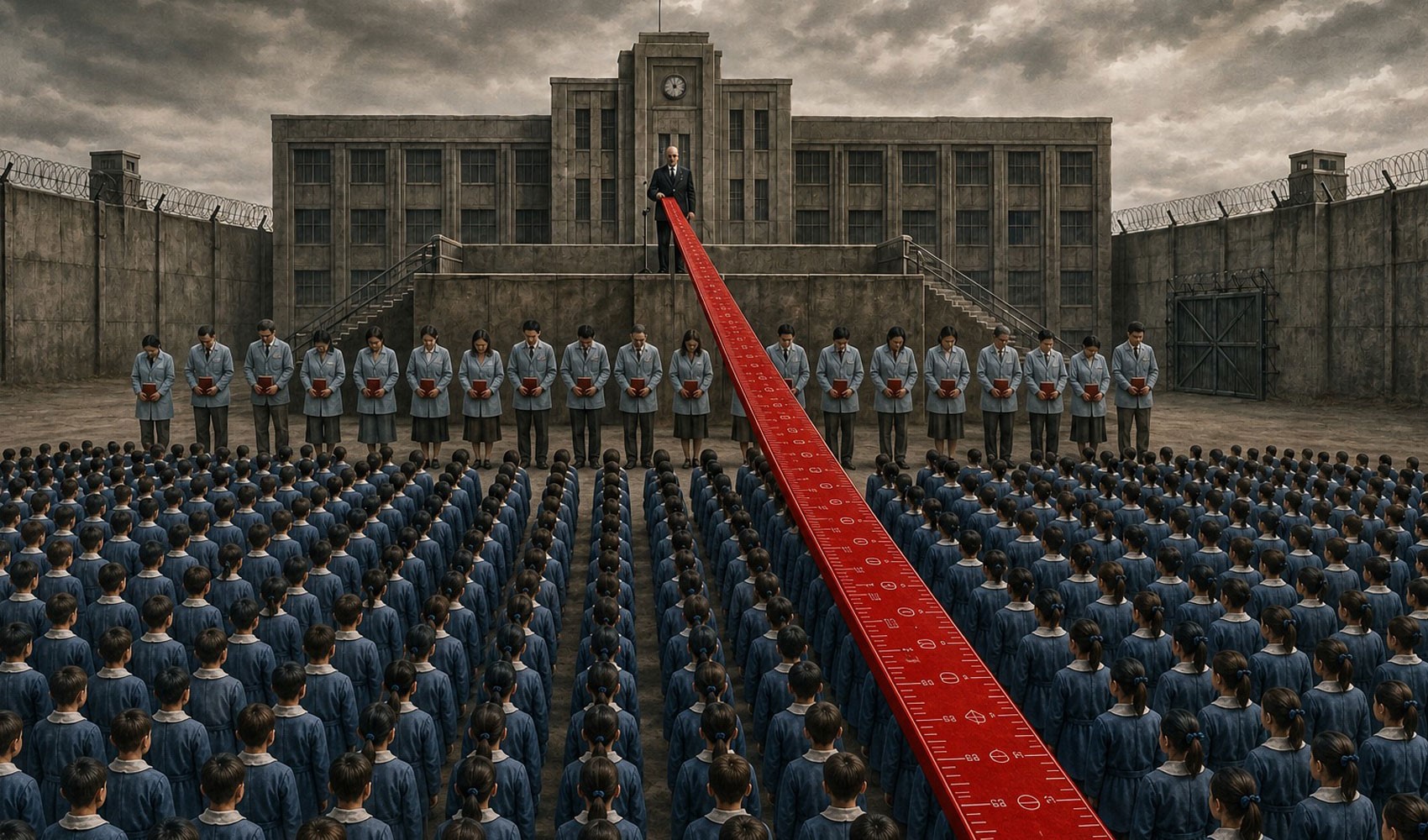
Why is Childhood a Strategic Political Space?
Today's children are seen as tomorrow's voters, civil servants, teachers, soldiers, and parents from the system's perspective; they are viewed as subjects who will largely make the continuity of the desired political order possible.
It is difficult to transform an adult; however, when a child is given a parallel perception education alongside instruction from the very beginning, it is dictated what is right and what is wrong, who is the enemy and who is the hero, and what is sacred and what is shameful.
The regime produces not only thought but also reflexes in the child.
For children, it builds a world where:
• Loyalty to the leader is seen as natural,
• Opposition is seen as a threat,
• Sacrifice is seen as greatness,
• Poverty is seen not as injustice, but as a moral test.
It builds a world where these are the norms.
For this reason, it is not enough to call the child merely an 'object of education.' The child is placed into the regime's future-oriented political project; while the regime works on them, it is actually patiently producing its own future.
Reconstructing Society
Authoritarian-revolutionary regimes generally do not settle for managing the present; they also aim to rebuild society from scratch. Within such a vision, the child ceases to be a small member of the existing society and turns into a prototype of the new society. Therefore, childhood is placed at the center of political projects not only because it is a biologically early period, but also because it is seen as the most malleable period for social reconstruction.
The Paradox Between the Revolutionary Child and the Docile Child
A striking paradox emerges here. The regime wants the child's:
• Energy, but not their freedom.
• Enthusiasm, but limits their independent judgment.
• Politicization, but only within the boundaries of its own politics.
Thus, the 'revolutionary child' and the 'docile child' are attempted to be produced at the same time: That is, the child;
• Will be active but not free.
• Will be conscious but not critical.
• Will be self-sacrificing but not questioning.
Childhood as a Field of Political Accumulation
When these methods are applied, childhood ceases to be merely a space of innocence to be protected; it becomes a field of accumulation that the regime can use in the future. In other words, childhood functions as a political reserve area where:
• Emotional energy,
• Capacity for obedience,
• Sense of belonging,
• Orientation of anger,
• And the morality of victimhood and sacrifice
are constantly produced. The images, fears, heroes, enemy figures, and moral codes planted at early ages then reinforce the regime's resilience within society in the future.
Economic Crisis, Fragility, and Anger
However, the scale of things changes during periods of economic crisis. Increasing class polarization, anxiety about the future, and the experience of powerlessness within the family cause anger to accumulate in the child's world. This anger reveals another dimension of political influence.
The issue is no longer just the transfer of certain values to the child; it turns into a problem of how their resentment and anger are interpreted, who they are directed at, and for what purposes they can be used.
Moreover, the political structure does not even need to recreate an anger that does not exist; it suffices to reinterpret previously formed fragilities, searches for belonging, and feelings of injustice within its own narratives.
So what happens in early adolescence? How do the factors that turn children into an energy reserve containing anger for politicians emerge?
Early Adolescence: The Search for Anger, Identity, and Belonging
The transition to adolescence does not just mean growing a few years older for the child; the search for identity, autonomy, and belonging in the child becomes sharper.
As they begin to move away from childhood, they no longer want to be just 'their parents' child.' They tend to become part of a group, a member of a side, and a representative of an idea; they move toward becoming an actor in their own story in the world of adults.
The early adolescent perceives the pressure in a world full of political and economic uncertainties differently than adults. Although they cannot analyze complex systemic reasons with the same conceptual tools as adults, they often do not experience the serious economic inadequacy in the family as a cold 'sociological analysis.' They experience it as deficiency, frustration, humiliation, deprivation, and powerlessness.
When the experience of inadequacy and helplessness is interpreted in the early adolescent's world, deeper down, as 'The world that should protect me is not protecting me,' 'My family is not strong,' 'My mother or father is not enough,' or 'Someone is keeping us down,' the child, easily falling into the spiral of enemies and heroes acquired at school, begins a search for an enemy to direct their anger toward and a hero to save themselves and their family.
Their cognitive structure, which has not yet settled into place, and the fact that their risk assessment capacity is not sufficiently developed, can cause the early adolescent to attempt more than they can easily handle.
In this context, they enter a search for power, believing that they can save their family, siblings, and friends, and even future generations when exposed to intense political manipulation.
At this very point, the questions the young individual seeks answers to in order to understand themselves and their environment can be summarized in three points:
1. Who is responsible for what happened to my family, me, and my friends?
2. Whose side will I be on in the face of good and evil?
3. How can I be strong to save myself and my environment?
What is decisive in the answers to these questions is what kind of explanation and what kind of offer of belonging the child encounters. So, how does authoritarian politics answer these questions?
The feeling of poverty and inadequacy undoubtedly has a crushing effect on a person. However, when the same experience is reframed as a 'dignified struggle,' it can become more bearable. Especially during childhood and early adolescence, when identity formation is ongoing, this narrative can create a strong attraction.
For mobilization-based authoritarian systems, youth anger, which poses a threat when uncontrolled, turns into political fuel when directed with ideological answers.
• 'The reason for the deficiency you experience is not your family, but the enemy.'
• 'The cause of poverty is not the wrong economy, but external powers.'
• 'Your pain is not meaningless; it is part of a sacred struggle.'
• 'Do not let your anger remain aimless; use it for the cause.'
Thus, the regime, by working on the child, actually secures its own political future.
Anger that could be directed at the family, the system, or class inequality is shifted toward an external enemy, the opposition, the 'traitor,' the 'imperialist,' the 'immoral,' the foreigner; or toward the sectarian, ethnic, or national other.
Thus, the child, instead of experiencing their own fragility directly, makes sense of it within an ideological story. The anger does not disappear; it is only channeled toward a new target.
The regime teaches the child to be 'righteously' angry. The child is no longer just angry, but the angry person of the right side; the child is no longer just poor, but a poor person who struggles and shows sacrifice. War and death are no longer terrible, but a glorious story of a meaningful and sacred extinction.
Losing the Country's Future While Saving Power
So, is it possible for politicians to achieve success in the long run as a result of all these practices?
When children who are talented, creative, and open to development—who would carry a society forward—are raised as people who unquestioningly accept what they are taught, remain silent in the face of authority, and blindly submit to what exists, what does this mean for the country's future?
Does the path to development not pass through asking questions, doubting, criticizing, and objecting when necessary?
Does the culture of obedience that the regime plants in children's minds to increase its own resilience in the short term not stifle intellectual production, scientific progress, and social renewal in the long term?
While the regime tries to save its own near future through children, does it not darken the country's possibilities for development in the distant future and, contrary to what it expects, put its own political future in danger?
Therefore, is it possible for the politicians of a country that has been left unsuccessful, untalented, and powerless to be called successful, talented, and powerful politicians?
Would you like to get notifications about new developments and save news?
- NotificationsNew developments and breaking news
- SaveNews is stored in the app
Most Read

Video response to Kim Jong-un claims

Murat Ağırel’s police statement has been revealed
Azerbaijan issues arrest warrants in absentia for 7 people living in Turkey

The Orionid meteor shower will be visible from Turkey!

The penalty for Ronaldo, who left the national team camp, has been announced

Fatoş Seğmen reveals the cause of her daughter's death

Latest status in the race between AKP and YENİ Party revealed

Injury shock at Liverpool: He may miss the Fenerbahçe match

Who authorized the concert held in a parking garage?

From brotherhood to a distant partnership...