


The legend of the Ganges River was written for the river's clean waters



The copper-hued gray river had awakened in the earliest hours of the morning. It had already taken the silence, voiced by the seagulls of the blue dome, upon its shoulders and set out to watch the sun-scorched clouds. Soon, colorful boats would line its banks, along with people murmuring prayers, and fabrics in crimson, scarlet, yellow, green, blue, earth, and ash colors. Young, old, men and women—people wanting to cleanse their sins in the cool waters of the river.
The calm river, wearing the sky in its hair, swayed toward the distant horizon with a deep hum.
According to the legend, the river goddess Ganga, who lived in the kingdom of the sky, wanted to descend to earth to forgive people and grant them eternal salvation.
However, the river goddess was so powerful that if she had descended to earth all at once, the world could have been completely destroyed. Shiva told her to first lower only her hair from the clouds down toward the earth. The river goddess transformed into the Ganges River, which curves majestically toward the infinite horizon with its wavy hair. Goddess Ganga was now a river adorning the earth to forgive people and lead them to salvation.
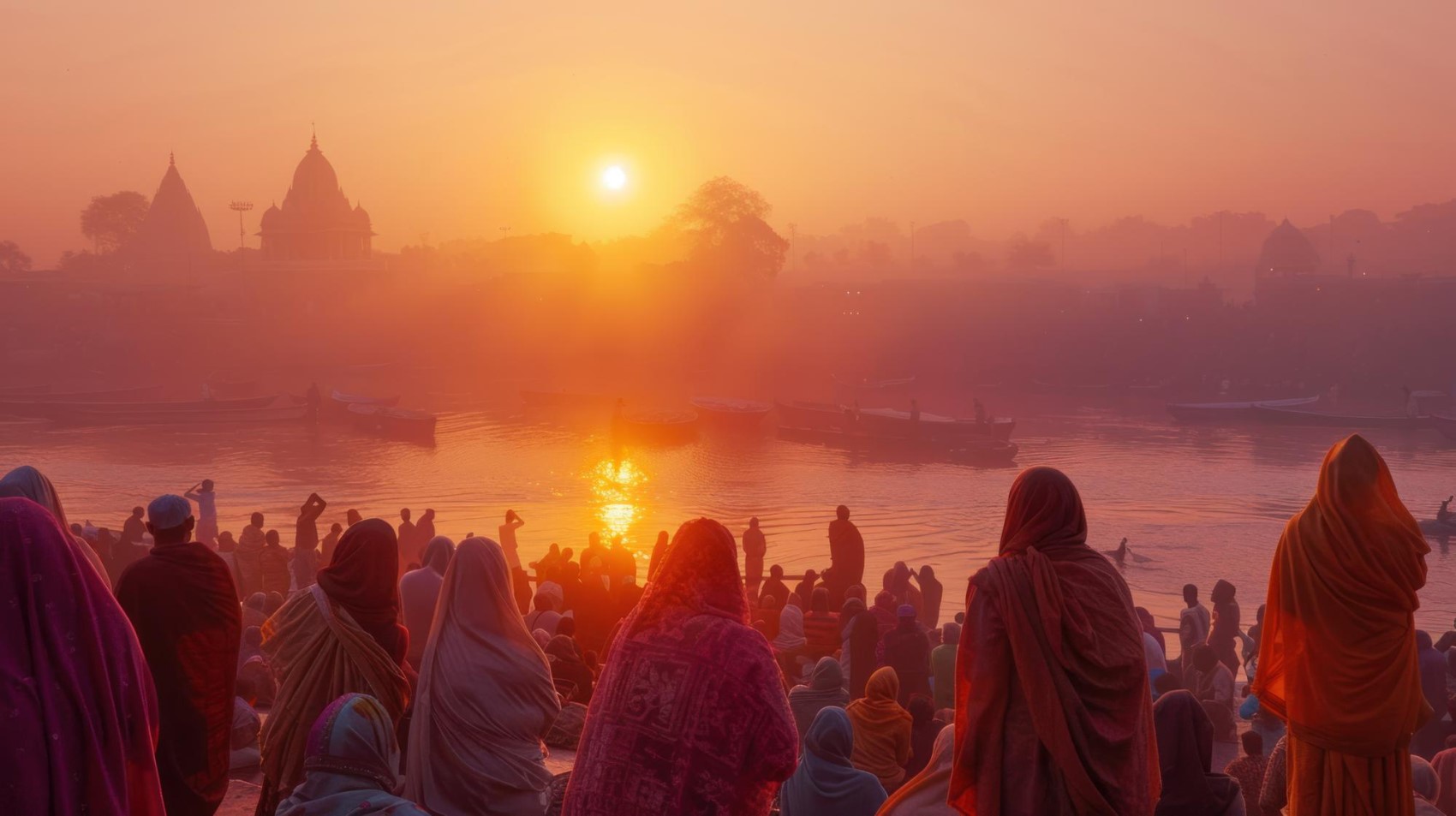
Waking up to this scene every sunrise for thousands of years, it was of course impossible not to liken the river to a beautiful young woman or even a goddess, and not to create legends and write poems in its name. This is exactly what mankind, who managed to build civilizations around the stories they created, did on the banks of the Ganges River.
PURIFICATION RITUALS IN THE DANGEROUS WATERS OF THE GANGES
The river, which is 2,704 km long and known as Ganga in Sanskrit and Ganges in English, passes through the city of Varanasi in northern India and through Bangladesh. The city of Varanasi, sacred to millions of Hindus, is considered the home of the god Shiva according to the legend, while the Ganges River is accepted as the goddess herself, as told in the story.
The river, identified with the goddess, is seen as a part of worship in the Hindu faith. Believers go to the banks of the river at sunrise to meet the goddess Ganga. According to the ritual, one must dive into and emerge from the river six times to be cleansed of sins, and it is believed that all diseases will be cured with two sips of water from the Ganges at the end of the ritual.

Although religious practices sometimes involve life-threatening risks, people do not hesitate to risk their lives for the sake of their faith instead of questioning their sacred-deemed rituals with rational methods. The point where the conflict between dogma and rationality deepens is exactly here: The congregation worshiping is not just the uneducated and faithful public; among those bathing in and drinking from the river are doctors, engineers, professors, and even chemists.
THE SCIENTIFIC STORY OF THE GANGES, ONE OF THE WORLD'S MOST POLLUTED RIVERS
The Ganges River, which meets the water needs of approximately 40 percent of India's population, is known as one of the most polluted rivers in the world. Wastewater from 22 separate districts in the city of Varanasi alone flows into the Ganges without being filtered.
Scientists say that extremely high amounts of heavy metals such as lead and mercury are found in some parts of the river, and that numerous bacteria, viruses, and parasites that can cause serious health problems have also been detected. Various chemicals such as pesticides, solvents, and oils are permanently damaging the water quality of the Ganges.
Despite all the findings, the public, who believe in the power of the Ganges, accepts the river as water that flows completely pure and clean. To them, it is impossible for the river, which is identified with the goddess herself, to be polluted in any way.
WHAT DO SIGMUND FREUD AND C.G. JUNG SAY ABOUT THIS SITUATION?
When rationality and logic remain helpless in the face of a person who repeats their dogmatic rituals at the cost of their life, listening to Freud and Jung brings some relief.
Freud views religious beliefs and rituals as a reflection of individual and collective neurotic behaviors. According to him, religious beliefs are an expression of unresolved conflicts in an individual's psychosexual development. Examining the psychological dynamics underlying religious beliefs, Freud relates the tendency of people to risk their lives for their beliefs to feelings of guilt, Oedipal conflicts, and fears of punishment lying in the individual's subconscious. According to Freud, such actions can be part of an individual's search for compensation for internal conflicts and identification.
Carl Gustav Jung, unlike Freud, considered religious beliefs and rituals as a fundamental part of human psychology. According to Jung, religious beliefs and symbols reflect archetypes in the collective subconscious of humanity and are part of the individual's effort to make sense of themselves and the universe.
He relates people taking risks for their beliefs to the individual's process of individuation and personal development. According to Jung, such actions can be a reflection of an individual's effort to connect with a deeper, spiritual reality and find personal meaning.
THE DIFFERENCE BETWEEN SCIENTIFIC LITERACY AND SCIENTIFIC UNDERSTANDING
Considering that rationality and scientific methods are part of university education, we face the dilemma that school education alone is not enough to raise rational individuals. It is necessary to mark as a phenomenon and try to understand how a person with scientific literacy, seeing in laboratory test results that the Ganges River is poisoned with lead, mercury, bacteria, viruses, and various chemicals, can still dive into the river's waters at six in the morning and drink mouthfuls of this water.
This is a situation that needs to be thought about deeply. First of all, it must be realized that scientific literacy and scientific understanding are not the same. The liberation of primitive man from rituals, fears, and animistic behavioral patterns passed down from generation to generation is not a problem that can be solved in one generation when left to its own devices. It appears that in an environment where even the family and teachers are not convinced, learning physics, mathematics, or chemistry alone is not enough to transform an individual into a person who can think rationally.

THE INVENTION OF THE SCHOOL SYSTEM AND THE NECESSITY OF A HOLISTIC CURRICULUM
Scientists and philosophers have been searching for ways to transform primitive man into a rational, sensible, and civilized individual for thousands of years. To ensure this, there is a universal curriculum created over many years, which we call 'school' in today's developed countries.
Thinkers and scientists who form the pillars of the civilized world knew, of course, that the content of this curriculum was not composed solely of positive sciences. Today, especially, scientific thinking methods need to be integrated into students' education in every field in a way that will permeate their daily lives. Knowledge of ethics, aesthetics, and logic, which are sub-branches of philosophy, must be indispensable parts of this education.
Through knowledge of sports, art, culture, music, and history, the doors of free thought and individual existence should be opened to the individual in the physical and intellectual spheres.
Otherwise, it is impossible to prevent even a chemist who performs analysis in a laboratory and determines that the river is toxic from drinking the poisonous waters of that river.
Would you like to get notifications about new developments and save news?
- NotificationsNew developments and breaking news
- SaveNews is stored in the app
Most Read

Video response to Kim Jong-un claims

Murat Ağırel’s police statement has been revealed

The Orionid meteor shower will be visible from Turkey!

Fatoş Seğmen reveals the cause of her daughter's death

Latest status in the race between AKP and YENİ Party revealed

Injury shock at Liverpool: He may miss the Fenerbahçe match

From brotherhood to a distant partnership...

Who authorized the concert held in a parking garage?

Acting mayor of Üsküdar has been determined

Good news from Izmir, may Istanbul be next