


What happens if the social contract between the nation and the state is broken?



If someone told you that the only way to be free is to give up your freedoms, you would stop and think for a moment, wouldn't you? Although this sentence, which seems contradictory, points to a paradoxical tension, this paradox leads us, as individuals who have signed an invisible social contract, to the starting point of the mechanism of social functioning. This invisible contract is, of course, not one-sided. One of the parties to this contract is the individual, a legal entity, that is, the citizen, while the other party is the state, which is also a legal template.
This contract, which is not written down anywhere, forms the basis of modern state-citizen relations. This silent agreement, shaped by the surrender of freedoms and the guarantees received in return, affects our individual autonomy on one hand, while aiming to ensure the continued stable functionality of society on the other. When this 'balance pact' is analyzed, we can better grasp how deep the relationship between personal freedoms and collective security is, and why the careful management of this relationship is so vital for the well-being of every citizen.
While the individual gives up many of their freedoms and delegates their powers within the scope of this social contract, the state takes over all these powers from the citizen with a state guarantee. The state commits to administering all the powers and rights it has received from the members of the community in a fair manner, with the interests of society in mind.
When members of parliament earn the right to enter parliament, they take an oath whose content is based on their honor and integrity. This oath is, in its essence, related to the social contract between the state and the citizen. I wish such an important trust had not been left to the mercy of invisible and immeasurable virtues like honor and integrity.
Of course, the citizen does not delegate these powers in a casual manner. Beyond internalizing the existence and integrity of the state through a sense of unity, the citizen also supports the state financially through their taxes. In return, they expect the state to represent and protect their rights—such as the right to life, property, education, training, health, and security—at an institutional level. The state, in turn, establishes institutions to properly fulfill these duties entrusted to it by the citizens.
Within the framework of this contract, collective public services that individuals could not create on their own—such as infrastructure, security, health, and education—are guaranteed by the state to those living under the roof of an organized state.
Furthermore, the state creates laws under its own guarantee, pledging to be impartial and fair to the public. It gives individuals living within the community a guarantee that their rights will be protected equally. In other words, when an individual is subjected to injustice, they are certain that their rights will be protected by the state.
Thus, in a lawless society where everything is arbitrary, an individual who would otherwise have to live under constant threat relinquishes some of their freedoms in the contract they make with the superstructure, feeling safe against all threats from within and without through the power and guarantee of the state.
In other words, while giving up their freedoms, they hope to receive security, justice, and equality in return...
Therefore, the idea of a social contract, which concerns civilized humans so closely, has been one of the most central concepts of political philosophy, examining the legitimacy of state authority and the origins of social order.
"LEVIATHAN" AND "TWO TREATISES OF GOVERNMENT"
In his 1651 work "Leviathan," Thomas Hobbes argues that if left to their own devices without a supreme authority to set rules, society would devolve into a structure where it is "a war of all against all." According to Hobbes, in such a structure, there would be no industry, culture, or secured property, and human life would be "solitary, poor, nasty, brutish, and short." To escape this chaotic state, individuals agree to a social contract in which they surrender their absolute freedom and power to a sovereign ruler or government in exchange for protection and social order.
John Locke, on the other hand, analyzes the necessity of the social contract from a slightly more optimistic perspective. In his 1690 work "Two Treatises of Government," Locke defines a society subject to a social contract as a state where freedoms exist but unchecked license does not. Locke explains the social contract based on the principle of the consent of the governed. People relinquish some of their rights to protect their lives, liberties, and property. However, according to Locke, the prerequisite for this relinquishment is that the government must exercise its power fairly and in accordance with the public interest.
SO, WHAT HAPPENS IF CRACKS FORM IN THIS CONTRACT BETWEEN THE STATE AND THE NATION?
What happens if the individual, having surrendered their freedom, becomes alienated from the superstructure to which they entrusted their life, property, security, health, and the future of their descendants; if they lose trust in the institutions representing these concepts; and, consequently, if the contractual bond between the two parties is severed?
What makes an individual visible and understandable within society is as much about their own existence as it is about the sense of 'feeling secure' provided by the orderly structure in which they live. If an individual experiences a kind of existential chaos—physically, financially, and spiritually—and feels threatened from every direction, what happens to that individual? More importantly, what does a society composed of such individuals turn into?
Does an individual who experiences existential anxiety, does not feel secure, and faces fundamental dangers such as homelessness and hunger due to an economic crisis commit suicide when they can no longer withstand all these pressures? If suicide rates in society increase for this reason, should this be attributed to human psychology, or to the state, which is the source of sociological erosion and has failed to fulfill its duties properly?
THE NAME OF EMILE DURKHEIM'S THEORY THAT SHEDS LIGHT ON THIS SUBJECT IS ANOMIE
According to Durkheim, anomie is a state of normlessness. During times of rapid social change or severe economic crises, people reach a point where they can no longer predict what to expect from institutions and society, or what is expected of them. This situation means that individuals lose the norms they are accustomed to, which creates a state of normlessness, or anomie. The loss of social norms creates uncertainty and leads to a lack of clear rules of conduct.
DISCORD BETWEEN INSTITUTIONAL MEANS AND THE PUBLIC
Robert Merton, by analyzing Durkheim's theories in greater detail, sheds light on this aspect of anomie. Merton states that the only legitimate way for the public to access cultural goals such as security and wealth is through education and employment opportunities. If the public's institutional means, such as education and job opportunities, are insufficient to reach their cultural goals like wealth and security—that is, if there is a discrepancy between cultural goals and institutional means—a loss of norms is expected to occur at this point. When people realize that legitimate paths to success are blocked, they may tend to resort to illegal methods, acts of violence, or taking justice into their own hands to achieve their goals or defend their rights.
SOME SITUATIONS THAT ANOMIE, OR THE LOSS OF NORMS, WILL CAUSE IN SOCIETY CAN BE LISTED AS FOLLOWS:
• Increases in crime rates and deviant behaviors are observed. This situation raises the level of stress, anxiety, and paranoia in society.
• The situation where access to fundamental rights such as education, health, and justice is not equal for all segments of society, increases social alienation within society, leading to a decrease in solidarity and a deepening of class divisions.
• The public's distancing from the state and seeking alternative illegal methods to protect themselves, or attempting to earn money through illicit means, increases the burden on state institutions and the government, making the control of resources more difficult and causing disruptions in institutional functioning.
• Since economic insecurity within the country increases the risk ratio for investors, domestic investors move their capital abroad, while foreign investors refrain from investing in the country.
• The assessment of increasing political and social instability as a risk factor in the international arena damages the country's credit rating; this situation increases the costs of borrowing, leading the country to take on more debt, which both complicates the country's access to international financial markets and restricts its financial room for maneuver.
ALTERNATIVE NORM TRAPS
As a result, due to the degeneration of norms, the public, having lost its sense of trust in institutional tools, feels abandoned and threatened in every sense. Consequently, driven by an instinctive existential anxiety, they begin to seek alternative solutions to protect themselves, their families, and their assets.
Individuals experiencing deviations or delays in security and justice, especially those with capital engaged in trade, seek protection from armed mafia groups instead of the state. This means that money leaves official state circulation and turns into unregistered funds transferred to the criminal economy.
Distrust in healthcare institutions drives the public toward alternative medicine or irrational, spiritual treatment movements, causing irreversible damage to the physical and mental health of the population. The money that should have been paid to healthcare institutions ends up in the pockets of charlatans, again moving into the informal economy.
The public, having severed its ties with the education system, takes on a significant economic burden by choosing private schools instead of state schools. The departure of young people who believe they cannot reach their targeted level of cultural prosperity by studying and working in their own country causes an irreparable erosion of the intellectual level in the country.
TRUTHS ARE SOMETIMES CLICHÉS, "WE ARE ALL IN THE SAME BOAT"

Truths are sometimes painful, yes, but sometimes they are also clichés. Unfortunately, to put it in the most cliché way possible, we are all in the same boat, and the sails we have been flying against the wind for a long time have long since been torn. The ship's engine room appears to be both damaged and out of fuel. Our physicists and engineers who would repair the ship are working in laboratories allocated to them in other countries, winning international awards. For some reason, the scientists on the ship are not properly consulted for their ideas, and we have not taught the youth evolution or calculus. The contract between the passengers and the senior crew has been swept away by the wind, and the compass is also missing. If you do not have wings, and you do not have a private plane or helicopter to take you from the deck of the leaking ship and fly you away, it is time to pick up a needle and thread and sew a patched sail using our own clothes. It is also time to send our school children to physics laboratories instead of shrines and saints, and to produce our own astrolabe by teaching them calculus, mathematics, biology, chemistry, and astronomy. As you are well aware, one does not need to be a world-renowned scholar to predict the fate of a ship that is taking on water, has no compass, and no sails.
Would you like to get notifications about new developments and save news?
- NotificationsNew developments and breaking news
- SaveNews is stored in the app
Most Read

Video response to Kim Jong-un claims

Murat Ağırel’s police statement has been revealed
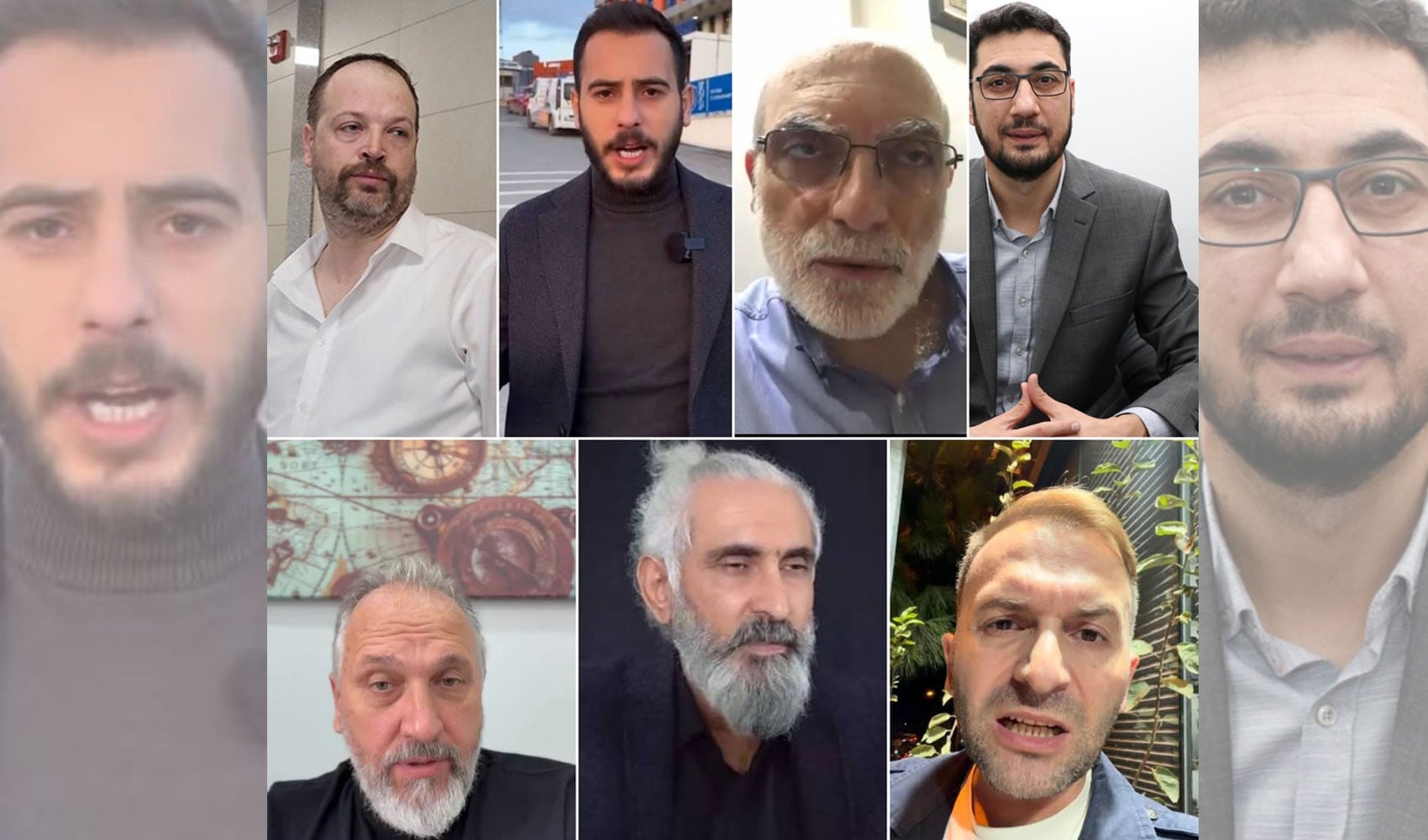
Azerbaijan issues arrest warrants in absentia for 7 people living in Turkey

The Orionid meteor shower will be visible from Turkey!

The penalty for Ronaldo, who left the national team camp, has been announced

Fatoş Seğmen reveals the cause of her daughter's death

Latest status in the race between AKP and YENİ Party revealed

Injury shock at Liverpool: He may miss the Fenerbahçe match

Who authorized the concert held in a parking garage?

From brotherhood to a distant partnership...