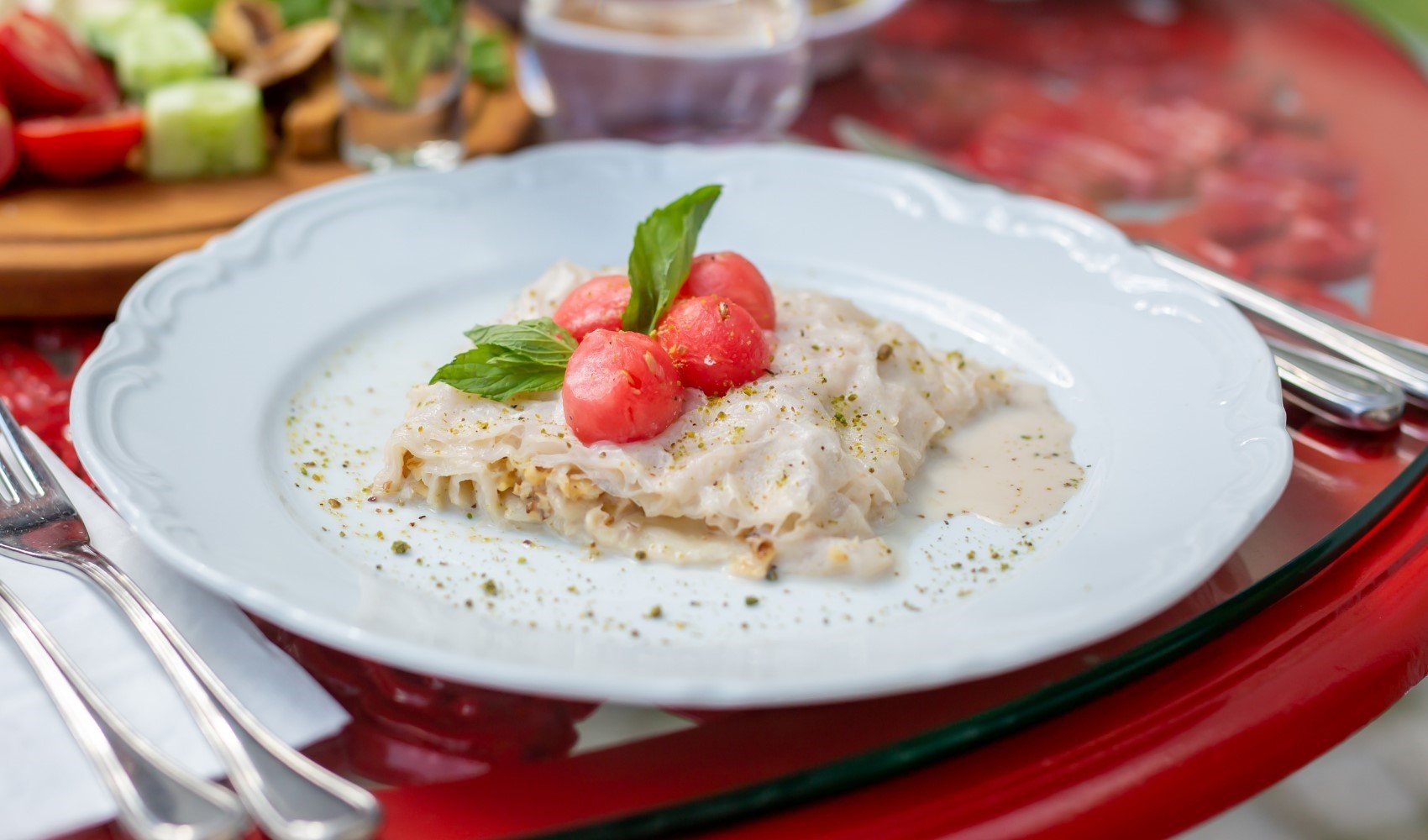
Güllaç was first introduced to the palace kitchen in 1489. Ali Usta from Kastamonu turned the leftover phyllo dough he had on hand into a dessert by soaking it in sweetened milk during a visit by palace officials to Kastamonu.
The palace officials, who enjoyed the dessert there, took Ali Usta with them to the palace as the head pastry chef.
During the Ottoman period, güllaç leaves were referred to as "varak" (sheets).
Palace kitchen records show that between 1573 and 1574, 19,740 sheets were purchased for the Ottoman palace, while 10,300 sheets were purchased between 1642 and 1654.
Turabi Efendi described the making of the sheets in his book: "Put the whites of 20 eggs into a bowl and beat them well, then slowly add about half a kilogram of wheat starch and mix thoroughly, then add enough water to create a thin dough and mix. To prevent it from overheating, place a round and slightly domed iron griddle, to the bottom of which you have previously attached about one and a half centimeters of ash, over a charcoal fire.
When it reaches a medium heat, pour enough of the dough with a suitable spoon onto the center of the griddle to form a sheet the size of a large dinner plate or larger. In less than a minute, this sheet will be ready. 'It should be snow-white and as thin as tissue paper,'" he explained.
Making the sheets requires expertise; if the sheet is too thick, it makes the güllaç mushy, and if it is too thin, it causes it to fall apart.
MADE WITH SUGAR SYRUP
Güllaç, which Ottoman sultans never missed from their tables, was usually made with sugar syrup, and rose water, musk, clotted cream (kaymak), pistachios, almonds, or hazelnuts were also added. The güllaç leaves were wrapped in the shape of a bundle, amulet, or roll. There was also a variety where the leaves were dipped in egg, fried, and then placed in syrup...
The most important legacy remaining from Ottoman and Turkish Ramadan culture, even if we do not remember the old customs, dishes, and traditions much these days, is güllaç.
When one thinks of güllaç, Ramadan comes to mind, and when one thinks of Ramadan, güllaç comes to mind.
News Source: 12punto