Celebrated every year on October 16, "World Food Day" draws attention to the situation of millions of people around the world who cannot afford a healthy diet and need regular access to healthy food.
Only 2.5% of the water covering approximately 71% of the Earth's surface is suitable for drinking, agriculture, and industrial use.
Factors such as rapid population growth, urbanization, economic development, and climate change are putting increasing pressure on the planet's water resources. At the same time, per capita freshwater resources have decreased by 20% in recent years.
It is warned that due to decades of water misuse and mismanagement, over-extraction of groundwater, pollution, and climate change, water availability and quality are rapidly deteriorating, and we are at risk of consuming this precious resource to a point of no return.
600 MILLION PEOPLE AFFECTED
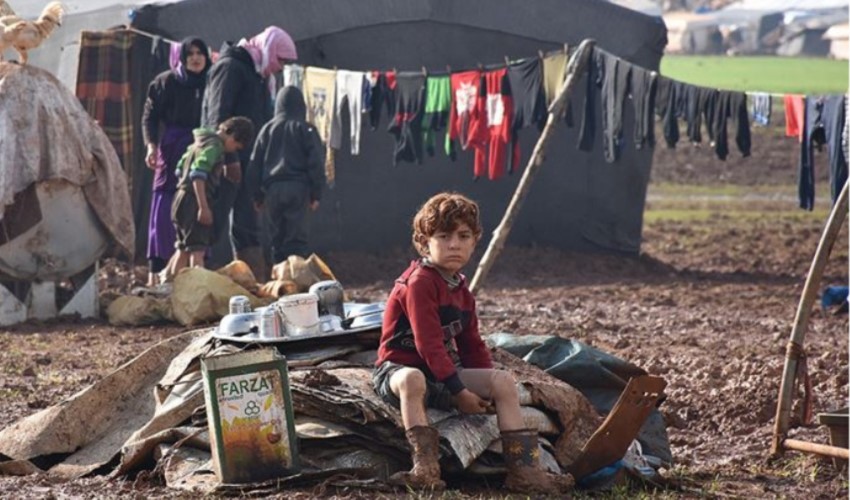
According to FAO data, 2.4 billion people currently live in water-stressed countries. Most of these are farmers who struggle to meet their daily needs, primarily women, indigenous peoples, migrants, and refugees.
Approximately 600 million people who rely, at least in part, on water-dependent food systems for their livelihoods suffer from the effects of pollution, ecosystem problems, unsustainable practices, and climate change.
PREVALENCE OF FOOD INSECURITY INCREASED FROM 2019 TO 2022
It is projected that approximately 600 million people will be chronically undernourished in 2030. This figure is 119 million higher compared to a scenario without the COVID-19 pandemic and the Russia-Ukraine war, and approximately 23 million higher than a scenario without the Russia-Ukraine war alone.
The prevalence of moderate or severe food insecurity at the global level showed a sharp increase from 2019 to 2020, and the situation remained unchanged in 2021 and 2022.
CHILDREN ARE UNABLE TO GROW UP HEALTHILY
In 2022, it was recorded that an estimated 148.1 million children under the age of five worldwide were unable to grow up healthily, and 37 million children were overweight.
While unhealthy growth is generally seen in children in rural areas, being overweight is slightly more common in urban areas.
The prevalence of undernourishment worldwide rose from 7.9% in 2019 to 9.2% in 2022. While the prevalence of undernourishment increased in Africa, Asia, and Oceania from 2019 to 2022, it decreased in Latin America and the Caribbean. In Africa, the prevalence of undernourishment, which was 17% in 2019, increased by 2.7 percentage points to reach 19.7% in 2022.
In Asia, the rate of undernourishment, which was 7.4% in 2019, rose to 8.5% in 2022.
In Oceania, the prevalence of undernourishment, which was 6.4% in 2019, increased slightly to reach 7% in 2022.
In Latin America and the Caribbean, the prevalence of undernourishment, which was 5.6%, reached 7% in 2021, but this prevalence rate fell by 0.5 percentage points to 6.5% in 2022.
News Source: AA