


A professor at the School of Engineering and Robert College: Karl von Terzaghi



Who is Terzaghi?
Karl von Terzaghi is the founder of modern soil mechanics. He developed the theoretical and experimental measurement methods of this scientific field in our country. Civil engineers say of him, “What Newton is to physicists, Karl Terzaghi is to soil mechanics.” Terzaghi was a citizen of the Austro-Hungarian Empire. This state was one of the states that dissolved after the First World War. He was born in Prague. He came from a family of Lombard origin. He was invited to Istanbul by the Committee of Union and Progress government (in 1916) to give lectures at the School of Higher Engineering. After the armistice, he worked in the engineering department of Robert College. He left our country, where he stayed for nearly 10 years, as an internationally recognized scientist and the founder of a new scientific discipline.
TERZAGHI IN RUSSIA AND THE USA
There were officers and engineers in his family. Terzaghi studied at Graz University of Technology. During his education, he was almost expelled from school due to his refusal to recognize authority. Nicola Tesla had also studied at the same school and was expelled due to indiscipline. They did not expel him. They interpreted his behavior as eccentricity. After graduating from Graz University of Technology in 1904, he worked for a while in St. Petersburg (1911-1912). As is known, St. Petersburg—like Venice—is a city with soil problems. He occupied himself with these matters. Based on the work he did in Russia, he received his doctorate in 1912, again in Graz, with a thesis titled “Calculation of circular tank foundations.” Then he went to the USA. His goal was to find work in large engineering projects such as dam construction. He could not find such an opportunity. He did not have very productive days until he returned to his country in 1914.
When the World War broke out, difficult tasks would fall to him. On the Serbian front, on the Danube river, he built positions with engineer battalions. He built military airfields. He served as the director of construction works for the Imperial Army.
GERMAN, HUNGARIAN, AND AUSTRIAN PROFESSORS WHO CAME TO THE DARÜLFÜNUN DURING THE WAR YEARS
The Unionists entered the country into the war in the autumn of 1914. This meant being an ally not only with Germany but also with the Austro-Hungarian Empire. This was the reason why the 15th Corps fought on the Galicia and Romania fronts.
While the war was continuing, in addition to German commanders, there were also soldiers of the Austro-Hungarian Empire in the Ottoman army. These were symbolic units. They took part as allies alongside the Ottomans in Gallipoli, Palestine, and the Eastern fronts. Let us remember; there is a photograph of Mustafa Kemal Pasha taken in Aleppo in 1917. There is one other person next to him, besides Fuat Bulca and little Abdürrahim: A German artillery officer.
During the war years, cooperation was also carried out in the field of science between the Ottoman State and its allies. Let us remember, the Istanbul Darülfünun was transformed into a university by the Republican administration in 1933. The Unionists had also thought of the same thing. They also wanted to reform the Darülfünun. Due to limited conditions during the war years, a comprehensive modernization could not be realized. Reform efforts were interrupted during the armistice. Nevertheless, over 20 German, Austrian, and Hungarian scientists were invited to the law, medicine, and literature departments. Departments of ethnography and Ural-Altaic languages were opened in the Faculty of Literature. It was discovered that Hungarians were a Turanian people. Hungarian professors such as Dr. Gyula Meszaros and Geza Feher were employed in these departments.
These figures were also present in the circles of the Turkish Hearths (Türk Ocakları) and Turkish Homeland (Türk Yurdu). They published articles in the Türk Yurdu journal. They gave conferences. Hungarian Brothers Street is a memory of these years of rapprochement. Mutual Turan societies were established in Istanbul and Budapest. The Hungarians gave an honorary doctorate to Enver Pasha.
TERZAGHI AT THE SCHOOL OF HIGHER ENGINEERING
Meanwhile, Terzaghi’s doctoral advisor, Professor Forchheimer, had started working as a consultant at the School of Higher Engineering (ITU). He ensured that his student was also invited. Terzaghi was invited to the engineering department of the Istanbul Darülfünun through the Imperial Ministry of Foreign Affairs. In September 1916, he came to Istanbul with his wife Olga and their newborn daughter.
In the days when Terzaghi arrived in Istanbul, the war was continuing with extraordinary intensity on all fronts (Europe, Suez Canal, Gallipoli, Iraq). Despite this, the years of his professorship at the Darülfünun School of Higher Engineering, which he described in his memoirs as “the two most beautiful years of my life,” had begun this way.
He gave his general construction methods lectures in French. He had an assistant, İlyas Bey, who translated the lectures into Turkish. The notes of the lectures he gave here would be published as a facsimile at the symposium held on the 75th anniversary of the founding of the science of Soil Mechanics (1995).
In the early years, Terzaghi lived in a small apartment in the Helbig Apartment in Galata (the current Doğan Apartment). He had devoted himself so much to the city’s urban planning that he had even made plans to cross the Bosphorus with a tube tunnel and a suspension bridge.
EVERYTHING CHANGES DURING THE ARMISTICE
The income he earned from the university was not bad. His own government was also sending some money. But everything would change with the armistice. Towards the end of the war, imperial support was cut off. When financial difficulties began, problems with his wife would start.
In the end, the Axis front collapsed. Both his own country and the Ottoman State had been defeated. Istanbul was occupied by the allies. After a while, the allied administration terminated the employment of all foreign professors employed by the Ottoman government. German and Austrian soldiers were detained. They were taken to prisoner-of-war camps in Cyprus, Egypt, and Malta. Civilians were dismissed from their jobs. One of them was him. Terzaghi was left unemployed and penniless. As financial difficulties increased, his marriage was shaken.
ROBERT COLLEGE YEARS
Coincidentally, just at this time, a professor at the higher section of Robert College (Boğaziçi University after 1971) passed away suddenly. This would create an opportunity for him. In those years, Robert College was trying to establish a strong engineering department under the leadership of Caleb Gates. A large engineering building (Gates Hall) had even been constructed. He accepted the job offer immediately. Since Robert College belonged to the Americans, the British could not intervene. Terzaghi’s employment became a great source of strength for the school.
Terzaghi’s subsequent life in Turkey was spent entirely at Robert College. The Istanbul of the armistice was a difficult city to live in in every respect. The fate of the city was uncertain. While the allies in Paris were cutting a shroud for Turkey, Mustafa Kemal Pasha started the Anatolian revolution. Just at this time, the civil war continuing in Russia resulted in the victory of the Bolsheviks. The White Army disintegrated on all fronts. In the autumn of 1920, Pyotr Wrangel’s White Army was defeated by the Red Army in Crimea, and the remnants were transported to Istanbul with their families on allied ships, and camps were established everywhere. Living in Istanbul had become even more difficult. But for Karl Terzaghi, the situation was not bad. He was teaching in an ivory tower on the Bosphorus. He was a professor who was liked, appreciated, and supported. He set up a small laboratory. Rector Gates even supported him with some money. He was conducting experiments related to soil mechanics. It was not easy at all to commute from Galata to Robert College in the Istanbul of the armistice. They moved to Bebek. When his relationship with his wife Olga Byloff deteriorated completely, he put them on the Adria ship (an Austrian ship) with his daughter and sent them to their country. The year had become 1921.
College officials gave him a room overlooking the Bosphorus in Theodorus Hall (now a girls' dormitory). This room gave him the opportunity to work more efficiently. He thought about and wrote many things regarding the foundations of soil mechanics here.
He presented the findings he reached here as a paper at the congress of applied soil mechanics in the Netherlands. It attracted a lot of attention. Terzaghi would turn his work in this field into a book. He titled his book Erdbaumechanik auf bodenphysikalischer Grundlage (Soil mechanics on the basis of soil physics). The book was published in 1925 by Franz Deuticke Publishing House in Vienna.
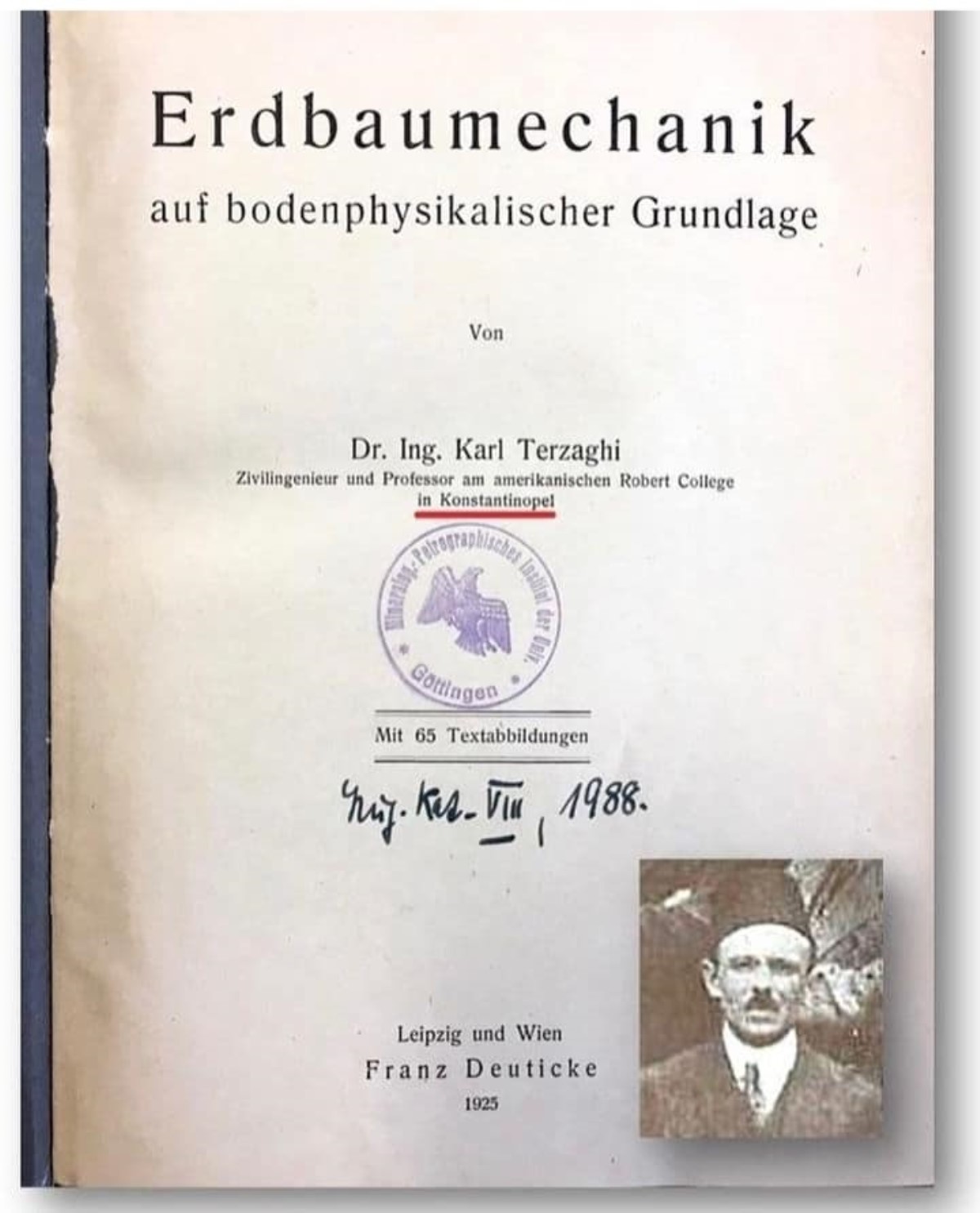
This publication opened the way to the USA for him. He received a teaching offer from the Massachusetts Institute of Technology (MIT). He had now become an elite engineering professor in the USA. He made his second marriage to Ruth Doggett of Harvard. He worked in Europe for a while during the rise of fascism in Germany and Italy. He had been invited to the platform construction of the great NSAIP rally held in Nuremberg (1936). He could not get along with the Nazis. He returned to his own homeland (Vienna) again. Here, Nazi sympathizers accused him of Bolshevism, and leftists accused him of being a Nazi collaborator.
In 1938, he returned to the USA once more. This time as a professor at Harvard. Towards the end of the Second World War (1943), he was accepted as a US citizen. In his life after this, he came to Turkey, which he said was his “second homeland,” many times. To ITU and Boğaziçi University. Honorary doctorates were given. International meetings were organized in his name. They gave his name to Soil Mechanics laboratories.
A HARVARD PROFESSOR IN THE ASWAN DAM CONSTRUCTION
After the 1952 Egyptian revolution, the Gamal Abdel Nasser administration wanted to send a strong message to the West. This would be to build a dam on the Nile: The Aswan Dam. This project was a challenge to 100 years of colonialism. The goal was to create a striking turning point in the thousands of years of Egyptian history.
The Free Officers turned to the Soviets to achieve this. They were already ready for such cooperation. At the head of the work, the Egyptian administration issued a call for scientific and technological support at the international level. Terzaghi was a professor at Harvard at that time. He also gladly joined the project’s board of consultants. He contributed from 1954 to 1959. But as can be predicted, the Aswan project was not just an engineering matter. The political aspect of the work was heavy. The Soviets did not want him on the board of consultants. Terzaghi had to leave the delegation.
MEMORIES OF HIM AT BOĞAZİÇİ
Today, if you enter Boğaziçi University from the Bebek Gate, as you walk upwards, just at the moment you feel tired, you will see a bench in the shade of the trees on the left. It is a stone bench on which Oxford historian Goldwin Smith’s famous quote “Above all nations is humanity” is engraved. It is known at the school as the Terzaghi bench. This is the place where he once sat for a long time and watched the Bosphorus. There is also a memorial corner that writes “In memory of the founder of soil mechanics, Karl von Terzaghi” in the place that Boğaziçi students call the “Lovers’ balcony”—just above Fikret’s Aşiyan.
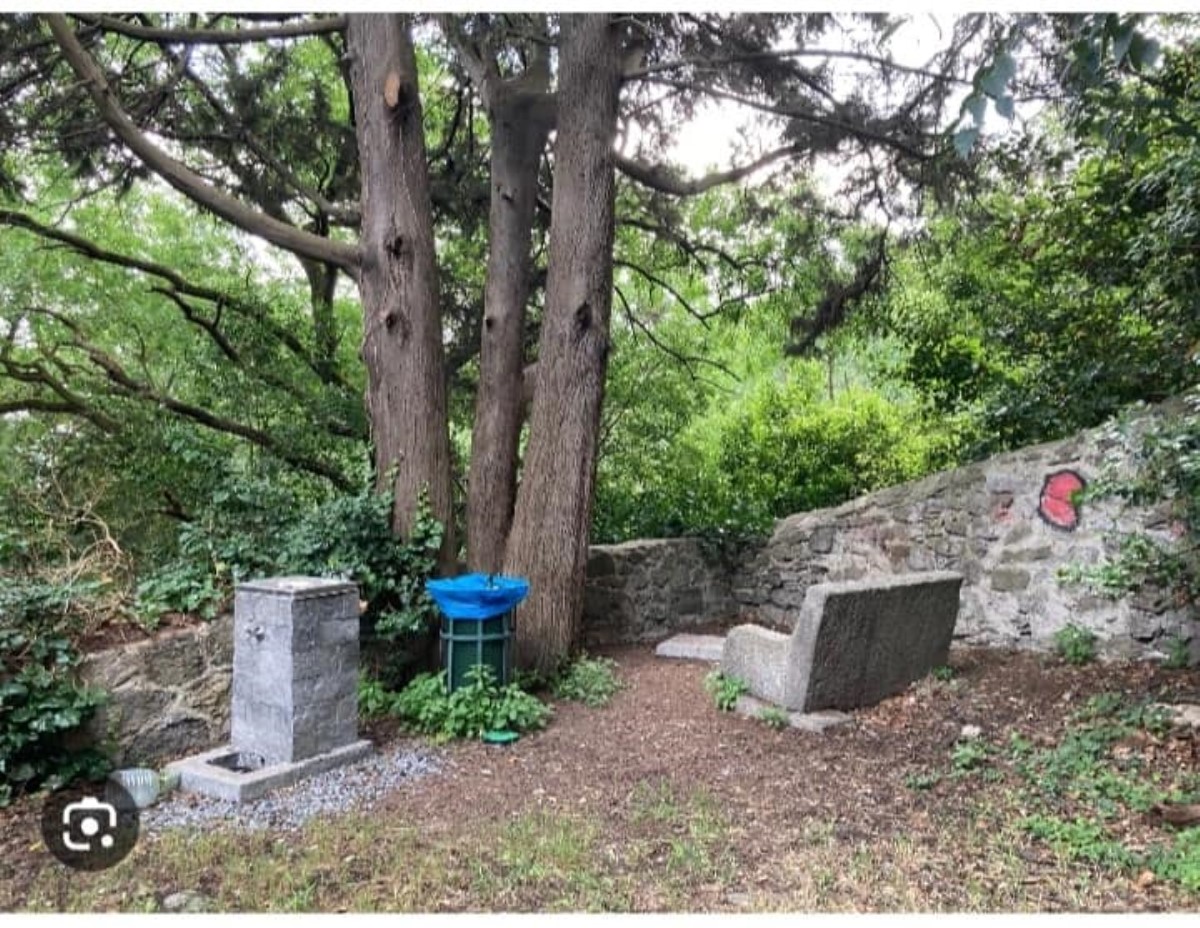
Terzaghi was an excellent student at the university. He was also extraordinarily successful in his academic life. In his youth, he had wanted to explore the poles like Amundsen. Astronomy, geometry, mathematics, physics, geography, and geology were his main areas of interest. In the 30s, right-wingers accused him of communism, and leftists accused him of being a Nazi sympathizer. At the end of the 50s, he was removed from the Aswan Dam project because he was an American citizen. Yet, he was a scientist who had dedicated himself to discovering the laws of nature, like Darwin, Humboldt, and others.
Would you like to get notifications about new developments and save news?
- NotificationsNew developments and breaking news
- SaveNews is stored in the app
Most Read
Statement from Nihat Zeybekci on the fund investigation
New 75,000-seat stadium plan for Fenerbahçe
Interpol and MIT tracking yields results in Izmir
ID convenience for KPSS candidates
2027 Budget: Taxes for the people, tax exemptions for capital
The reality of Akkuyu and the longing for national nuclear power
To whom and how was the Petition of Intellectuals submitted? Who accepted the petition?
The Çanakkale robbery -1- How was the Troy treasure smuggled out?
Artificial intelligence and the new imperialism

Ministry investigation into unauthorized promotional messages