


To whom and how was the Petition of Intellectuals submitted? Who accepted the petition?


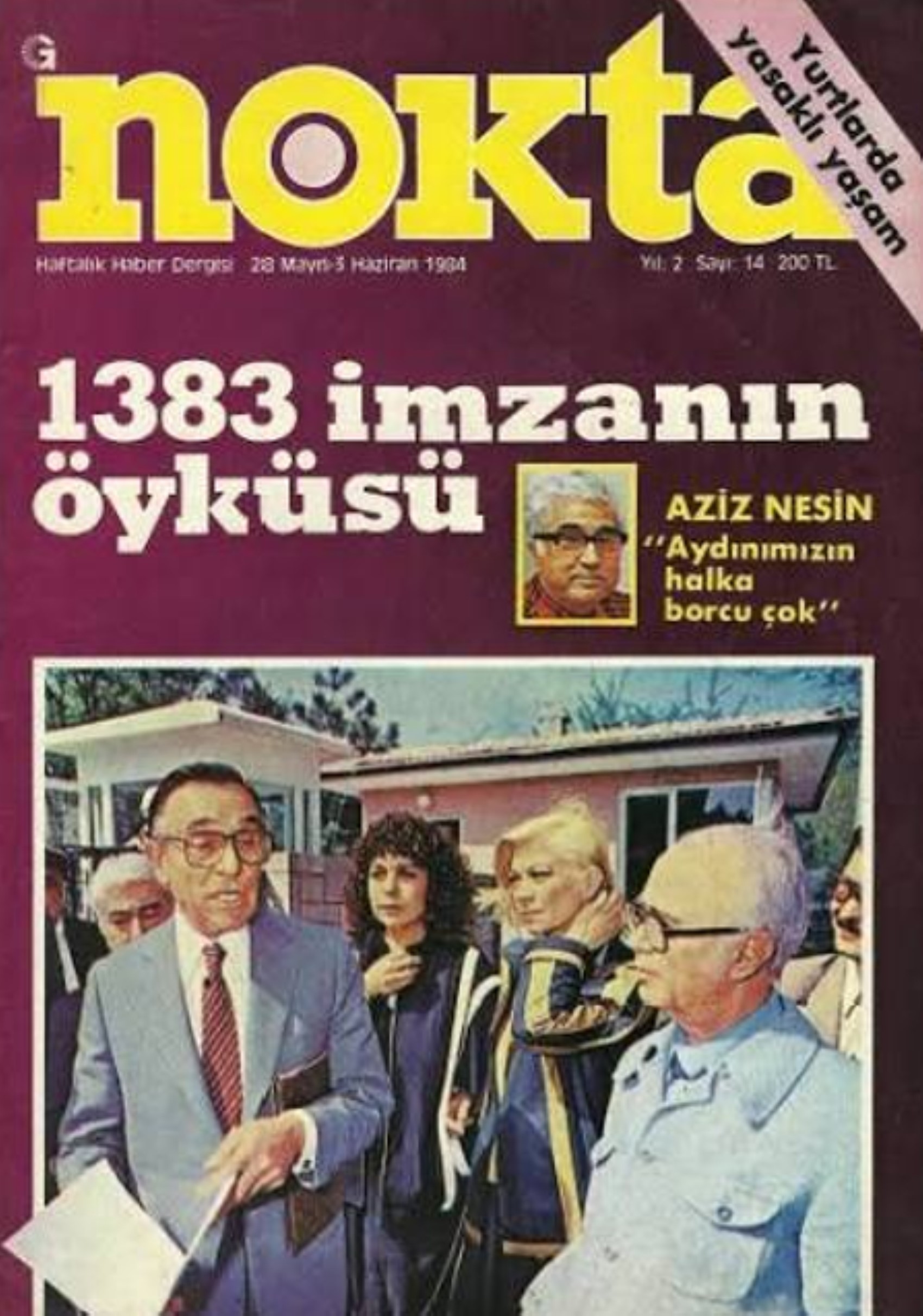
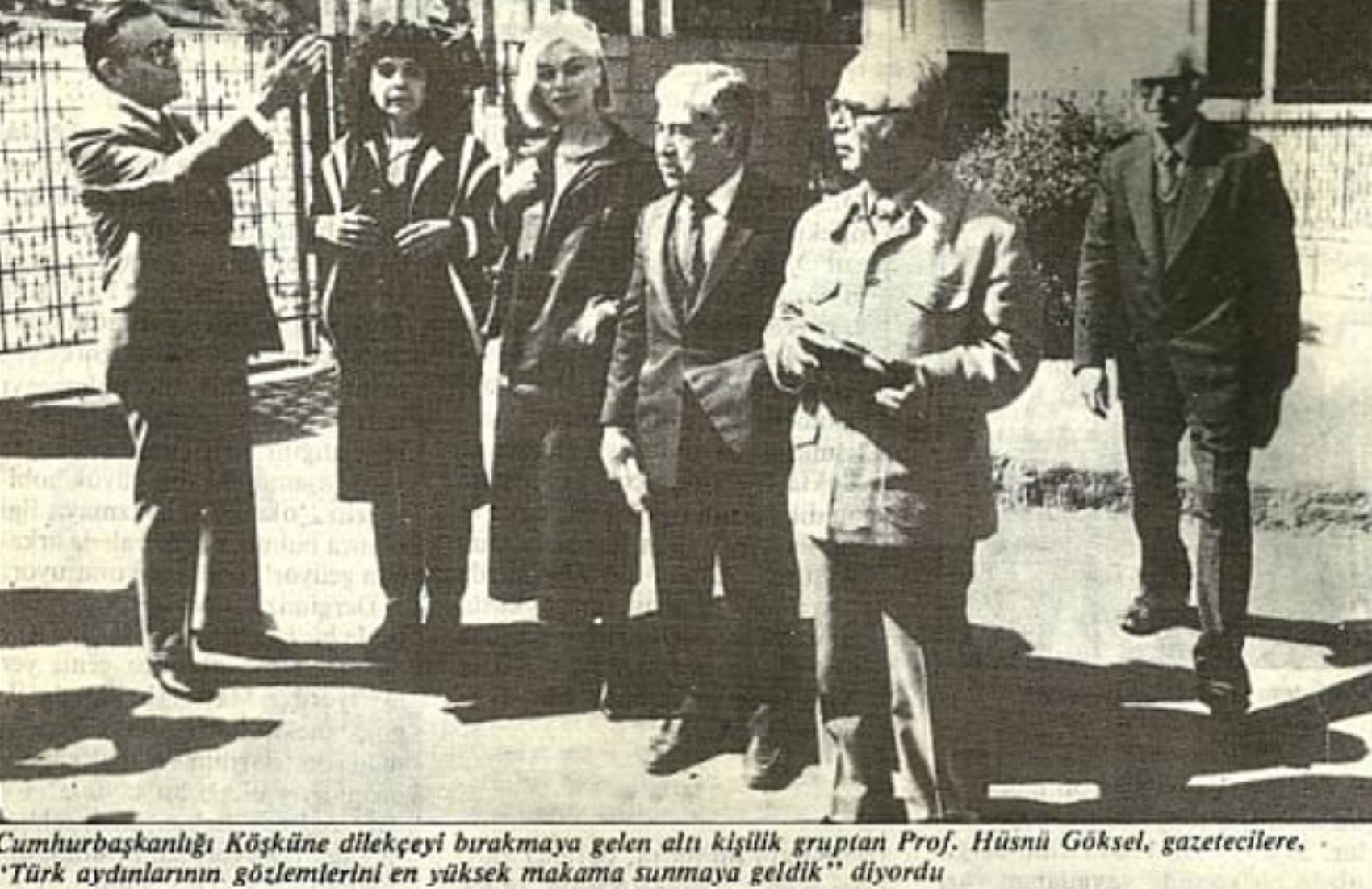
The Petition of Intellectuals was submitted on May 15, 1984. Kenan Evren did not accept the delegation that came to Çankaya representing the intellectuals who drafted the petition; the petition was received by an officer at the gate.
A copy of the petition was submitted to the Speaker of the Grand National Assembly of Turkey (TBMM), Necmettin Karaduman.
The petition was titled “Observations and Demands Regarding the Democratic Order in Turkey.”
The intellectuals who led the petition had the text and the signatories recorded at the Altındağ Notary Public to avoid any potential provocation. This was the correct approach.
The Petition of Intellectuals is one of the significant milestones in ending the September 12 regime.
WHAT WAS THE ESSENCE OF THE PETITION OF INTELLECTUALS?
In its essence, the petition demanded the removal of all restrictions placed on political rights by martial law. Despite the transition to a multi-party political life, the September 12 regime continued covertly through martial law commands. The petitioners wanted a genuine, unrestricted democratic political life.
The petition addressed the Speaker of the TBMM and demanded that the legislative assembly abolish the death penalty. It called for the removal of pressures on the press, which were restricted through martial law commands, and advocated for the true autonomy of TRT.
In Turkey, the radio and television broadcasting monopoly belonged to the state. This allowed the power holding the government to turn it into a propaganda tool.
Especially during the Nationalist Front governments, the most extreme examples of partisanship had been seen.
During the September 12 period, TRT was turned into the junta's propaganda apparatus.
The petitioning intellectuals demanded scientific, administrative, and financial autonomy for universities. They wanted university administrators at all levels to be elected rather than appointed. Meeting these demands was, of course, contrary to the “nature of things.” Turkey's order was not suitable for this.
One of the significant measures of the September 12 regime took place in the field of higher education. YÖK (Council of Higher Education) was established when Kenan Evren delegated the “task of fixing” higher education to Prof. Dr. İhsan Doğramacı. YÖK is the product of the government's desire to establish complete dominance over universities.
Previously, there were different higher education institutions affiliated with the Ministry of National Education, such as academies and teacher training institutes. With YÖK, all higher education institutions were brought under the university structure. The Higher Education Law No. 2547 was enacted (1981). With the 1982 Constitution, YÖK became a constitutional institution. Universities were placed under the full control (tutelage) of the executive branch.
The Council administration had envisioned the university as an institution directly affiliated with the junta. Rectors are appointed directly by the President. All decisions were linked directly or indirectly to the executive.
The appointment of rectors by the President began during Kenan Evren's presidency.
The system in which faculty members indirectly contributed to the appointment was adopted during the Demirel-İnönü coalition (1992).
After the July 15 coup attempt, this practice was abolished. With Decree-Law No. 676 issued under the State of Emergency, the practice of faculty members electing rector candidates was ended. With the transition to the Presidential Government System on July 9, 2018, the authority to appoint rectors was given directly and solely to the President.
A lot of water has flowed under the bridge since the YÖK law was passed. Eras have changed. Finally, the state with all its institutions fell into the hands of the AKP. University rectors also began to be appointed by the AKP government.
In this way, all universities were brought under the ideological and political hegemony of the AKP.
YÖK was established nearly half a century ago. All political parties complained about YÖK while in opposition. When in power, they tied the YÖK administration to themselves.
The “New Turkey order” that began after 2002 showed where this could lead. The university became the backyard of the government in every sense.
You can find the full text of the petition at the end of the article.
THE ATTITUDE OF THE “STATE CLASS” TOWARD THE COLLECTIVE PETITION
I attended university during the conditions of September 12 (1980-1984). The thing we were most intimidated by was a collective petition. Even two people applying to the administration at the same time/on the same subject was considered a dangerous initiative, and a political motive was sought behind it.
Years later, I remember Zafer Toprak saying, “I will never sign any collective petition.”
However, a petition is something that exists in our “Patrimonial State” tradition on one hand. On the other hand, it is one of the earliest rights of a constitutional state. Since the 1876 Kanun-ı Esasi (Basic Law), the petition has been an important right of the subject/citizen.
There are pictures of the Great Atatürk examining the petitions “presented” to him with seriousness. Because he is the head of state.
THE SEPTEMBER 12 REGIME AND THE EXECUTION OF DEATH PENALTIES
After September 12, 1980, one of the first things the Council administration did was to make regulations that further reinforced the martial law regime. Detention periods were gradually increased. Especially among leftist groups, there were those who were kept in detention under torture for months without being brought before a judge. The petition demanded that these practices be ended and that those responsible for treatment incompatible with human dignity be found immediately.
During the September 12 interim regime, 50 people were executed. This number includes sentences that had reached the TBMM Presidential Council years ago but were not implemented because they were not ratified in the general assembly. In this situation, there were 24 pending files. These sentences were executed.
Evren's expression, “Should we not hang them but feed them?”, was said regarding these convicts. To put it more clearly, 24 common criminals, whose sentences had been finalized years before September 12 but were waiting without being executed, were executed with a rapid approval process as a September 12 measure.
During this period, 17 left-wingers, 8 right-wingers, and 1 ASALA militant (Levon Ekmekçiyan) were executed. After the ANAP came to power, the ruling party also passed laws approving the execution of death penalties. The number of these executions is 4. The last death penalty executed took place in Burdur Closed Prison (October 25, 1984).
CONDITIONS FOR THE TRANSITION TO FORMAL DEMOCRACY
The National Security Council administration took the country to the 1982 referendum under conditions it determined itself. The voting was held under anti-democratic conditions. There is no doubt about this. The only freedom applied to the promotion rallies for the constitution by the President and NSC Chairman Kenan Evren. It was free to watch Evren's rallies.
These meetings were called “Promotion on behalf of the State.” An NSC decision had even been issued regarding this. The rate of acceptance of the constitution shows the conditions under which it was voted on.
As a result of the referendum, Kenan Evren moved from the office of Head of State to the office of President. He continued to hold the titles of NSC Chairman and Chief of General Staff. Until the November 6, 1983 elections, his titles other than the presidency were gradually removed.
The decision that allowed the political life, which was banned after the September 12, 1980 coup, to restart and new political parties to be established is the National Security Council (NSC) decision dated April 24, 1983, and numbered 76.
However, party-building activities were carried out in an uneasy environment, like the activity of forming an association. The NSC had its eyes on the newly formed parties. Evren was behaving like a parent who was not satisfied with their child's report card grades. He was even uncomfortable with the number of new parties. 2-3 parties were enough. More were harmful. He was also harshly criticizing the party names. He was almost in the mood of a general scolding the troops lined up in the “Brigade Assembly Area.”
However, despite the political bans in the constitution and the excessive restrictions in the political parties and election laws, politics would naturally find a flow bed for itself.
With the closure of the Great Turkey Party and the vetoing of political party founders, the NSC's comfort zone began to narrow.
With the formation of the TBMM Presidential Council, the other members of the NSC gained the title of Presidential Council member.
Özal's ANAP winning the elections was in line with the interim regime's projection. As predicted, a single-party government had emerged from the ballot box. This result was a consequence of marketing Özal, the man of the comprador bourgeoisie, as a civilian option against the military dictatorship. This attitude was even adopted by *Yeni Gündem*. Özal was being consecrated as the founder of Turkish liberalism.
WHAT WAS THE POLITICAL ENVIRONMENT LIKE BEFORE THE PETITION?
Despite the transition to a constitutional order, Kenan Evren, who had become accustomed to the comfort of the long years of the closed regime, had difficulty retreating to the borders of Çankaya with the powers shown in the constitution. He missed the “comfort of educating” the public with square speeches.
The local government elections held in the spring of 1984 consolidated the ANAP government.
Although the TBMM was the supreme organ where national sovereignty was manifested, Özal's ANAP was content to govern the country in the shadow of the former junta.
Political bans and the fact that martial law commanders continued their habits of restricting fundamental rights and freedoms provided the ease of governing a depoliticized society with policies that coincided with the interests of the capital class.
The Peace Association Case and the DISK Case were continuing. Most of the defendants were still in custody.
The requirements of a democratic social order did not enter Özal's area of interest.
He had little interest other than the privatization of education and health and the complete marketization of production relations.
The first action Özal took as soon as he came to power was to pass the Metropolitan Municipalities Law. I think it is a very meaningful step, actually. Through this law, it would be possible to make interventions on urban rent that did not exist in the past. And it happened.
ANAP was interested in issues such as the money/credit market and the cheapening of the labor market.
It would be correct to say that Özal did not have a positive thought regarding the social state. He believed in the well-known principle of liberal economics that the “invisible hand” (the market) would set everything right.
The ruling party wanted to maximize its benefit by positioning itself behind Kenan Evren in the new political order. Özal built his strategy accordingly.
ÖZAL POSITIONING HIMSELF BEHIND EVREN AFTER THE PETITION
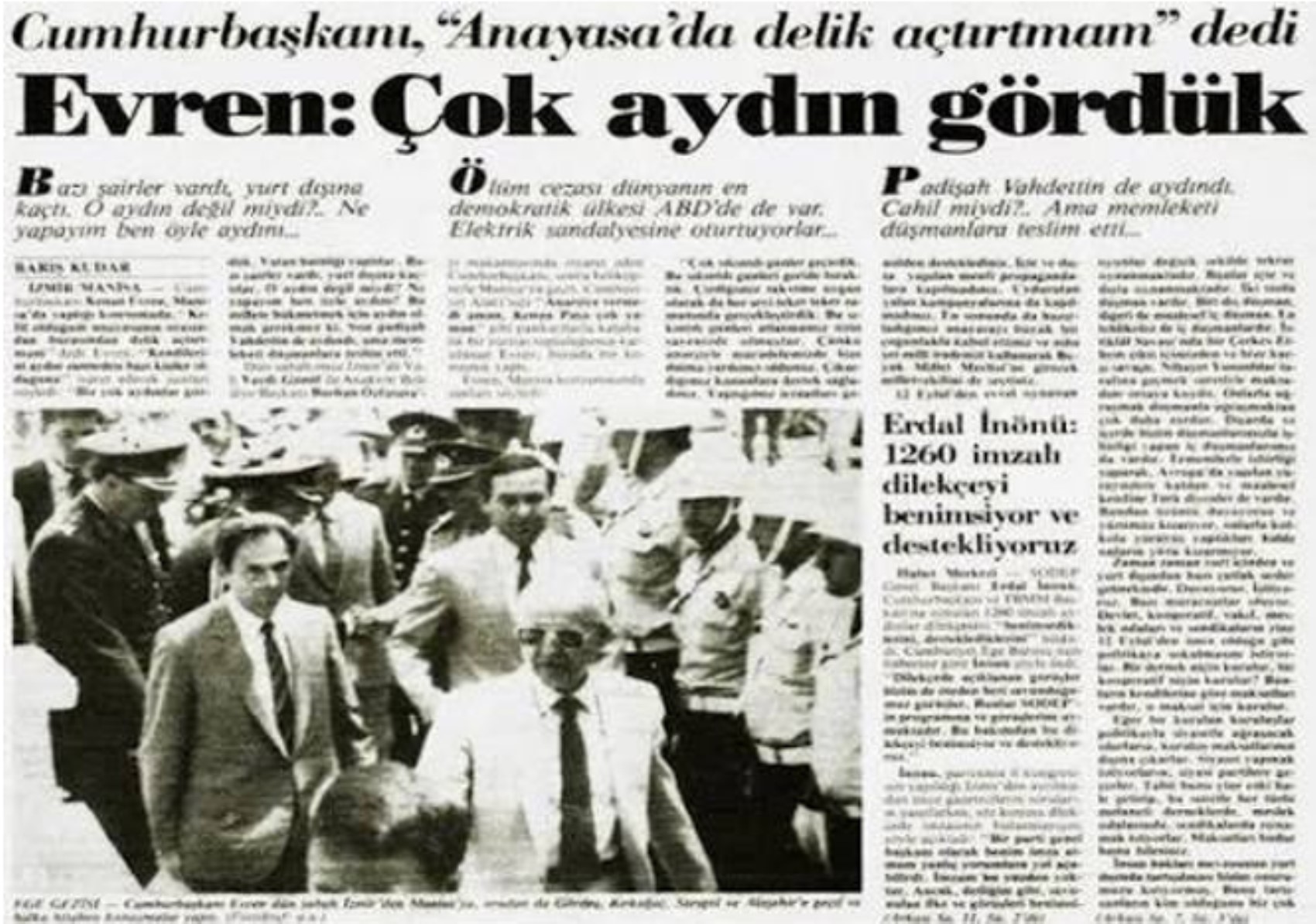
When I read the petition carefully—again after 42 years—I found it completely justified. The prime minister of the period, Özal, and the president, Evren, did not start a discussion about the content of the petition. Evren pulled the issue to the level of treason. He compared the petitioners to Vahdettin.
The two most important people at the head of the country's administration did not appear to be concerned with the views and criticisms put forward in the petition.
Özal stated that he saw the submission of the petition as an important stage in democracy. In other words, he brushed it off with sophistry.
Evren, on the other hand, saw his own area of power as the addressee of the petition. He targeted 1,383 citizens who used the right to petition, which is a requirement of the constitutional order. The real reason for the case being opened was—definitely—Evren's narrow-minded militaristic attitude.
The September 12 shadow over the regime continued until the DYP group protested Evren by not standing up when he entered the general assembly at the 1987 TBMM opening session.
THE OPENING OF THE CASE AT THE ANKARA MARTIAL LAW COMMAND NO. 1 COURT
Upon Evren accusing the petitioners who used their citizenship rights of “treason” in his angry square speeches, the Martial Law Prosecutor's Office took action and launched an investigation.
The petition and signature lists recorded at the Altındağ 1st Notary Public were seized. The petition, signed by 1,383 of our distinguished citizens and expressing the shortcomings of Turkish democracy, was almost going to be considered “evidence of a serious crime.”
The military prosecutor's office, which was surely aware that submitting a petition (individually or collectively) could not be a crime, interpreted the act of submitting a jointly written text as a petition to the highest authorities of the state as distributing a leaflet. According to the martial law prosecutor, the petitioners had committed the act of distributing leaflets contrary to the communiqués of the Martial Law Command.
The criminals (!) had committed an act contrary to martial law prohibitions and Law No. 2969 by submitting a petition. The prosecutor's office interrogated the signatories.
As a result, a case was opened against the “ringleaders of the act of distributing leaflets disguised as submitting a petition” (59 people).
The requested penalty was imprisonment from 3 months to 1 year.
WHO WAS THE CASE OPENED AGAINST?
It is said that the number of people who signed the petition in various places was 1,383. There are also statements showing the number above this.
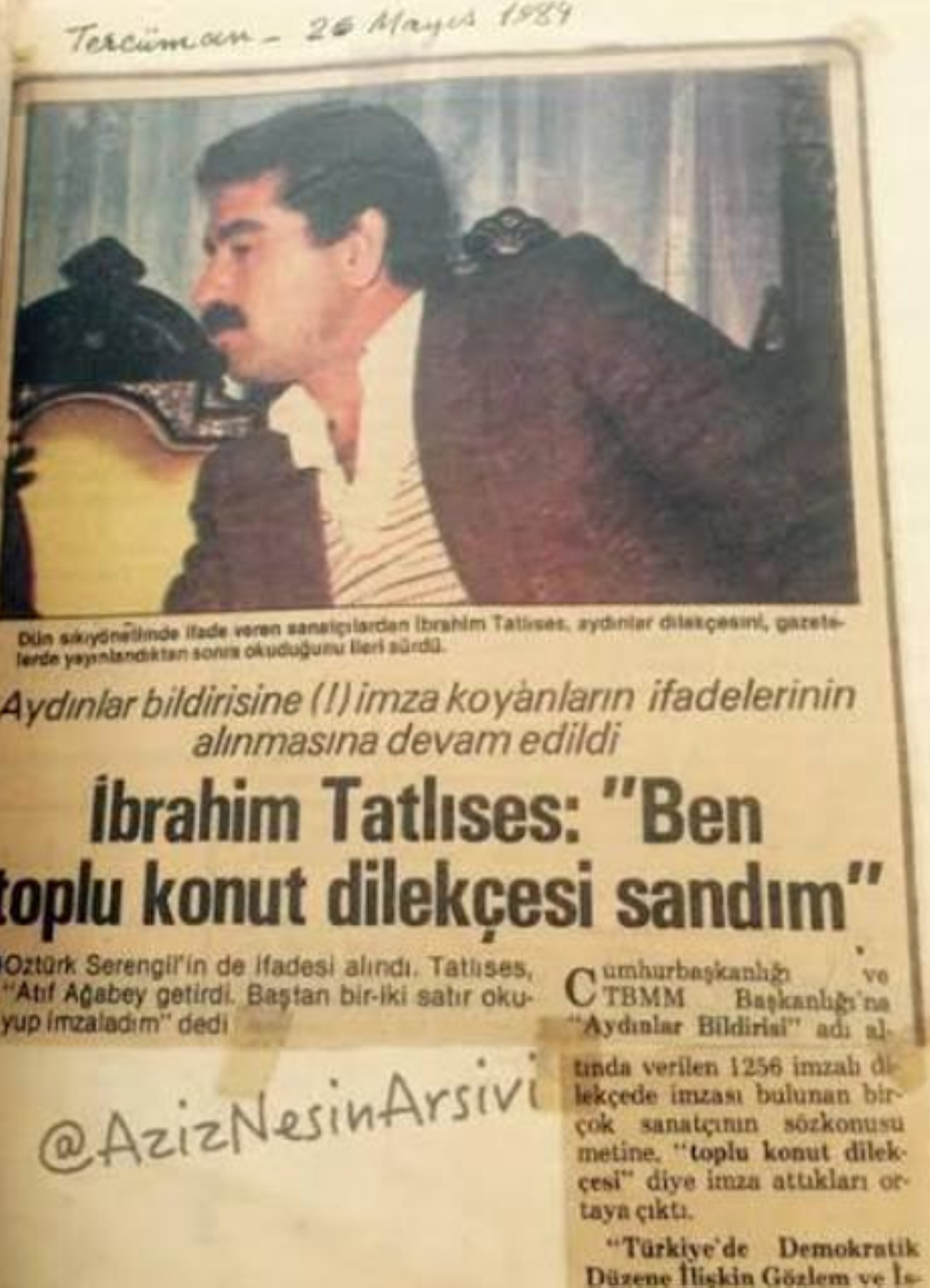
As a result, the Martial Law Prosecutor's Office interrogated over a thousand intellectuals, faculty members, journalists, lawyers, and artists. There were those among the theater, cinema, and performing artists who withdrew their signatures.
Who withdrew with what thoughts and motives could also be the subject of another article. On this occasion, it was seen how intimidated people could be put into a humiliating situation.
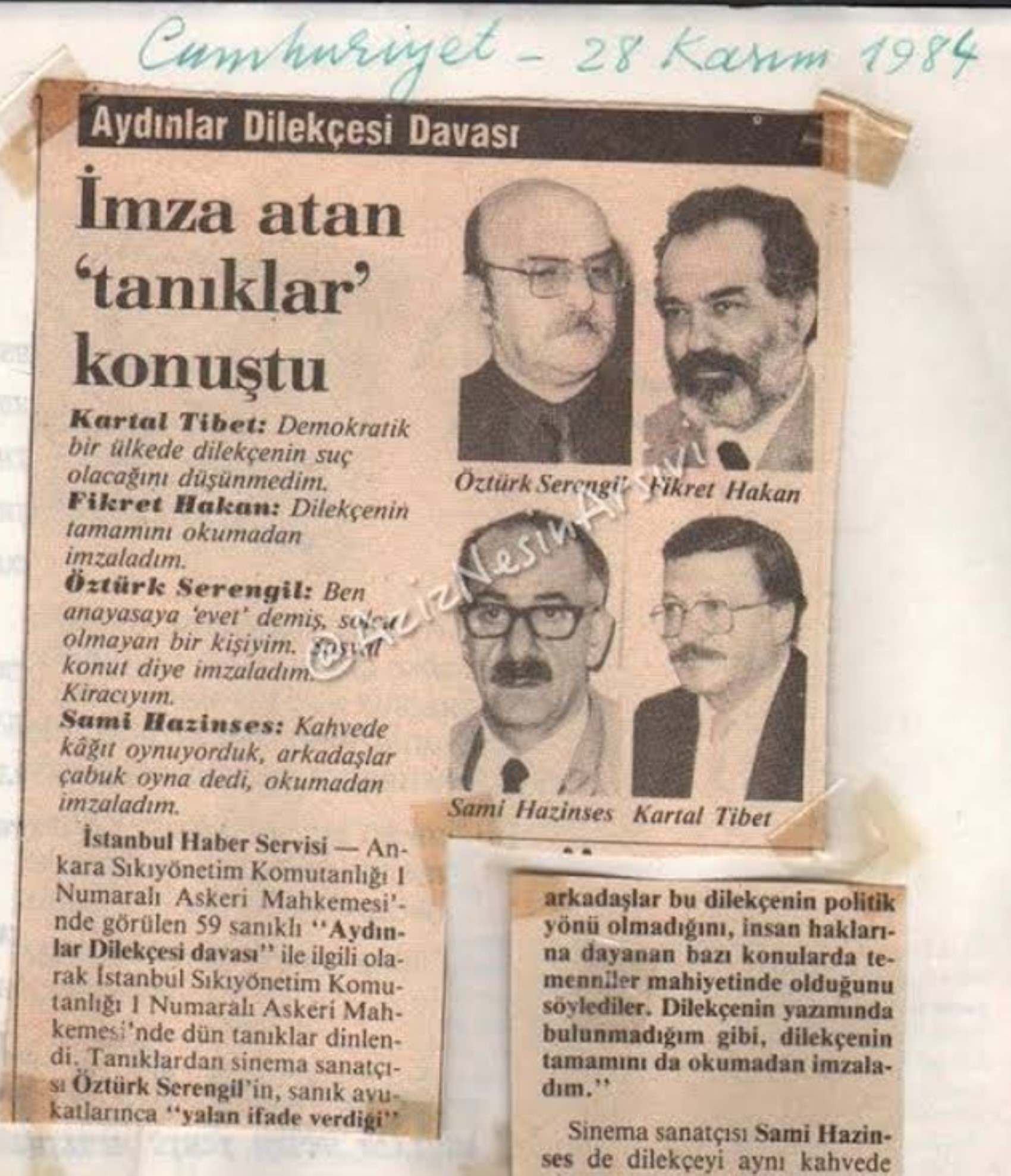
The common identity of the 59 people against whom the prosecutor's office opened a case is that they were people with secular, leftist tendencies. The list of people against whom the case was opened is available in the links. Some of the people targeted by Evren were writers for the *Cumhuriyet* newspaper (such as Uğur Mumcu, Ali Sirmen, İlhan Selçuk, Erbil Tuşalp).
Evren was particularly furious at Uğur Mumcu's writings. The journalist Uğur Mumcu was the one he accused of “treason” in his square speeches during the referendum phase of the Constitution.
The late Uğur Mumcu suffered the wrath of the military regime on September 12, just as he did on March 12.
Ali Sirmen was a defendant in the Peace Association Case. He remained in custody for 3 years in this case.
The Martial Law Prosecutor's Office targeted the intellectual mind and organizers behind the petition. The thinkers who wrote the petition were treated as an illegal organization that had come together to commit a crime.
According to Evren, the primary perpetrator of the act was Aziz Nesin.
The state-oriented segment has been uncomfortable with what he wrote and said in every era. (CHP, DP, May 27, AP, March 12, September 12 and after are well known).
Starting with Aziz Nesin and Uğur Mumcu, they directed a move that exposed the current government's (regime's) formal democracy game to the people at the very top of the regime.
The citizens had used their constitutional rights. For this reason, the case should have been dismissed. The act that the prosecution accused of being a crime had no equivalent in the world of law.
If the court had punished them by considering the petition as a leaflet against martial law prohibitions, this decision would have meant that democracy stumbled during the stage of its re-establishment.
The Ankara Martial Law No. 1 Military Court decided on February 7, 1986, to acquit all defendants on the grounds that the material and moral elements of the crime were absent.
From that date on, Kenan Evren, who sat in the presidential office, had to gradually retreat.
INFORMATION ABOUT THE DEFENDANTS' DEFENSES
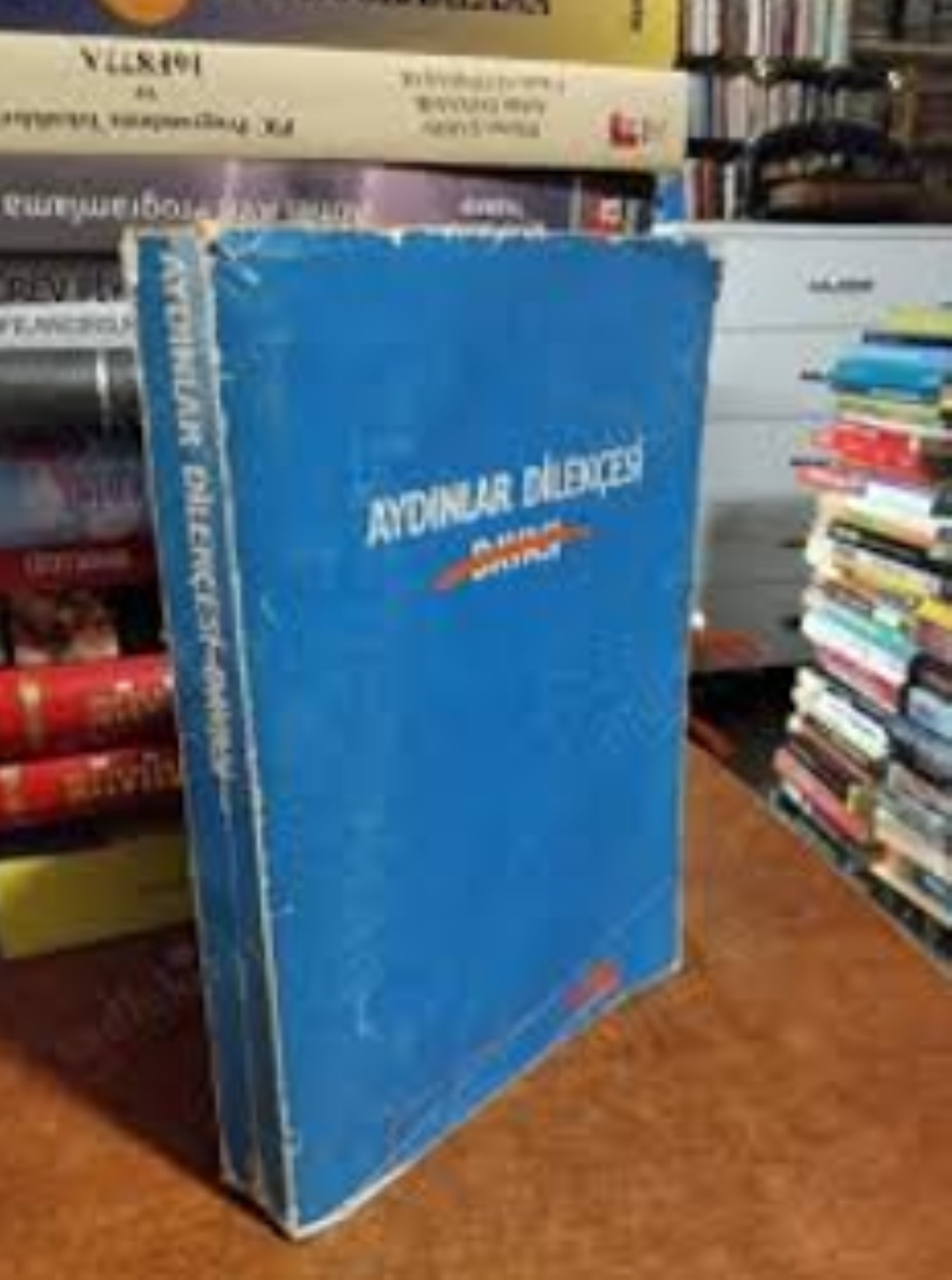
The defendants' defenses are collectively available in the *Petition of Intellectuals* case book. The book was published by Adam Yayınları in 1986 after the historic case resulted in an acquittal.
In the work compiled as a collective effort (Board of Writers), the forewords of Aziz Nesin, Hüsnü Göksel, and Haluk Gerger are included.
This book contains the full text of the indictment of the case heard in the Ankara Martial Law Court between 1984-1986, the interrogations of the defendants, the hearing minutes, the defenses, and the reasoned acquittal decision.
However, initially, since the martial law authorities banned the printing and publication of the defenses, the first edition was carried out by Info-Türk (abroad).
I did not have time to read all the defenses before writing this article. I found the defenses of names like Aziz Nesin, Uğur Mumcu, İlhan Tekeli, and Halit Çelenk. I read them.
Aziz Nesin's defense is a democracy manifesto that puts September 12 in the defendant's chair. It is a magnificent text. I read it with pleasure. Please read it too. You can find Aziz Nesin's defense text at the end of the article.
Uğur Mumcu's defense is available in the um:ag publications archive. It is also possible to reach the defenses of İlhan Tekeli and Halit Çelenk.
THE BLOCKED OPPOSITION ENTERING THE ASSEMBLY THROUGH “HÜLLE” (LOOPHOLES)
Two important developments in this process are: the MDP dissolving its own legal personality, and the Populist Party merging with SODEP into the SHP legal personality. Political parties found quite successful formulas to “bypass” Article 84.
The real opposition parties that were left out of the TBMM in the 1983 elections entered the assembly through indirect ways. DYP, SHP, and DSP formed groups in the Assembly. This result was achieved with “legal loopholes” applied against Article 84 of the Constitution.
DEMİREL'S RE-EMERGENCE AND THE BY-ELECTION
Taking advantage of the dissolution of the MDP, the DYP formed a group in the summer of 1986. It became the second party in the by-election held in the autumn (September 28, 1986). This was an important political indicator.
Politicians who had remained outside the assembly (not banned) entered the TBMM. Names like Süleyman Demirel's trusted men Hüsamettin Cindoruk and Köksal Toptan, and Sümer Oral were now in the assembly.
Thus, 3 years after the vetoed/banned elections, and a few years after the release of the defendants of the Peace Association Case, “The party of the one who knows” took its place in the TBMM under the chairmanship of Hüsamettin Cindoruk.
On the left, the SHP, which was formed at the Merger Congress on November 3, 1985, brought Erdal İnönü to the chairmanship in 1986. SHP Chairman İnönü entered the TBMM in the by-election like the chairman of the DYP.
Thus, the order established by Evren had almost come to the brink of collapse (in the autumn of 1986).
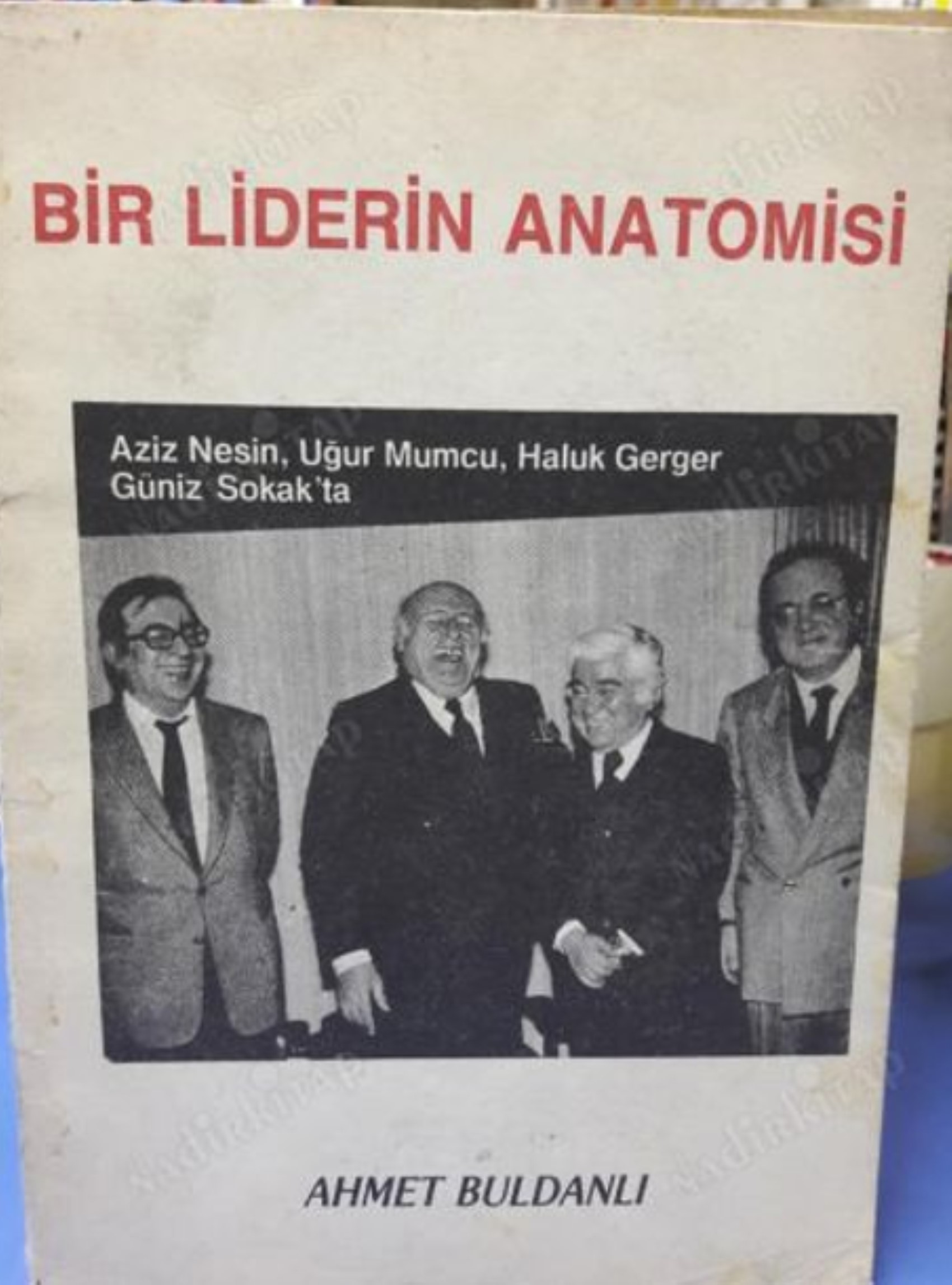
After the DYP entered the Assembly, the biggest move was the surprise visits of the pioneers of the Petition of Intellectuals, Aziz Nesin and Uğur Mumcu, to the banned former prime minister Süleyman Demirel at his home on Güniz Street at the beginning of 1987 (January).
The pose they gave together showed that the September 12 regime, represented in the identity of Kenan Evren, had no allies left other than Özal.
With this result, all parameters of politics had completely changed.
For this reason, the Petition of Intellectuals served a very important function in overcoming the interim regime wall. From 1987 onwards, the psychological superiority passed to the opposition.
WHAT IS THE POLITICAL RESULT OF THE PETITION?
The developments that started with the Petition of Intellectuals triggered each other and brought our country to the 1987 referendum.
Full text of the petition
https://yurtsever.org.tr/2021/15-mayis-1984-aydinlar-dilekcesi-kenan-evrene-verildi-3-438718/
Full text of Aziz Nesin's defense
https://www.hukukpolitik.com.tr/2018/01/11/aziz-nesin-aydinlar-dilekcesi-savunmasi/
Would you like to get notifications about new developments and save news?
- NotificationsNew developments and breaking news
- SaveNews is stored in the app
Most Read
Statement from Nihat Zeybekci on the fund investigation

New 75,000-seat stadium plan for Fenerbahçe

Price announced for the Togg T10F 4More Kehribar design package
Fistfight at the Istanbul Bar Association elections!

ID convenience for KPSS candidates

2027 Budget: Taxes for the people, tax exemptions for capital

To whom and how was the Petition of Intellectuals submitted? Who accepted the petition?

Sinem Fıstıkoğlu, who left Halk TV, announces her new destination

The reality of Akkuyu and the longing for national nuclear power

Beşiktaş condemns Serdar Ali Çelikler over remarks about Italiano