


Atatürk's Ambassadors to Prague



WHO IS COVERED IN THIS ARTICLE?
In this article, I will not be discussing Ahmet Cevat Bey, Şefkati Nuri Bey, Hasan Basri Menteş, or Celal Osman Abacıoğlu, who served as envoys or ambassadors in Prague during the Atatürk era. Instead, I will examine the Prague ambassadorships of Vasıf Çınar, Cevat Açıkalın, and Yakup Kadri Karaosmanoğlu, who hold special significance in the history of our revolution.
A NEW STATE: CZECHOSLOVAKIA
Czechoslovakia is a state established after the First World War. The Principality of Bohemia, which had been under the sovereignty of the dual monarchy (the Austro-Hungarian Empire) since 1867, became one of the new states formed following the collapse of the empire.
Czechs and Slovaks united to form a new state. With the onset of the armistice, the Austro-Hungarian Empire had reigned from 1867 to 1918. As the successor to the Holy Roman Empire, Austria declared a republic on November 12, and Hungary did the same on November 16.
Czechoslovakia was founded on October 28, 1918, with the declaration of independence by the Czechoslovak National Council in Prague. Prague, the center of historic Bohemia, was declared the capital of the new state. Following the collapse of the Soviet system, the Czechs and Slovaks separated peacefully in 1992.
ESTABLISHMENT OF DIPLOMATIC RELATIONS BETWEEN TURKEY AND CZECHOSLOVAKIA
Diplomatic relations between the two countries were established with the treaty signed in Ankara on October 11, 1924, between Turkey and the Czechoslovak Republic. The relationship was initially at the legation level. Our first envoy, Vasıf Çınar, began his duties on August 20, 1925.
VASIF ÇINAR'S DIPLOMACY AND HIS PLACE IN OUR REVOLUTIONARY HISTORY
Vasıf Çınar was Atatürk's Minister of Education and a very close friend of Mustafa Necati. During the initial phase of our national war of liberation, they published the newspaper 'İzmir'e Doğru' (Towards İzmir) together in Balıkesir. In 1923, Vasıf Çınar was elected as a deputy for Saruhan to the 2nd Grand National Assembly of Turkey. He was the architect and first implementer of the Law on Unification of Education (Tevhidi Tedrisat), which was a turning point for secular education.
A summary of his diplomatic life is as follows: Vasıf Çınar represented Turkey in Prague from June 16, 1925, to December 11, 1927. After serving as an ambassador in Budapest between 1927 and 1928, he was appointed to Moscow. Upon the death of Mustafa Necati, he was brought back to the Ministry of Education on January 1, 1929. He served as ambassador in Rome from 1932 to 1934. On July 16, 1934, he became the ambassador to Moscow. He passed away while in office on June 2, 1935.
Latife Hanım'S SANATORIUM TREATMENT IN EUROPE AND VASIF ÇINAR
The marriage between the Gazi and Uşşakizade Latife Hanım did not last long. After the divorce, Latife Hanım retreated into a deep silence that would last until the end of her life. Her personal papers and the memoirs she wrote were donated by her family to the Turkish Historical Society. Access to them was delayed for some time due to private matters, following a report by the expert Ord. Prof. Reşat Kaynar. Here, we will discuss something else: Latife contracting tuberculosis and her decision to go to Europe for treatment following persistent advice. Strangely enough, Fikriye Hanım, who committed suicide after being coldly received at Çankaya, had also been sent to Europe for tuberculosis treatment. In other words, both had contracted tuberculosis.
Tuberculosis was very common in those years. İsmet Paşa, for example, had his house in Heybeliada purchased due to his own struggle with the disease. Treatment options were limited in those years: good nutrition and fresh air. Penicillin and streptomycin had not yet been discovered. Receiving good treatment meant being treated in a sanatorium in Europe at that time. For instance, Yakup Kadri received treatment in Europe for two years.
Once it was finalized that Latife would go to Europe for sanatorium treatment, she was issued a passport under a different identity. The Council of Ministers' decision was as follows: "A Council of Ministers decision regarding the issuance of a diplomatic passport (red passport) under the name Fatma Sadık to Uşşakizade Latife Hanımefendi, who will travel to Europe for treatment, and the inclusion of her nurse, Hasibe Ahmet Hanım, in the passport." Let us recall that the Gazi's relationship with Latife Hanım ended with a letter dated August 5, 1925. In his letter, the Gazi stated, "I have found it appropriate to set you free and have divorced you." This means "I have divorced you."
There was correspondence between Latife Hanım and Prague Ambassador Vasıf Çınar during her sanatorium treatment process. The first of these letters is dated December 10, 1926. The letters indicate that they had a sincere relationship. The sentences and the words chosen by Latife Hanım in the letters show that she had received a serious education. She tells Vasıf Bey, "I will remain incognito," meaning her identity would remain hidden.
Latife first checks into the Bristol Hotel in Vienna. She meets with doctors. She frequently uses the term 'professors.' It is understood that, following their recommendations, she received treatment in several places (countries) depending on the season. One of these was the Sanatorium Palace Tatra in the Carpathians. It is also understood from the correspondence that they were in contact by phone.
In the spring of 1927 (March and April), she is set to go to a place called Merano in Italy upon the doctors' advice. Throughout all these medical trips, she is constantly in contact with the ambassador to Prague, Vasıf Çınar. Perhaps the ambassador had even been specifically tasked with looking after Latife. The frequent communication throughout her treatment is evidence of this.
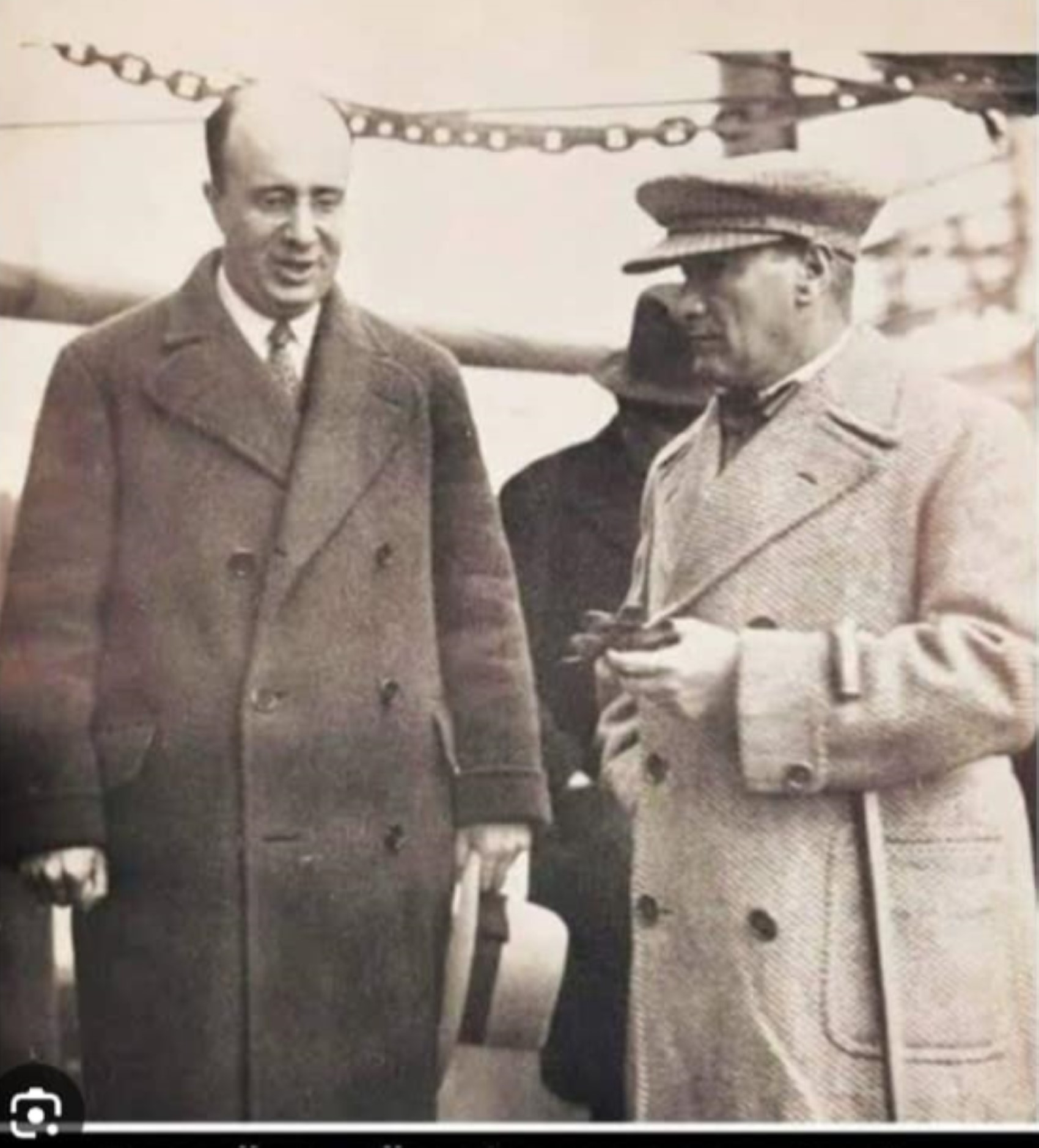
(Ambassador Vasıf Çınar with Atatürk)
THE SOVIETS BRING VASIF ÇINAR'S BODY BACK WITH A CEREMONY
It is truly saddening that Vasıf Çınar passed away at such a young age, just like his friend Mustafa Necati. The point that seems strange to me is this: there were many deaths in the 30s involving abdominal symptoms. The Ambassador to Berlin, Kemalettin Sami Pasha, died on the operating table during stomach surgery in Berlin. Mustafa Necati died of acute appendicitis, and Frunze died during an appendectomy. Trotsky's son, Leon Sedov, also died of appendicitis in Paris. Similarly, it is interesting that Vasıf Çınar passed away in Moscow due to a bowel obstruction. I am not writing this to imply anything. But it seems strange to me that the Turkish Ambassador could not be saved in the Soviet capital in 1935.
The Russians brought our ambassador back to Turkey with a grand ceremony. Stalin placed special importance on the transfer. Magnificent ceremonies were held in Moscow and Sevastopol. I compare the return and burial of Vasıf Çınar, brought via the Moscow-Sevastopol-Istanbul-Ankara route, to the return of our Washington ambassador, Münir Ertegün, who died in the US during the war in 1946 and was brought back on the battleship USS Missouri to be buried in Arlington Cemetery. In both cases, there was a gesture toward Turkey.
The Russians, led by Kalinin, Voroshilov, and Litvinov, conveyed their sorrow and condolences to the Turkish government. After the magnificent ceremonies, the body was brought to Sevastopol by train. It was sent to Turkey on the cruiser Chervona Ukraina. A squadron of aircraft escorted the cruiser carrying Vasıf Çınar.
The Chervona Ukraina was met at the entrance of the Bosphorus by the battleship Kocatepe. The body was received at the Tophane pier. On the same day, it was taken to Ankara by train from Haydarpaşa. A ceremony that would leave a mark in memories was also held in Ankara. Foreign Minister Tevfik Rüştü Aras delivered a poignant speech. Vasıf Çınar was laid to rest in Cebeci.
In his book titled *Our Diplomats*, Bilal Şimşir wrote the following about him: "He was an Ankara revolutionary, a child of the revolution." Falih Rıfkı says: "Discovering young talent and cultivating new men was among Atatürk's interests. Vasıf Bey was one of the young men discovered. He became a minister at 28 and an ambassador at 29. He passed away from this world at 39. He was a fiery Turkish revolutionary who could not be contained. Vasıf Çınar's first post as Atatürk's ambassador was Prague."
CEVAT AÇIKALIN'S AMBASSADORSHIP AND OTHER DUTIES
Among the ambassadors to Prague during the Atatürk era, Cevat Açıkalın is an important figure. Açıkalın is one of the brightest faces of the Republican foreign service. Açıkalın, who lost his life in Sapanca as a result of an unfortunate accident in the 70s, was the son of Cevat Bey, the last Chief Secretary to Sultan Abdulhamid II. After graduating from the Mekteb-i Sultani, he studied law in Geneva. Immediately upon graduation, he was assigned to the Republican foreign service. He participated in the Lausanne Peace Negotiations as a clerk. In the delegation, he worked on commissions related to financial issues alongside Hasan Saka, Münir Ertegün, and Yusuf Hikmet Bayur. The Lausanne Conference was Açıkalın's first diplomatic experience at a young age (born in 1901).
His first ambassadorship was in Warsaw (1924). He married Rukiye Celalet Hanım, the sister of Latife Hanım. He was sent to the court of Amanullah Khan (Kabul) with the duty of legal advisor. He stayed in Afghanistan for two years. He held diplomatic posts in Belgrade and Tehran. He was appointed to Prague in 1929.
Açıkalın is a diplomat who lives up to his surname (Açıkalın means 'open-minded' or 'clear-browed'). Throughout his life, his guiding principle in duty was an honorable, transparent, and realistic stance.
An important negotiation he took part in was the Montreux Convention Regarding the Regime of the Straits. He served as the secretary-general of the Turkish delegation. With his knowledge of international law and strong negotiating skills, Açıkalın played a significant role in the acceptance of the Turkish thesis at Montreux.
Another major mission of Açıkalın was to oversee the annexation of Hatay to Turkey following negotiations between the Turkish and French governments. As is known, Hatay had a status similar to that of Lebanon under the French mandate.
While changes were being made to the status of Syria and Lebanon, Turkey requested the same regime from the French government for Hatay as well. The request was accepted.
An important factor here was the winds of war intensifying in Europe. Since the Treaty of Lausanne, Turkey had taken care to be a country that acted in sincere accordance with international law.
Due to France's policy of establishing good relations with Turkey—and also out of a necessity to focus on European politics—Hatay was granted the status of an autonomous state. Cevat Açıkalın played a very important role in the process leading up to the decision by the Hatay Autonomous State Assembly to join Turkey.
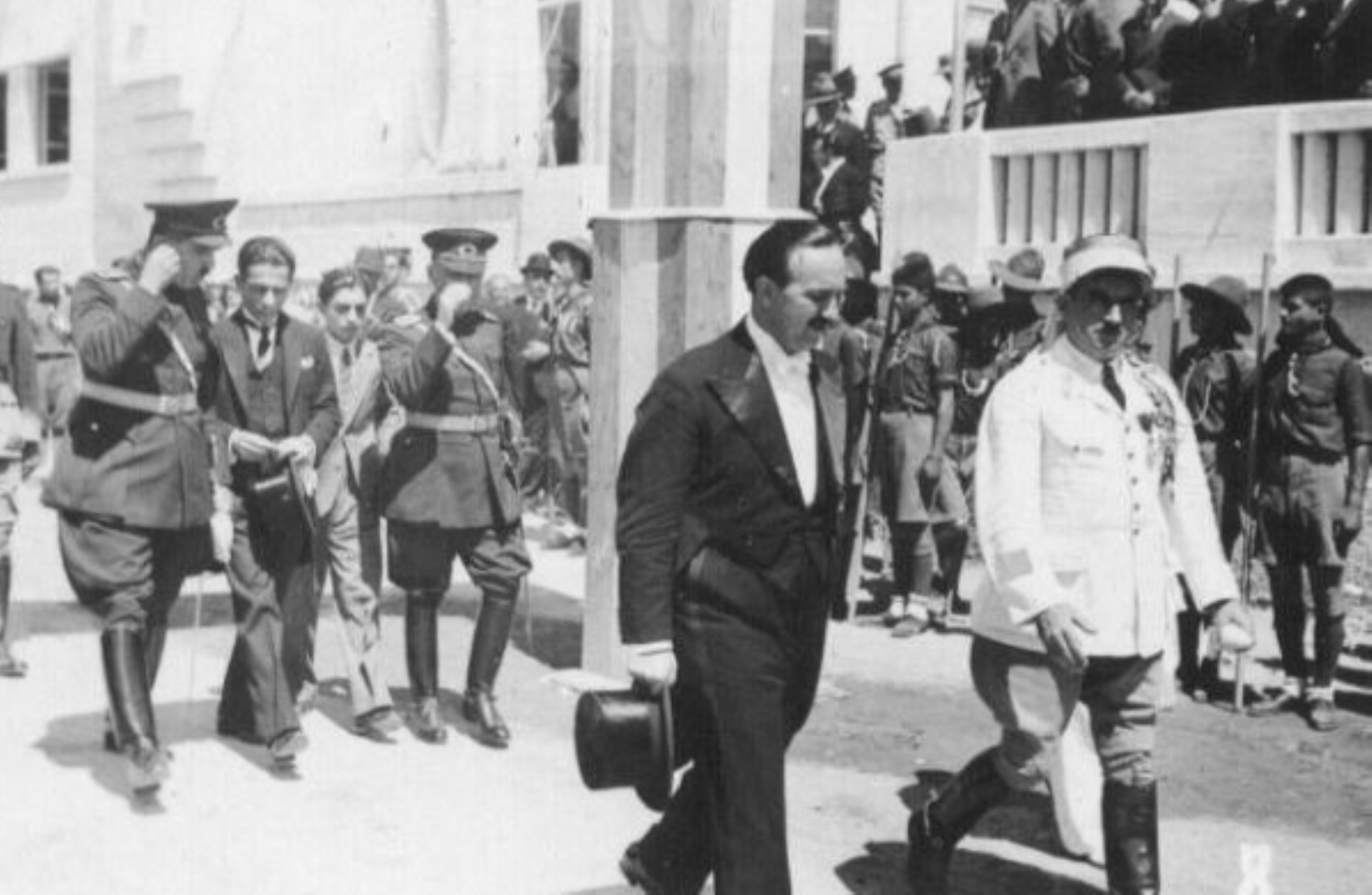
(Ambassador Cevat Açıkalın with French representative Colonel Collet in Antakya)
Açıkalın was always the prominent diplomat during the processes of the Hatay elections and referendum being held under the supervision of Turkish and French gendarmerie, the convening of the Assembly, and the decision to join Turkey. His official title was Extraordinary Envoy of the Turkish Government to Hatay.
Starting from July 15, 1938, Açıkalın served as an extraordinary envoy alongside Damien de Martel, France's representative to Syria and Lebanon, and Colonel Collet, the representative to Hatay. After the decision to join, Açıkalın chaired the delegation that took over Hatay. Cevat Açıkalın was among the most reliable and experienced diplomats of the foreign service during the Atatürk and İnönü eras. He also served as the Secretary-General of the Ministry of Foreign Affairs for a long time. He was appointed as a quota senator by Cemal Gürsel in 1962. He lost his life in an accident along with his wife.
YAKUP KADRİ KARAOSMANOĞLU: FROM KADRO TO AMBASSADORSHIP
After the 1931 CHP Congress, the party's program had become clearer. Meanwhile, the Kadro magazine had begun publication with the claim of creating the ideology of the Turkish Revolution. The magazine continued its publication for about 3 years under the suspicious gaze of the party's right wing. The first issue was in January 1932, and the last issue was in December 1934.
The majority of the writers of the magazine, for which Yakup Kadri was the concessionaire, came from a leftist background, such as İsmail Hüsrev, Şevket Süreyya, and Vedat Nedim. I should note that I do not place Burhan Asaf and Şevki Yazman in that category. The writers were figures who had been educated in Russia in the 20s and had subsequently joined Kemalism.
In the magazine, one could notice an attempt to find a class-transcendent revolutionary mission for Kemalism by utilizing Marxism. The reason Kadro was able to continue its publication for such a long time was that Yakup Kadri Karaosmanoğlu was at the helm of the magazine (as the concessionaire).
It is truly worth noting that Karaosmanoğlu, who would later (in 1962) leave the CHP on the grounds that the party had deviated from Atatürk's revolutions, had founded and maintained Kadro with three writers who had undergone Marxist training in the 30s. An interesting point was that Prime Minister İsmet Pasha had written a very positive introductory article for the first issue of the magazine.
In the end, Atatürk requested that the magazine cease publication. The ideological and political reasons for this decision could be written about separately. The Gazi found suitable public duties for each of the writers. What fell to Yakup Kadri was the ambassadorship in Tirana.
Albania was a new state that had gained its independence from the Ottoman Empire following the Balkan Wars. During the interwar period, it fluctuated between republican and monarchical regimes under tensions with Italy, the Austro-Hungarian Empire, and the Kingdom of Serbs, Croats, and Slovenes.
Yakup Kadri initially did not want to accept the post, arguing that he lacked the background and skills in diplomacy. Ultimately, due to the insistence and directives of the President, the road to Tirana appeared for Yakup Kadri and Leman Hanım (the aunt of Murat Belge).
In his works "45 Years in Politics" and "The Reluctant Diplomat," Karaosmanoğlu describes the environment that awaited them in Tirana. It was possible to see there the ruling elite class inherited from the Ottoman Empire and the founding leaders of the state.
Yakup Kadri did not stay in Tirana for long. As it is understood, in order to create a better position, the Prague ambassadorship was vacated, and he was appointed to the capital of Czechoslovakia after a while (17.2.1936-16.9.1939).
YAKUP KADRİ'S AMBASSADORSHIP: FROM TIRANA TO PRAGUE
Yakup Kadri had arrived in Tirana to replace Ruşen Eşref Ünaydın. He presented his credentials to King Zogu (Ahmet Muhtar Zogoğlu) on December 12, 1934. King Zogu's father was Zogollu Cemal Pasha, an Albanian aristocrat.
Zogu had first been elected president and then declared himself king, much like Louis Bonaparte. President Bonaparte's coup was famously referred to by Marx as "The Eighteenth Brumaire of Louis Bonaparte," a title under which a book has also been published. He, too, had first been elected president and then declared himself emperor. There are certainly parallels.
After 14 years as a member of parliament and a brilliant career as a writer, the start of his diplomatic mission was initially difficult for Yakup Kadri. He even wrote that he felt like an outsider in the presence of career diplomats.
He did not stay in Albania for long, but he did witness an uprising. The protesters raided all the embassies, though the Turkish embassy received special treatment. He adapted to the situation quickly. He felt more like an Ottoman governor than an ambassador. In 1939, Fascist Italy occupied Albania, and King Zogu was forced to flee his country. It is worth noting this as well.
YAKUP KADRİ IN PRAGUE
After the First World War, 7 million Czechs, 2 million Slovaks, 3 million Sudeten Germans, and 700,000 Hungarians established a new state with the declaration of independence by founding president Tomas Masaryk. The name of this state was Czechoslovakia.
As the founding leader, Masaryk took care to pursue a calming and unifying policy among all ethnic elements. He worked to consolidate the institutions of the new state until his death in 1935.
When Yakup Kadri was appointed ambassador to Prague, Edvard Benes had succeeded Masaryk. He presented his credentials to him. Some time later, the Munich Agreement was signed. The agreement partitioned Czechoslovakia against its will and ceded the Sudetenland to Nazi Germany. This situation plunged the Prague administration into crisis. Edvard Benes resigned from the presidency and left the country. Dr. Hacha was elected president. Throughout all this chaos, Yakup Kadri served as Turkey's ambassador to Prague.
Angry Czechs wanted to storm the British and French missions to protest the Munich Agreement. They destroyed diplomatic cars. Yakup Kadri and the Turkish embassy were also nearly caught up in the unrest. When the angry crowds turned toward Yakup Kadri's car, the driver shouted "Turkish!" Suddenly, the crowd stopped and began telling our ambassador about how their country had been sold out, complaining about the politicians.
Simultaneous with this process was the passing of the great Atatürk. Following this, Czechoslovakia was occupied by Hitler's Germany. It lost its independence and was turned into a "protectorate" administration. Upon this, Yakup Kadri Karaosmanoğlu was appointed as ambassador to The Hague.
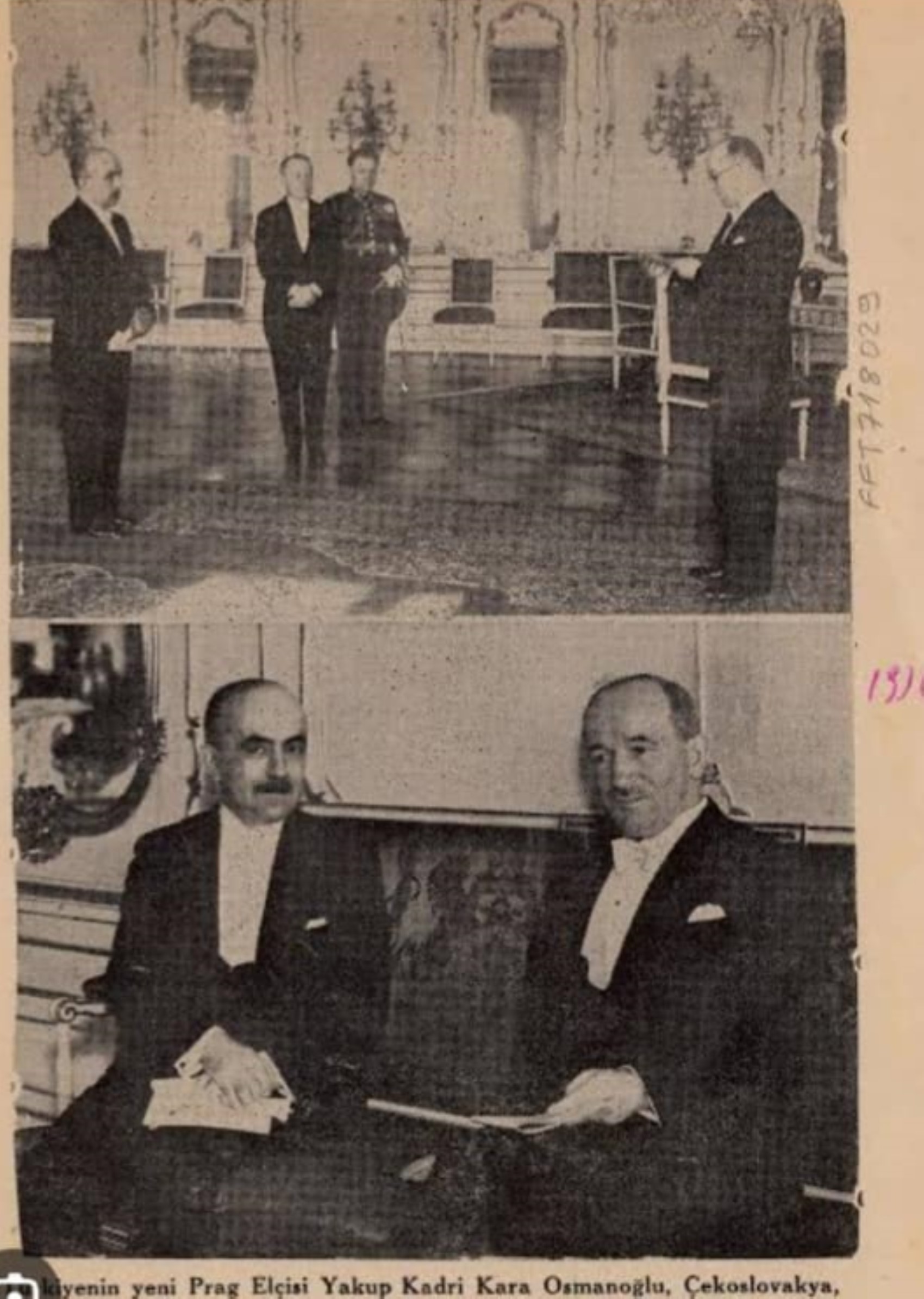
(Source: Salt Research - Ambassador Yakup Kadri Karaosmanoğlu with Benes)
A FEW WORDS ON OUR AMBASSADORS TO PRAGUE
Turkey and Czechoslovakia were two new states established after the First World War. Although small, Czechoslovakia was the heir to the trade, industry, and cultural life of Bohemia, the most developed region of the Austro-Hungarian Empire. The Skoda factories, in particular, had pioneered the establishment of the arms and automotive industries. Skoda had become a firm with an international reputation, and it remains so today. When I was in primary school, the municipal buses were Skodas.
The Czechs had reached a quite advanced level in the fields of knowledge, technology, and infrastructure investment. Turkey wanted to benefit from this expertise. In the Turkey of the 30s, Czechoslovak engineers, technicians, and skilled labor (craftsmen) were employed.
Czechoslovakia was occupied by Nazi Germany in 1939, and the Turkish ambassador Karaosmanoğlu was appointed to The Hague.
While establishing the Republic's foreign service, Atatürk utilized the experience of the Ottoman Ministry of Foreign Affairs. However, in addition to this, he also assigned duties to the military and civilian elite of the National War of Independence. Examples include the London and Paris ambassadorships of Ahmet Ferit Tek and Fethi Okyar.
Ahmet Muhtar Mollaoğlu, Münir Ertegün, Enis Akaygen, and Suat Davaz were figures who transitioned from the Ottoman diplomatic service to that of the Republic. Names from Gazi's own cadre, such as Hüsrev Gerede, Ruşen Eşref, Kemalettin Sami Pasha, and Memduh Şevket Esendal, also served in the foreign ministry. Yahya Kemal served as ambassador in Spain and Warsaw, and was later sent to Kabul.
Vasıf Çınar, Cevat Açıkalın, and Yakup Kadri Karaosmanoğlu, whom I discuss in this article, were appointed as ambassadors to states in Europe that had recently gained their independence. Among them, only Cevat Açıkalın was a career diplomat.
Vasıf Çınar was the architect of the Law on Unification of Education and one of the founders of the republican education system. He became the first ambassador appointed to Prague. He was, in every sense, a missionary of the revolution. In his short life, he served as ambassador in Prague, followed by Budapest, Rome, and Moscow.
Cevat Açıkalın, who served in Prague, was one of the founding figures of the republican foreign service. He made significant contributions during the Lausanne and Montreux negotiations, as well as during the process of Hatay's annexation to Turkey. He always held a distinguished place within the diplomatic corps. During the era of the 1961 Constitution, he also served as a quota senator.
The last figure Atatürk sent to Prague as ambassador was Yakup Kadri Karaosmanoğlu. From those years until the end of the 60s, he was one of Turkey's most distinguished writers. Karaosmanoğlu was a Turkish intellectual who produced works in many fields.
Each of these figures was treated with the prestige of the Atatürk Republic in the capitals to which they were assigned. This is how the republican foreign service, which the ruling power disparaged as "monşerler" (mon chers), was established. Then the era changed. We have seen the visions and the cadres of those who speak of a New Turkey. We are still seeing them.
Would you like to get notifications about new developments and save news?
- NotificationsNew developments and breaking news
- SaveNews is stored in the app
Most Read
Statement from Nihat Zeybekci on the fund investigation

New 75,000-seat stadium plan for Fenerbahçe
Interpol and MIT tracking yields results in Izmir
ID convenience for KPSS candidates

2027 Budget: Taxes for the people, tax exemptions for capital
The Çanakkale robbery -1- How was the Troy treasure smuggled out?
To whom and how was the Petition of Intellectuals submitted? Who accepted the petition?
The reality of Akkuyu and the longing for national nuclear power

Artificial intelligence and the new imperialism

Ministry investigation into unauthorized promotional messages