


What does Fethi Okyar represent in our political history?



FETHİ BEY AS A MEMBER OF PARLIAMENT AND MINISTER OF INTERIOR IN THE FIRST ASSEMBLY
The date Fethi Bey joined the First Assembly is clear: August 15, 1921. However, how he was accepted as a member is somewhat ambiguous. As will be remembered, there were two types of members in the Grand National Assembly of Turkey. The first were members of the 4th term Ottoman Chamber of Deputies. Atatürk had also been elected to this assembly as the deputy for Erzurum. The second category consisted of deputies newly elected by the decision of the Representative Committee (Heyeti Temsiliye). After a while, the Grand National Assembly of Turkey adopted principle decisions regarding assembly membership. It enacted the Law on Rules of Procedure (Nisabı Müzakere Kanunu). Those who did not join the assembly by a certain date would not be accepted in Ankara, even if they had been elected as deputies. With one single exception: deputies who had been elected and taken into exile in Malta. Fethi was in Malta. But he was not an elected deputy. Under these conditions, Fethi's membership did not seem possible.
In my opinion, he was elected as a deputy for Istanbul using the formula for occupied provinces (memaliki meşgule), just as Fevzi Pasha was elected as the deputy for Kozan. Let there be no misunderstanding. After the election board's mandate is read and approved in the general assembly—of course—he is a member of the First Assembly. I just wanted to point out that he became a deputy through an indirect path.
TBMM Speaker and Commander-in-Chief Mustafa Kemal Pasha made Fethi Bey the Minister of Interior. He was the Minister of Interior during Nurettin Pasha's suppression of the Pontus uprising. Fethi was responsible for internal security. The appointment of Fethi to the head of such an important ministry (in a difficult time like 1921) was, of course, related to a bond of friendship and trust that dated back to their days at the Manastır Military High School.
THE MINISTER OF INTERIOR WHO ASKED FOR PASSPORTS FROM THE OCCUPIERS
When the Grand National Assembly of Turkey convened, Fethi Bey was among the exiles in Malta. He had last served as a deputy in the 3rd Term Assembly in 1917. He had been elected as an Istanbul deputy in a by-election. He had been brought to the Ministry of Interior in the Izzet Pasha-successor government. In fact, when the allied fleet arrived at the port of Istanbul on November 13, 1918, he interpreted the armistice in his own way and asked the allied commanders to present their passports. Not long after, those who were asked for passports disregarded Ottoman sovereignty and had him exiled to Malta.
FETHİ BEY'S EXILE TO MALTA AND HIS RETURN
After being held for a while in the Galata Arabyan Inn and the Bekirağa Barracks in the spring of 1919, Fethi Okyar was taken to Malta by the British occupation forces along with other prominent Unionists. This was a practice that was also contrary to the understanding of international law at the time. Because the Ottoman State had not surrendered unconditionally. It had signed an armistice. The official justification for the practice was the trial of war crimes they were alleged to have committed. This was the Armenian genocide allegation.
He was released after being detained in Malta for nearly two years. During these two years, the letters he wrote to Galibe Hanım, the daughter of İsmail Hakkı Eldem, whom he married in 1916, have been published by İş Bankası Cultural Publications under the title “İki Gözüm Galibem” (My Dear Galibe).
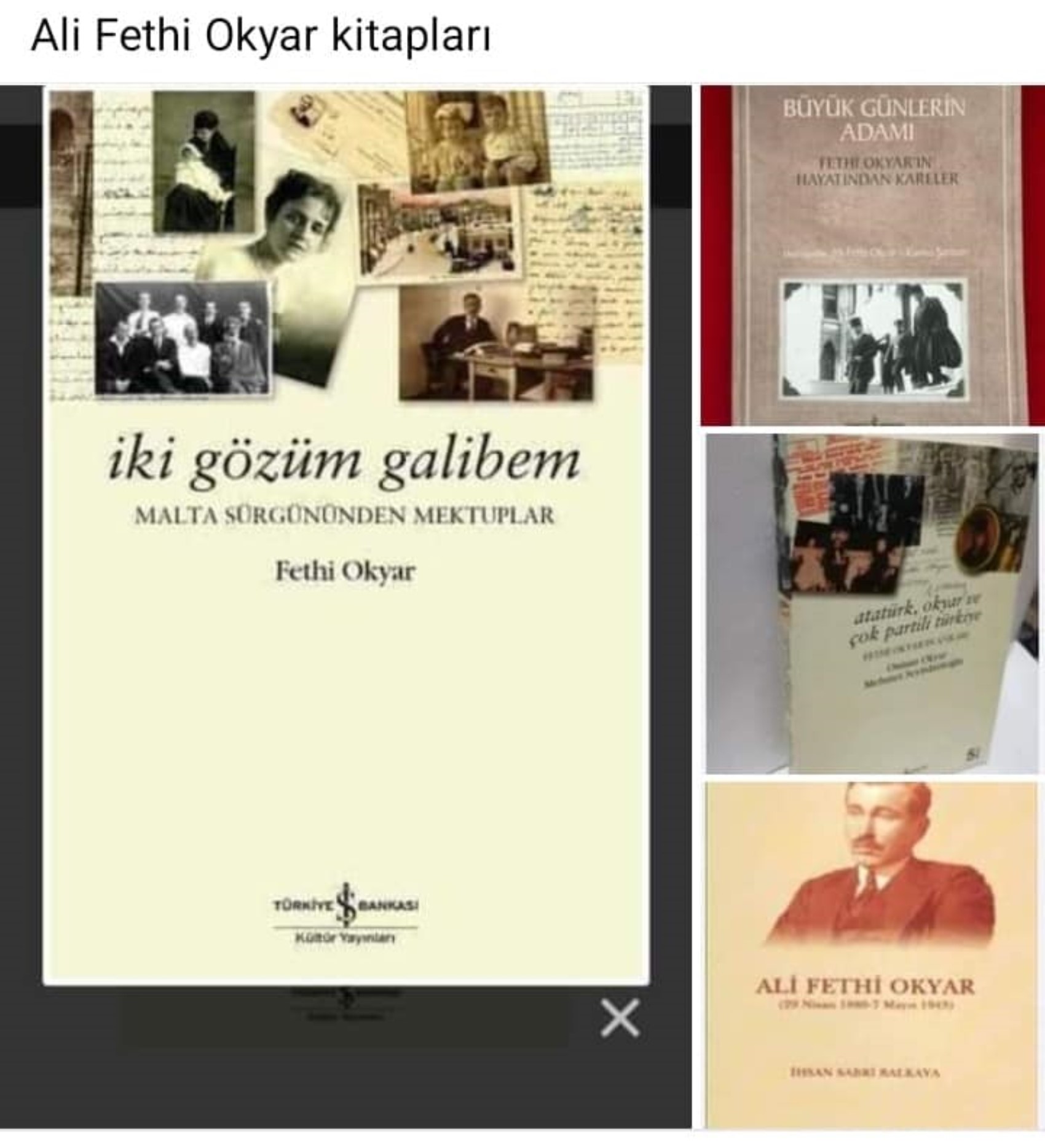
The Malta exiles were released with the exchange agreement made after the Battle of Sakarya. Until 1921, there were those who escaped from the island (e.g., Ali İhsan Sabis) as well as those who were released for various reasons. One of them is Fethi Okyar.
Fethi Bey was a former ambassador to Sofia, a former deputy, and Minister of Interior. He questioned his detention many times with long petitions he wrote to the British government. The argument he put forward in his petitions was British democracy and human rights. Finally, the petitions he wrote addressed to Lloyd George and Curzon yielded results. Fethi was released to return to Turkey via Italy. The year was 1921. He was released on May 31. When he joined the Anatolian movement, nothing was clear yet. Victory was still very far away.
MINISTER OF INTERIOR FETHİ BEY IN LONDON
It is important that Fethi Bey was sent to Europe after Minister of Foreign Affairs Yusuf Kemal Tengirşenk. He was sent to London to end the war before the Great Offensive. Why is this event important? There is a meaningful aspect here. Fethi had been held in detention in Malta by the British government for two years. Now the Turkish Government was sending him to England to ensure peace. Curzon did not give him an appointment for a long time. This worked in favor of the Turkish headquarters. This delay masked the Turkish offensive preparations. After the Great Victory, those who did not accept him intervened in a panic. They called immediately. But the era had changed. The Turks had been victorious.
SECOND ASSEMBLY ELECTIONS: FETHİ AND RAUF BEYS
The second assembly elections were held under conditions where Mustafa Kemal Pasha was the Savior Gazi (Halaskar Gazi). This is decisive. Fethi Bey was again elected as an Istanbul deputy from the Defense of Rights (müdafaa-i hukuk) list.
Meanwhile, the delegation had signed the Treaty of Lausanne and returned. A year ago, an important change had been made in the Law on the Council of Ministers: Law No. 244. According to this, the Head of the Council of Ministers would be elected directly by the assembly. The goal was to weaken Mustafa Kemal's power. The Second Group had succeeded in the initiative it started. The person elected as Prime Minister was also a meaningful name: Rauf Bey. Rauf Bey, who caused problems for the delegation and the TBMM speaker throughout the Lausanne process, had also been nominated from Istanbul and elected as a deputy. If one asks why, it would not have been ethical not to nominate Rauf Bey despite all the conflicts between them. After Rauf returned from Malta, he had become a deputy as required by the decision of the Grand National Assembly of Turkey. I must state clearly that Rauf Bey's function throughout the National War of Independence was not very positive. His only motive was to weaken Mustafa Kemal's power. As the great Atatürk pointed out in his Nutuk (Speech), and at the most critical stages. Regarding this, I could even write an article titled "What was Rauf Bey's contribution to the War of Independence?" From the summer of 1922 to 1923, he acted like a member of the second group within the first group.
CHANGES WITH THE SECOND ASSEMBLY
With the second assembly, conditions changed. The reason: the profile of the representative had changed in August 1923. Now it was Mustafa Kemal Pasha's turn. Naturally, the leader of the defense of rights was elected as the speaker of the Grand National Assembly of Turkey. This also meant being the de facto head of state. Fethi Bey became the head of the Council of Ministers (Prime Minister). As a result, the opposition deputies lost their position to compete with Mustafa Kemal.
As of August 1923, the legislative and executive branches had passed to the Kemalist majority. The opposition continued to take a stance within the party within the framework of their own jurisprudence: as in the proclamation of the Republic and the abolition of the caliphate.
GAZI MUSTAFA KEMAL PASHA AS PRESIDENT, FETHİ BEY AS PARLIAMENT SPEAKER
While the Republican revolution made Mustafa Kemal Pasha the President, it brought Ali Fethi Bey to the TBMM Speakership he had vacated. This is a meaningful choice. This choice pointed to the number one and number two men of the new Turkey. The group photos in Çankaya featuring Latife and Galibe showed the esteemed wives of the new regime's leaders.
FETHİ BEY'S PRIME MINISTRY
Fethi Bey's prime ministry was not just a maneuver against the Progressive (Terakkiperver) movement. It also had the aspect of satisfying the dissatisfied segment of the İsmet Pasha government within the People's Party (Halk Fırkası). The cadre that would establish the Progressive party was actually a potential opposition party, even if they were elected from the defense list. Their nomination had both an ethical aspect and the meaning of a political gesture. It should not be forgotten that the event had a dimension of maintaining the balance within the party. In the conditions of 1923, the Gazi could not have had an option such as not nominating figures like Orbay, Karabekir, and Cebesoy. As of that date, the lines had not yet been clarified. There was still a year left until the swords were drawn.
The intra-party conflict resulted in the establishment of a new party in November 1924—one year after the proclamation of the Republic: the Progressive Party. This was to be a party established by the dissidents within the People's Party. The President, as the head of the party and the state, brought the second man to the head of the council of ministers to prevent political turmoil: Ali Fethi Bey.
It was the 3rd republican government established by Fethi Bey. İsmet Pasha had established the second one after the abolition of the caliphate. After laws 430 and 431. He had reconstituted the government according to the revolutionary laws. It became the third government established by Fethi Bey. Fethi Bey moved to the government position by also receiving support from the Progressive Party. The opposition also voted in favor in the vote of confidence. Fethi Bey had served as the Speaker of the Grand National Assembly of Turkey between November 1, 1923, and November 22, 1924. Now he had become the Prime Minister of Turkey. Kazım Özalp Pasha was elected as the Speaker of the TBMM. Until 1936, then Abdülhalik Renda would be the Speaker of the Assembly.
The Sheikh Said rebellion brought an end to the Fethi Bey government. His prime ministry lasted only between November 22, 1924, and March 3, 1925. In my opinion, he could not grasp the gravity of the Sheikh Said uprising. He thought he could solve the matter with ordinary measures. He did not find extraordinary management—measures like the Independence Tribunals—suitable for his political temperament. The rebellion expanded and continued until the summer of 1925. The process was stopped with İsmet Pasha's Law on the Maintenance of Order (Takriri Sükun) regime.
İsmet Pasha's 4th Republican Government began with the Law on the Maintenance of Order and the Eastern Independence Tribunals. This period was a period in which revolutionary laws were implemented with harsh measures: 1925-1927. For this reason, the Great Nutuk is a summary document. After 1927, there is a different Turkey.
THE ORIGIN OF FETHİ BEY'S LIBERALISM
It can be said that Fethi Bey was close to the liberal wing of the Committee of Union and Progress. He was against the hawk wing of the Committee of Union and Progress on issues such as the army staying out of politics, the functioning of parliamentary institutions, and the existence of legal opposition.
This is the reason why he was sent to Paris as a military attaché in 1910 and appointed as an ambassador to Sofia in 1913. He belonged to the minority wing within the Committee of Union and Progress. He was among those who remained outside the power bloc within the party.
This is also the reason why Mustafa Kemal was appointed as an attaché to Sofia in his presence. Fethi had seen political parties and parliamentary institutions and practices in Paris and Sofia. Although I am not entirely sure that he fully grasped their dynamics, he cared that the principles of administration in the constitutional monarchy and the republic be within this framework. He could have been the prime minister of a liberal democracy with established institutions.
FETHİ BEY AS PARIS AMBASSADOR
Just as Fethi Bey was appointed ambassador to Sofia in 1913, this time he was made Paris Ambassador. This decision meant sending a politician who had served as speaker of the assembly and prime minister in Turkey to the French government. During the Ottoman era, there were those who served as ministers, even as speakers of the Chamber of Deputies, and went to the embassies of Paris, London, and Berlin: Mustafa Reşit Pasha, Ali Pasha, Tevfik Pasha. Like Ahmet Vefik Pasha.
After Lausanne, the establishment of diplomatic relations and missions with England, France, and the USA took place over time. For example, for London, the republican government brought former foreign minister Yusuf Kemal to the embassy, followed by Ahmet Ferit Tek. In Paris, Ahmet Ferit Tek was the diplomatic representative during the national struggle period. Ahmet Ferit Bey had served as a minister in the Anatolian government. Between 1924-1925, Hüseyin Ragıp Baydur and Cevat Ezine served as ambassadors in Paris. But our embassy was still in the establishment phase.
The appointment of a strong political profile like Fethi Bey as ambassador to Paris can be explained as follows. There was no position left for Fethi to take in domestic politics. Also, he was a former prime minister. In this respect, the Paris Embassy was a task commensurate with his identity. Thus, he was also moving away from the feverish political environment inside. The President of Turkey, Gazi Mustafa Kemal Pasha, personally saw Fethi Bey off from the Ankara station, both to win his heart and to emphasize the importance of the ambassadorial duty. Both the French government and the President who accepted his letter of credence attached importance to the appointment. The public showed great interest in Fethi's embassy.
As soon as Fethi returned from the Malta exile, he had participated in the negotiations with the French together with Yusuf Kemal. The French, who stood by us on political issues in Lausanne, were the delegation that challenged us the most on financial issues. For a very understandable reason. Because they had financial interests that dated back to the capitulations. Fethi had to deal closely with the regime of the liquidation of the Public Debt Administration (Düyunu Umumiye). The sharing of Ottoman debts by the successor states of the Ottoman Empire within the framework of the proportional distribution principle was at the top of the tasks Fethi Bey had to solve.
During the five years Fethi Bey stayed in France, besides the liquidation of Ottoman debts, he also dealt with issues such as the Turkey-Syria border, French schools and health institutions in Turkey, and concession contracts owned by French companies. He found solutions.
THE BOZKURT-LOTUS CASE
An important issue that corresponds to Fethi Bey's Paris Embassy period is the Bozkurt-Lotus case. The Lotus ship belonging to the Messageries-Maritimes company collided with the Turkish ship Bozkurt off the coast of Lesbos, and eight people lost their lives. The Turkish and French captains were arrested by Turkish authorities and referred to court. France claimed that the incident took place in international waters. It was claiming the incompetence of the Turkish judiciary. The Turkish government, on the other hand, was of the opinion that the incident took place in Turkish territorial waters and that the Turkish judiciary was competent. Finally, the matter was referred to the Hague Court of Justice. In the trial where Turkey was represented by Minister of Justice Mahmut Esat Bozkurt, the Turkish thesis was found to be justified.
The result was important in the following respect. After long periods of judicial capitulations, the new Turkish State, whose existence was registered in Lausanne, had been successful in the first test it gave in the field of international law. This event took place during Fethi Bey's Paris embassy period.
THE MEANING OF THE FREE PARTY (SERBEST FIRKA) EVENT
When Fethi Bey came to Turkey in the summer of 1930, the task of organizing the Free Party (Serbest Fırka) was assigned to him. Atatürk also included Ahmet Ağaoğlu, Nuri Conker, and even his sister Makbule in this work. Fethi was made a deputy from Gümüşhane once again—through a vacated deputy seat, as in 1917. He established the party.
A comprehensive analysis article could be written on why the Free Party attempt failed within 2.5 months. What I can express within the scope of this article—for now—is: The fact that the results of the 1929 World economic depression began to be seen in Turkey caused the opposition party to grow rapidly. It gained a political dimension. The Free Party—the name was given by Atatürk in the sense of a liberal party—had the potential to turn into a position where counter-revolutionary forces were stationed. And so it did. The supervision party design that Atatürk started by gifting a car to the party leader and adding his relatives and trusted men to the leader's side was certainly not like the Civil Code or the Law on the Adoption of the Hat. It would be sociological reality, not legislation, that would determine the fate of his movement. The Free Party movement, which Adnan Menderes also joined from Aydın, started in this way.
It is understood from Atatürk's attempt to have the Free Party established that the Turkish bourgeoisie represented within the Republican People's Party was eager to take power. But they did not seem capable of defending the democratic character of the revolution against reactionary feudal forces. Or rather, they had not fully grasped this aspect of the republican revolution.
Atatürk would probably have accepted this. A political order where the Free Party won but he also maintained the presidency. He saw very quickly that this was politically impossible.
In the party's dissolution decision, the concern of the People's Party organization about falling from power was as effective as the reactionaries trying to infiltrate the party. The fall of the CHP from power would mean that the bureaucratic state actors who had settled into power would lose their privileged position.
After 1931, Atatürk turned to pluralism within the party instead of an open opposition party. All the cadres who would later establish the Democrat Party were represented within the CHP. For example, Adnan Menderes became a CHP Aydın deputy.
FETHİ BEY'S RESENTMENT AND ILLNESS
He did not become a candidate in the 1931 elections either. He did not even want to be nominated. The symptoms of heart failure had already begun. He retired as a patient in Istanbul. The former Paris ambassador, former deputy, and former prime minister devoted himself to reading, writing, making translations, and receiving treatment. Atatürk sent his friend, whose heart was broken and whose illness was increasing, to Vienna for treatment, accompanied by Salih Bozok. This process of resentment and treatment continued until Atatürk invited him to the 10th-year celebrations of the republic in 1933. Fethi Bey was in Ankara during the 10th-year celebrations. The situation had relatively improved.
FETHİ BEY'S BÜYÜKADA VINEYARD HOUSE
Fethi Okyar had married Galibe Hanım on March 3, 1916. Galibe is the daughter of İsmail Hakkı Eldem. Eldem was a well-known monograph writer, translator, and diplomat. His son is the famous architect Sedat Hakkı Eldem. An approximately 100-acre plot of land where an abandoned Greek vineyard house was located in Büyükada was purchased from the Real Estate and Orphans Bank (Emlak ve Eytam Bankası). In the first half of the 1930s. I am of the opinion that Atatürk had a hand in the purchase of this property.
Namely, after the failure of the Free Party, a heart condition appeared in Fethi Bey. In my opinion, Atatürk contributed to the registration of this land on the West side of the Island in the name of Fethi Bey. In order to mend his heart, which was broken after the Free Party event, to some extent.
We can say that this land, which is a priceless property for today, was registered in the title deed in the name of Fethi Okyar as an abandoned vineyard in the Turkey of the 30s. Probably at a very reasonable price.
Just like the purchase of İsmet Pasha's house in Heybeliada. But Fethi's is a large property. The land is currently in the possession of Fethi Bey's heirs. The redesign of the vineyard house inside in the Turkish architectural style was done by Galibe Hanım's brother, Sedat Hakkı Eldem.
When the project was completed and the vineyard house (actually a mansion) became livable, Fethi Bey stayed there when he came to Turkey for holidays. The Okyar family also stayed from time to time in the Necmettin Molla Mansion in Sarıyer. Atatürk visited Fethi Bey in both places. Just as he visited Fethi Bey in his house on the island, there were times when he had him picked up and brought to Dolmabahçe.
LONDON EMBASSY
When Fethi Bey's heart weakness improved a little, he accepted the London embassy offered to him: March 19, 1934. A while later, Atatürk gave him the surname Okyar. The word meant a wise friend. Atatürk had treated his friend and won his heart.
Fethi Bey's acceptance of the London embassy shows that he had the pragmatism to see the margins of the system. The political order he had in mind did not exist in Turkey. Perhaps he saw that it could not exist yet. He did not take an attitude opposed to the leader's policies. He went to London by accepting the embassy duty once again.
Fethi Bey became the London ambassador in an environment where Hitler came to power in Germany and there were many uncertainties in Europe. There is an important point here. Fethi Bey had been taken to Malta as a detainee in 1919 and released after being held in a concentration camp by the British government for two years. Now the same person had been appointed as the Ambassador of modern Turkey. This was a very meaningful return.
In 1936, Minister of Foreign Affairs Tevfik Rüştü Aras, along with Asım Gündüz and Suat Davaz, had come to Switzerland for the negotiation of the Montreux Straits Convention. Fethi Bey joined them. Fethi Okyar also signed the Straits Convention signed in July 1936.
A month later, British King Edward VIII would travel to Turkey, and it would again be Fethi Bey's duty to accompany him. We see him welcoming, seeing off, and in the pictures on the Ertuğrul yacht together with Edward, Atatürk, and İnönü.
THE PURCHASE OF SAVARONA
Another important event during Fethi Bey's London Embassy is the purchase of the Savarona ship while Atatürk's illness was worsening. Savarona was purchased at a very reasonable price by taking advantage of the struggle between Germany and the USA. The ship, which left Hamburg port on March 18, 1938, entered British territorial waters with the US flag on March 20, and all procedures were completed at the South Hampton port, and the Turkish flag was hoisted. The Presidential Secretary General Hasan Rıza Soyak, our London naval attaché, the managers of İş Bank and Eti Bank, and the undersecretary of the Ministry of Economy attended the ceremony here. After the necessary maintenance on the ship was completed, Savarona set sail for Istanbul with Captain Sait Özege and his 45-person crew. It anchored off Dolmabahçe at 13.45 on June 1, 1938. In a letter he wrote to Afet İnan, who was writing her doctoral thesis next to Eugene Pittard, Atatürk said that he was waiting for the ship like a child—with the hope of recovery.
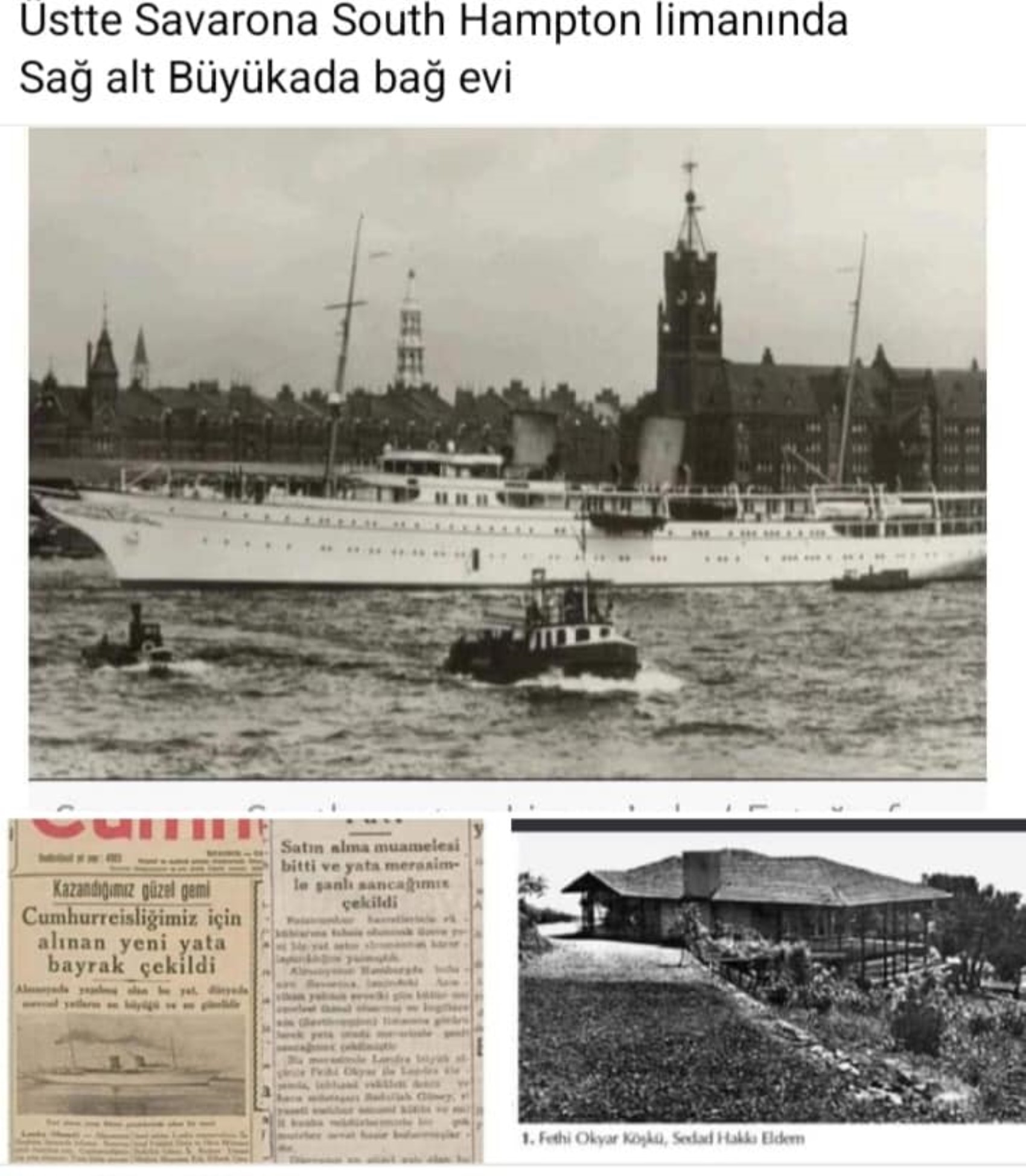
The arrival of Savarona in Turkey as the presidential ship corresponds to a time when Atatürk's illness had become quite severe. The doctors' advice was sea air, pine forest air, strict adherence to diet, and absolute rest. One day, Savarona anchored off Büyükada. He had Fethi, who had come for a holiday, picked up. They met. He even wanted him to come to Dolmabahçe.
Atatürk, on one hand, wanted Fethi to be interested in him, but from time to time he also said contradictory words such as "This Fethi is also very interested in my illness."
How sad it is that Atatürk could only stay on this ship for 45 days. The illness was progressing with high fever from time to time. Atatürk was trying to feel better by sailing to the Black Sea sometimes and to the Marmara sometimes. Towards autumn, the situation became even more severe. One midnight, Atatürk was moved to the palace in an armchair with the help of his friends and could never get out of bed again.
Everyone realized that the inevitable end was approaching. For this reason, Fethi did not want to return to London. He stayed in Istanbul until the middle of October. When Prime Minister Bayar said that the situation in Europe was complicated and that he should return to his duty, he returned to London. He was in London when Atatürk passed away. Just as he was in London during the Great Offensive.
ALI FETHİ OKYAR'S PERSONALITY AND POLITICAL IDENTITY
Fethi Bey's character does not resemble either İsmet Pasha's or Atatürk's. İsmet Pasha was someone who acted with the reflexes of the bureaucratic state tradition at critical thresholds. Personally, he also had a suspicious nature. Atatürk, on the other hand, possessed the characteristics found in all great revolutionaries. After deciding on the appropriate moment for the breakthroughs he would make with his intelligence and foresight, he would continue his action decisively until he achieved results without paying attention to obstacles. This was his understanding of military service and politics.
Fethi Bey, on the other hand, was a man of moderation. He was not a man of extreme attitudes and behaviors. His superiority over his peers was evident from his degree at the War Academy. His graduation from the Military Academy and War Academy is one year before Atatürk's. Most people write that they are classmates, but they are not; they are schoolmates.
He had a different place among the Unionists with his approach to issues. For this reason, he is the one who wrote the Constitutional declaration upon Talat Bey's request. He held important positions, but he was never in the middle of hot politics. They had given him the responsibility of taking the deposed Sultan Abdulhamid II to the Alatini Mansion in Thessaloniki. After March 31, he supervised Abdulhamid II for three months together with the guard regiment. When it became certain that Thessaloniki would fall during the Balkan wars, the task of bringing the deposed sultan to the Capital was again given to him. The deposed Sultan spent the rest of his life in the Beylerbeyi palace.
His Paris Military Attachéship and Sofia Ambassadorship had been decided by the radical wing of the Committee of Union and Progress. And he had accepted it with pleasure. His later political life shows that he was in politics, but he was not in the fever of politics. Talat Pasha ensured his election as a deputy for Manastır in the 1912 elections. After the Balkan War, he became an ambassador to Sofia. In 1917, he was elected as an Istanbul deputy in a by-election. The easy transition between ambassadorship and deputyship shows that Talat Pasha was protecting him. His being the Minister of Interior in the successor cabinet (Müşir Izzet Pasha cabinet) established by the Committee of Union and Progress while entering the armistice is characteristic of the function attributed to him. As a former ambassador, former deputy, and minister, he was taken to Malta captivity. During the two-year Malta exile, he wrote long petitions based on solid arguments addressed directly to the British government. As a result of this struggle, he was released before the Inebolu exchange. This shows his ability to achieve results through negotiation.
When he crossed into Anatolia in the winter of 1921, the situation was complicated in every respect. He was elected Minister of Interior. This means the ministry responsible for internal security in the most difficult times. Mustafa Kemal Pasha had wanted him in this position.
Mustafa Kemal Pasha's sending him to London before the Great Offensive is an important choice. After two years of Malta captivity, he had been tasked with negotiating the terms of peace as a Minister of the TBMM Government. When the second assembly convened, he was elected as the head of the Council of Ministers. This choice meant that Rauf Orbay and his circle, who constantly caused problems—and even sulked—during the Lausanne negotiations process, would remain outside the Kemalist Party in government affairs.
The system of the union of powers and parliamentary supremacy was increasing the competition among deputies regarding entering the government. The transformation of the Ankara Convention into a republic with a constitutional amendment happened for this reason. At this threshold, an important choice was made: while the first government of the Republic was established by İsmet Pasha, Mustafa Kemal Pasha was elected President. Fethi Bey was brought to the Grand National Assembly of Turkey speakership he vacated. This was also a conscious and meaningful choice. After the Republic, it is possible to make the ranking as follows: The First and Only man Mustafa Kemal Pasha, the Second man TBMM Speaker Fethi Bey, the third man İsmet Pasha, who was brought to the head of the government.
From October 1923 to November 1924, the balances of the Republic of Turkey were established in this way. Let's remember the Çankaya pictures of Galibe and Latife with Mustafa Kemal and Ali Fethi. This is the reason.
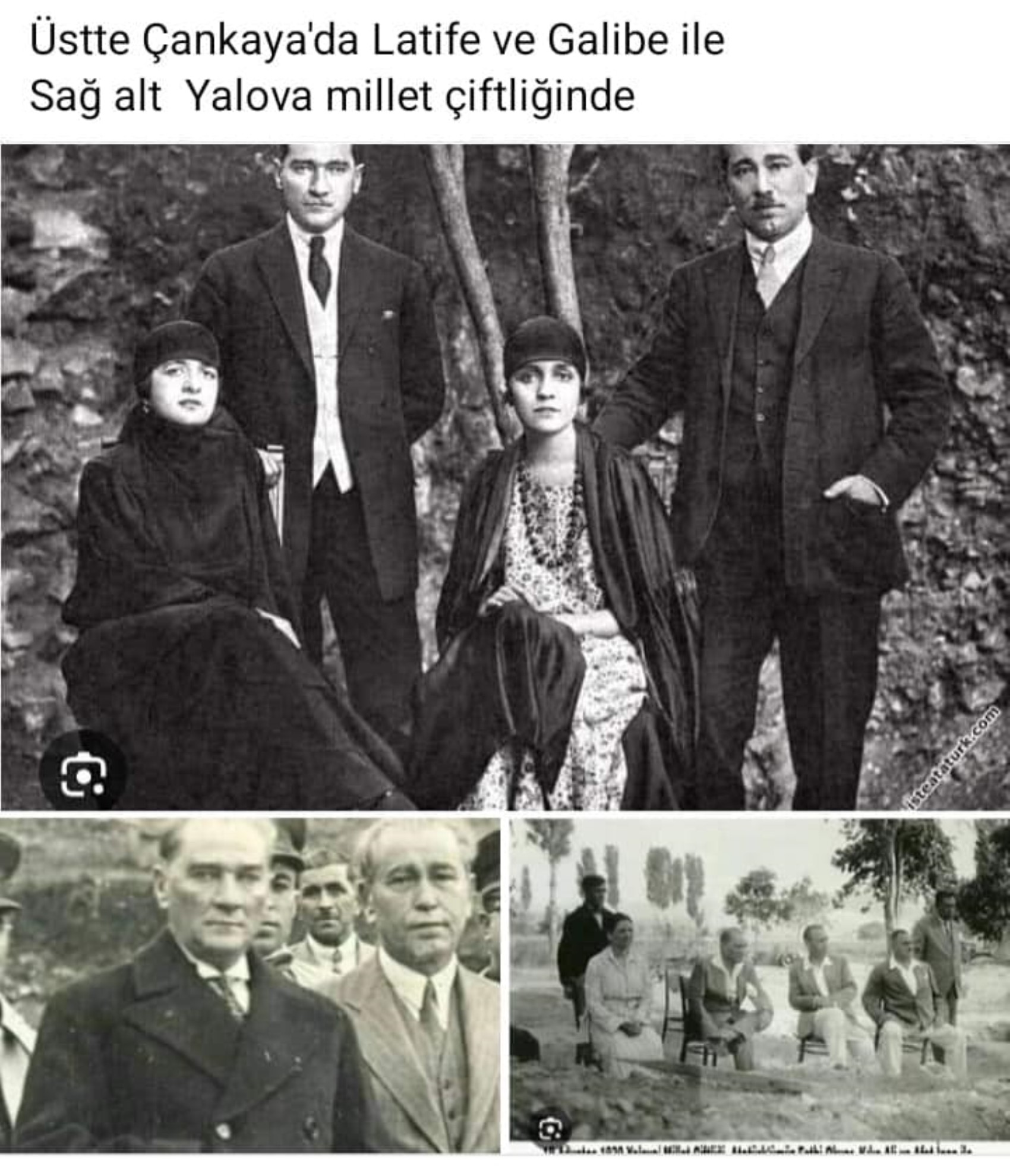
The opposition faction within the People's Party separated and became a party in November 1924. The President brought Fethi Bey to the prime ministry to appease the opposition and keep the party in his hands.
Fethi Bey's prime ministry was also supported by the Progressive Party. They voted in favor in the vote of confidence. It was the Sheikh Said uprising that ended Fethi Bey's three-month prime ministry. Fethi Bey thought that the new regime institutions were at the same level of development as the institutions he saw in France.
However, Turkey had reached this point by progressing on a different line of political evolution. Fethi Bey's executive politics showed what could not be in Turkey under the conditions of that time. What could be done in the face of a feudal-separatist uprising.
In my opinion, Fethi Bey could not fully grasp the nature of the issue. He was thinking like a prime minister of a liberal democracy with established political institutions. Turkey's sociological reality and political culture showed that this was—not yet—possible. Fethi Bey withdrew. İsmet Pasha became prime minister. The bureaucratic state option ensured public order.
Fethi Bey's being sent to the Paris embassy until 1930 was extremely appropriate for Turkey. For one thing, he had remained sufficiently away from domestic politics for his own part. It was also appropriate in terms of Turkish foreign policy. He represented Turkey for five years in France, which is an extremely important country. He solved many problems remaining from the Ottoman Empire with France. After five years of ambassadorship, Atatürk tried the Free Party with him as his "most trusted friend." Once again, when he saw his own leadership, his party, and the republic at risk, he stopped the process.
WHAT SHOULD OUR JUDGMENT BE ABOUT FETHİ BEY?
When Fethi Okyar returned from London, the Atatürk era was over and the İnönü era had begun. During Atatürk's illness, political circles in England and France wanted to see him as Atatürk's successor. A lot of speculation was made about his name. They were unaware that the single-party state would not choose Fethi. The party's heavy-handed line represented the statist-elitist front. İsmet Pasha's election as president had in a way become the party's decision to continue the status quo.
İsmet Pasha ensured that Fethi Bey, who returned to the country with his health severely deteriorated, was elected as a deputy from Bolu in 1939 and 1943. He was brought to a not-very-active ministry in the Dr. Refik Saydam Government: Ministry of Justice. When he passed away from heart failure at the age of 63, he was a statesman and politician who had seen three eras. If we include the Sofia embassy, he had served as an ambassador for 13 years. At every critical threshold—when a novelty attempt was in question—he was called to duty as the most suitable political profile. His prime ministry in 1924 had served as a political catalyst. In 1930, liberalization in the regime was tried with him as the most trusted man. Turkey saw with Fethi Bey's Free Party what could not be. His ambassadorial duties show that he adopted himself as a state actor outside of politics. As a final point—if his life had been sufficient—one might think whether Fethi Bey could have been the leader of the party instead of Celal Bayar when the Democrat Party was established in 1946. In my opinion, no. Although Fethi Okyar's thoughts were inclined towards liberal democracy, he did not have a character to lead the struggle that would carry an opposition party to power. A bit of politician's fabric was needed for this job. This fabric was abundantly present in Bayar.
Would you like to get notifications about new developments and save news?
- NotificationsNew developments and breaking news
- SaveNews is stored in the app
Most Read
Statement from Nihat Zeybekci on the fund investigation
New 75,000-seat stadium plan for Fenerbahçe
Interpol and MIT tracking yields results in Izmir
ID convenience for KPSS candidates

2027 Budget: Taxes for the people, tax exemptions for capital

The Çanakkale robbery -1- How was the Troy treasure smuggled out?

To whom and how was the Petition of Intellectuals submitted? Who accepted the petition?

The reality of Akkuyu and the longing for national nuclear power

Artificial intelligence and the new imperialism

Ministry investigation into unauthorized promotional messages