


Necip Fazıl’s State of Supreme Presidency



INTERSECTING PATHS AT THE NAVAL ACADEMY: NECİP FAZIL - NAZIM HİKMET - FAHRİ KORUTÜRK
There is a connection between Necip Fazıl and Nazım Hikmet that dates back to their years at the Heybeliada Naval Academy. Necip Fazıl was a student two classes behind him. Nazım was born in 1901, and Necip Fazıl in 1904. It was the Minister of the Navy, Cemal Pasha, who placed Nazım in the school. Necip Fazıl’s family, on the other hand, moved to Heybeliada after his father’s death due to financial difficulties. He must have been enrolled in this school during that time. He was a classmate of our sixth president, Fahri Korutürk. When Korutürk was elected president, he sent him a congratulatory letter. Korutürk reciprocated to his classmate in the form of a thank-you note.
There was occasional correspondence between Nazım and Necip Fazıl. When the amnesty law was passed on July 15, 1950, Necip Fazıl was in prison. He was also released. While Nazım was forced to flee abroad in 1951, Necip Fazıl began to lean toward the Democrat Party government. In a letter, Nazım addresses Necip Fazıl as follows:
“Dear Necip, your name means pure. You know better than I do. Do not make the pure (Necip) impure (necis). You are a poet who produced your most universal works while wandering the streets of Paris without a penny. Do not let your soul be torn to pieces just so your pockets can be filled with money. I know your pen is agile. Your tongue is nimble. I know you can breathe soul into paper in three lines. I know if you wrote, you would shatter the Great Wall of literature. It breaks my heart, Necip, to see you licking the paths of the Babıali slope with that abstract tongue of yours.
Dear Necip,
For the sake of the God you believe in, do not turn your powerful pen into a mosque pillar just to serve as a prop for the government. Do not parcel out your powerful words for three cents. To the spineless ones whose three words aren't worth three cents.
Dear Necip, you hold the Trumpet of Israfil in your hand. Do not turn it into a bugle. Your old friend, Nazım.” I believe this letter explains the path Necip Fazıl adopted after the 50s very well.
THE DESIRE TO BE A MEMBER OF PARLIAMENT
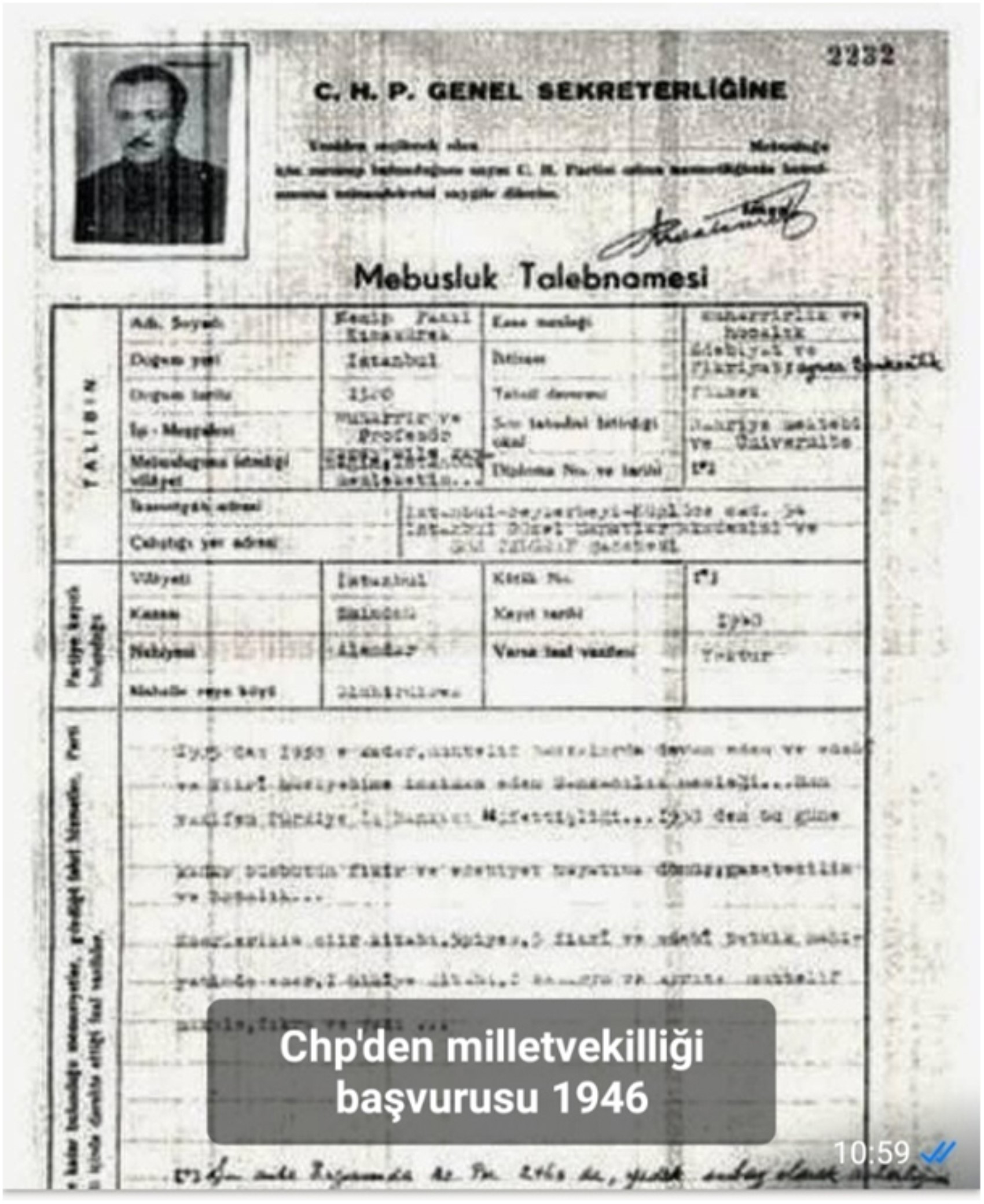
Necip Fazıl wanted to be a parliamentary candidate for the CHP in the 1946 elections. This application might seem interesting. One would have expected him to be a candidate for the Democrat Party. There is a possibility that Necip Fazıl may have had doubts about the fate of the Democrat Party. His CHP candidacy was vetoed by İnönü. I believe this is the fundamental reason behind the deep hatred for İsmet Pasha that continued until his death (1983).
In the next Grand National Assembly of Turkey (TBMM) elections (1950), he tried his luck with the Democrat Party this time. He applied to become a member of parliament. The DP executives did not nominate him either.
The reason both his applications resulted in failure is, in my opinion, that he was seen by party officials as a character who could cause trouble. In the 70s, he was not nominated as a parliamentary candidate by any party.
NECİP FAZIL’S EXPLOITATION OF THE DEMOCRAT PARTY GOVERNMENT
Necip Fazıl had published provocative content in two incidents. The first is the destruction of the Tan Newspaper printing house: December 19, 1945. Tan was Zekeriya Sertel’s newspaper that published leftist content. In reality, Sertel was following an editorial line based on defending fundamental rights and freedoms. In my opinion, Hüseyin Cahit Yalçın’s Tanin newspaper is also responsible for this incident.
The second incident is the attack on Ahmet Emin Yalman, the editor-in-chief of Vatan Newspaper, in Malatya. The perpetrator of this incident is one of the famous figures of our right-wing history: Hüseyin Üzmez. Here, the history of right-wing politics should be understood as the history of antisemitism.
Necip Fazıl was tried on charges of being the instigator of this incident. He was acquitted in this case. Üzmez was convicted. After reinforcing his enmity toward the CHP and İsmet Pasha, he tried to get closer to Adnan Menderes. It would be more accurate to say he infiltrated Menderes. He personally applied to Menderes and wrote letters to secure financial support. Financial support: meaning benefiting from the discretionary fund that the prime minister could use at his discretion.
After the 1950 elections, circles dissatisfied with DP policies—many of whom had supported the Democrat Party after '46—began publishing magazines such as Akis, Kim, and Forum. Ahmet Emin Yalman’s Vatan Newspaper had also moved to the opposition after 1952.
There were a limited number of newspapers supporting the Democrat Party. They were continuing their publication lives with the support of the government. Such as Kudret, Zafer, and Son Havadis. Necip Fazıl was promising Menderes that he would deal with all the opponents.
 THE DISCRETIONARY FUND CASE
Necip Fazıl thought he could establish an offensive line against İsmet Pasha and the new liberal opposition with his Büyük Doğu magazine. He committed to this to Menderes. Of course, he would also have some requests.
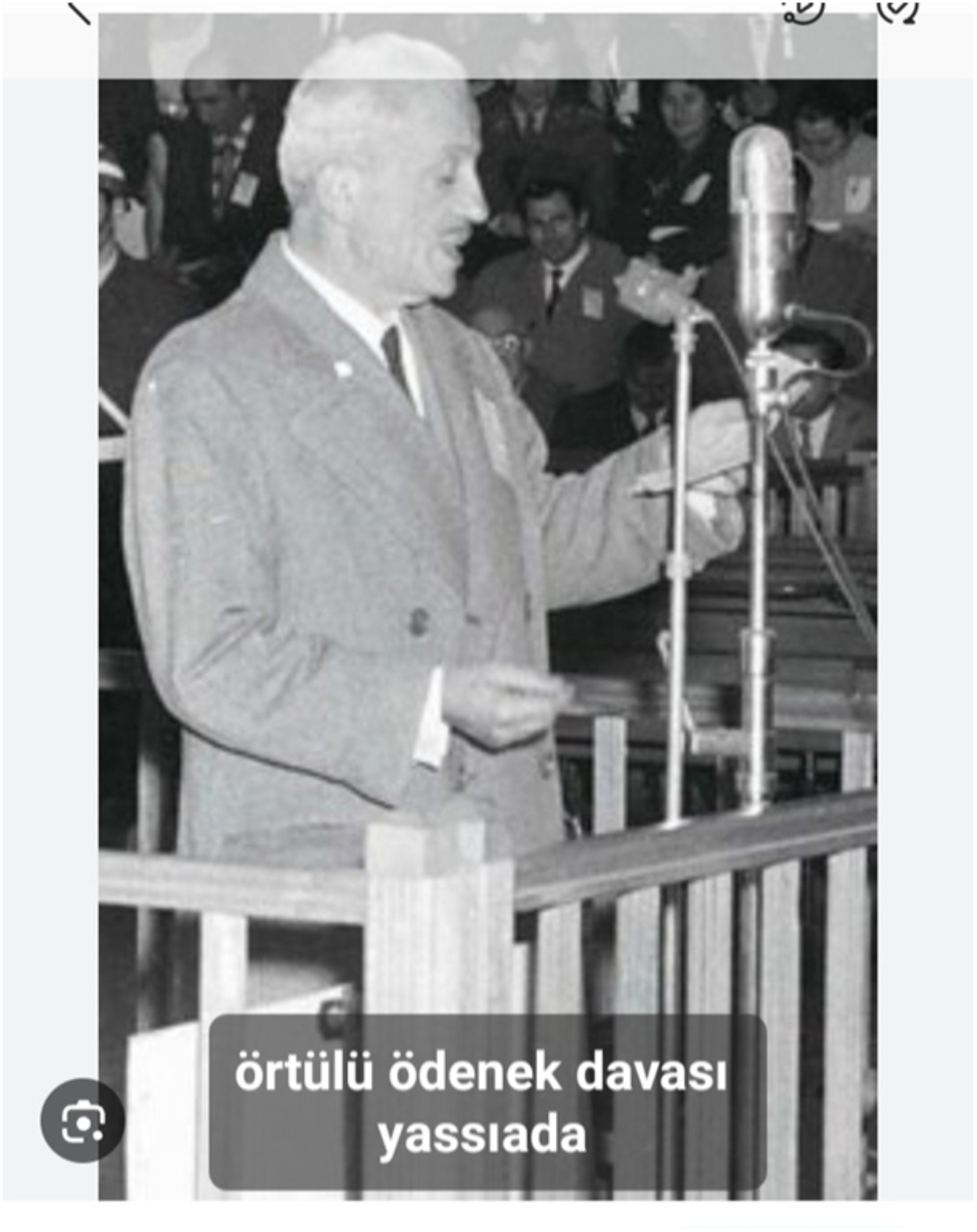
In the letters he wrote to Menderes, he was sometimes a guiding intellectual and sometimes a writer pleading due to economic difficulties: such as “If you would grace me with 10,000 liras.” In the High Court of Justice, it was proven that Necip Fazıl received more than 140,000 liras from Prime Minister Menderes. The money was given to him to act against the CHP.
Menderes accepted the accusations. He only made embarrassed sentences implying that they gave up after realizing Necip Fazıl’s true face.
I must say that I am sincerely saddened that he answered Salim Başol’s condescending/scolding questions with the tone of a schoolboy who had committed a crime.
NECİP FAZIL AFTER MAY 27
Necip Fazıl spent the period of the “May 27 revolutionary government” as a prisoner. He stayed in prison for 1.5 years due to the discretionary fund case. After his release in 1961, he launched a more violent attack. As always, the first target would be the CHP and İsmet Pasha.
He entered into new searches on the right wing. He could not find a place for himself in Demirel’s Justice Party. And he didn't. He accused Demirel of being a mason and a servant of the USA. His “Süleymanname” is famous.
He turned to marginal right-wing parties. It is said that he, along with Necmettin Erbakan, also signed the Establishment Declaration and program of the National Order Party. After a while, Erbakan Hoca distanced himself from Necip Fazıl, and over time, their paths completely separated. The Master’s next stop would be the Nationalist Movement Party (MHP).
DISTANCING FROM ERBAKAN, DRAWING CLOSER TO TÜRKEŞ
After 1975, Necip Fazıl drew closer to the MHP. The party had strengthened by joining the Nationalist Front governments and had significantly increased its effectiveness with its paramilitary actions before the 1977 elections. However, it had only been able to win one parliamentary seat in the 1969 elections. The number of seats the MHP won in the 1973 elections was three.
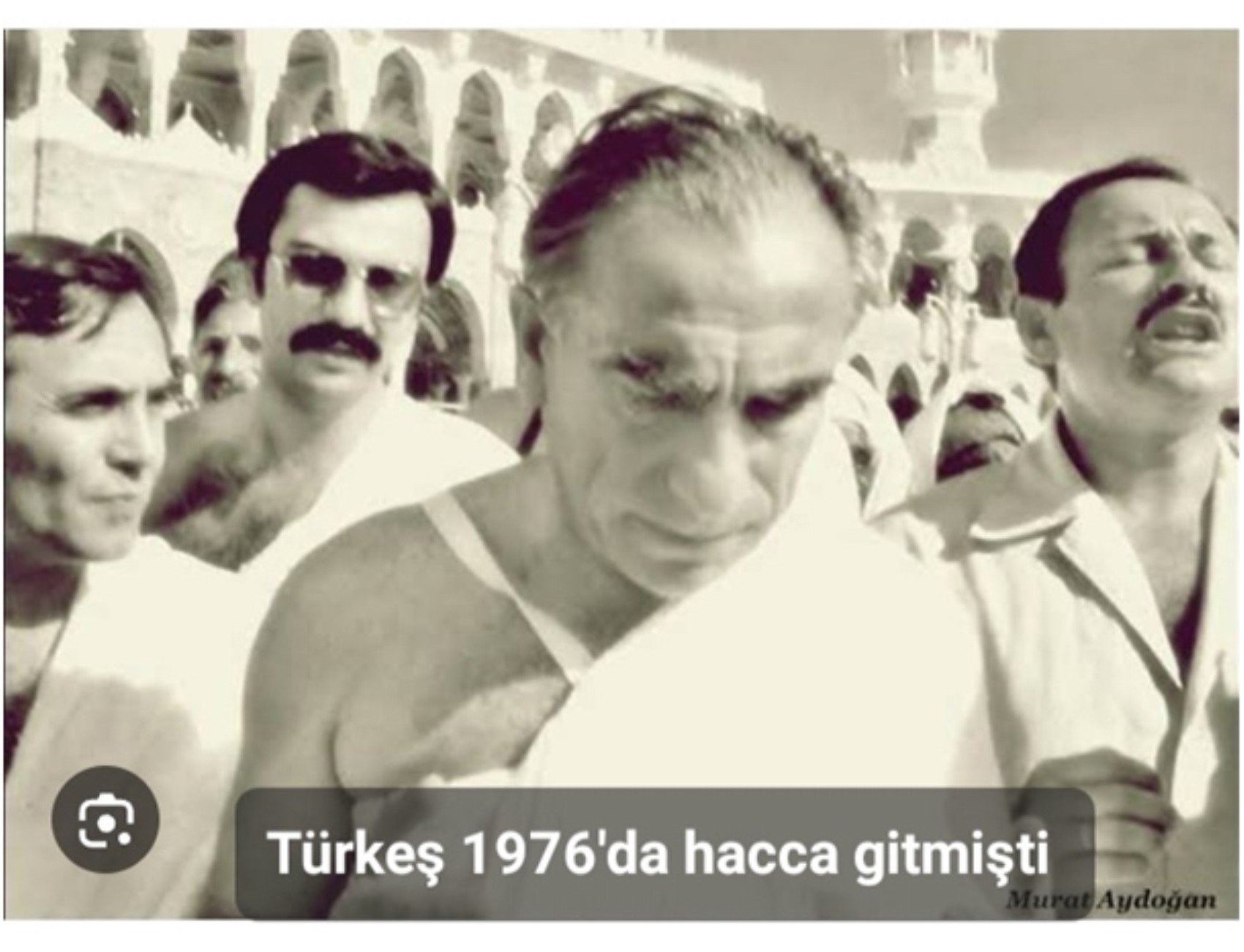
The MHP, which consolidated its power in the Nationalist Front governments, shifted from Turkism to the Turkish-Islamic synthesis. To hold a strong place on the right, it leaned toward a religious line. The party leader, “Başbuğ Türkeş,” went on the Hajj. The reason for this policy change can be explained as follows: Türkeş felt the need to make such a maneuver to bring the Anatolian voters (conservative Sunnism) who could fall under the influence of the MSP into the ranks of the MHP. I think this move worked. While the MHP was on the rise in 1977, the MSP significantly declined.
In the 70s, Necip Fazıl began to become an indispensable actor in the activities of the National Turkish Student Union (MTTB), which had fallen into the hands of Islamists. At MTTB meetings, Islamist youth would enthusiastically read Necip Fazıl’s poems. The most popular of these is undoubtedly the Sakarya Anthem.
In the poem, there is a longing for Anatolia’s return to Muslim values. You can feel a call to resistance against the Republican Revolution and the Kemalist center. Muslims (Sunni Anatolia), who are said to be “pariahs” in their own homeland, are invited to shake themselves off and stand up.
Necip Fazıl, who was in close contact with the MSP in the 1973 elections, distanced himself from Erbakan over time. The real determinant of this distancing was Erbakan. Erbakan broke the already weak bond. He even put a clear distance between himself and Necip Fazıl. It seems to me that Erbakan sensed the potential in Necip Fazıl to enter into a leadership struggle in the Islamist wing.
 NECİP FAZIL - TÜRKEŞ MEETING: THE GREAT MARCH TO ROME
It is possible to understand the clues about what kind of role Necip Fazıl wanted to assume in a possible MHP government from his meeting with Türkeş. It would be useful to share the following information conveyed by Taha Akyol, who was in the MHP administration in the 70s: Akyol had arranged a Türkeş-Necip Fazıl meeting before the 1977 elections.
What I understand from what he told is this: Necip Fazıl encouraged Türkeş to take an action similar to Mussolini’s 1922 march on Rome. It would not be wrong to say this.
He may have thought that power could be seized through chaos created in the 1977 election environment by deploying the MHP’s blackshirts (commandos) to the field.
Expressions conveyed by Taha Akyol such as “My esteemed Colonel... Are you in? Are you ready? Can you take the risk?” support my suspicions.
MHP’S SUCCESS IN THE 1977 ELECTIONS
The party that achieved the greatest growth on the right wing in the 1977 elections was the MHP. It won 16 parliamentary seats. This was a great success. Even a CHP-MHP coalition was discussed. The CHP had won 213 seats but could not take power alone. The idea of a coalition between the two parties had come from Ankara Mayor Vedat Dalokay.
Dalokay had argued that by establishing such a coalition government, violent acts would stop and political tension would decrease.
NECİP FAZIL TOWARD SEPTEMBER 12
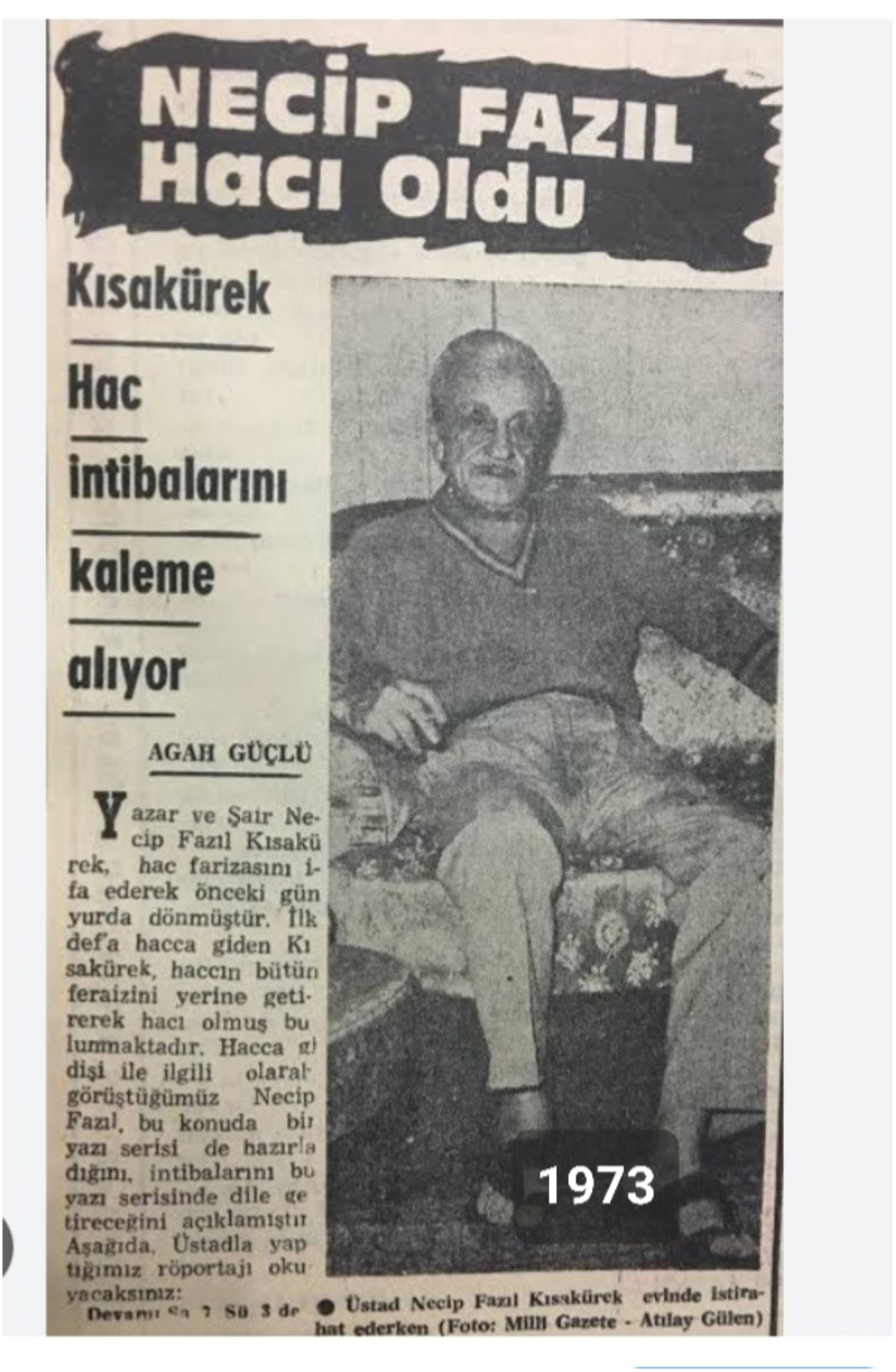
Necip Fazıl wrote articles in favor of the MHP and Türkeş in Büyük Doğu. He went on the Hajj in 1973. Later, Türkeş would also go on the Hajj (1976). Thus, conservative nationalism settled on a line where Islamism weighed heavily.
In this context, the Necip Fazıl jubilee held at the National Turkish Student Union carries special meaning (November 23, 1975). The First Nationalist Front government is in power. Justice Party Chairman Demirel is the prime minister. The coalition includes the MSP-MHP-CGP. The MHP and MSP continue to staff the state with great zeal. Republican Reliance Party Chairman Turhan Feyzioğlu, who entered the coalition with hatred for Ecevit, is also watching these developments with concern. This jubilee shows that Necip Fazıl is the common denominator of Islamism and conservative Turkism.
Again, by organizing such a meeting, he was given the title of Sultan-üs Şuara (Sultan of Poets) on May 26, 1980. This act was also a challenge from the right against secular intellectuals. On this date, the Demirel minority government was in office. The MSP and MHP were supporting the Justice Party government from the outside. It would not be wrong to define this government as the covert III. Nationalist Front government.
TAQIYYA AND ANTISEMITISM IN NECİP FAZIL
In Necip Fazıl’s thought, there is the utilization of the institutions of liberal democracy. Until the favorable moment to eliminate the regime arrives, it is necessary to “keep the hatred inside, not express it, and hide the real target.”
Necip Fazıl is one of the early examples of the idea of getting off the tram. This attitude has to do with the idea of cheating to defeat the enemy. There is cheating in Islamism. Cheating to make the truth manifest is legitimate.
These words show where he stands in terms of thought: “Those who create a 100-year-old immoral, rootless, characterless generation have been directed and managed by Jews. After the Tanzimat, the rulers of Turkey became masons, converts, and cosmopolitans. Westernization/modernization has meant moving away from our essence.”
NECİP FAZIL’S ADVICE TO THE BÜYÜK DOĞU FOLLOWERS
Necip Fazıl felt the need to warn the “Büyük Doğu” jihadists about one issue. The subject, as you might guess, was secularism.
The Master wanted to say, take advantage of the freedom regime of democracy. Just be careful until the “golden strike.” He meant, do not clash too much with the “red line” of secularism of Kemalism. In secularism debates, soften your words a bit. Do not go on a frontal attack, he was saying. And he explained the reason with these words: “Our cause is as delicate as Çeşm-i Bülbül. Let us not drop it and break it.” I would like to remind you that Çeşm-i Bülbül is a type of crystal made with fine craftsmanship.
SALİH MİRZABEYOĞLU - NECİP FAZIL RELATIONSHIP
Salih Mirzabeyoğlu is the founder of the Islamist Great Eastern Raiders Front. Short name: İBDA-C. Mirzabeyoğlu’s discourse almost completely overlaps with Necip Fazıl’s construction of society and state. He was very influenced by him. I would like to explain the relationship between them with an old expression: Mirzabeyoğlu is Necip Fazıl’s disciple.
He also rejects all institutions of Western civilization. As will be remembered, Mirzabeyoğlu is known for Islamist violent acts. He also wrote a book: titled “The State of Supreme Presidency and the New World Order.” He died in Istanbul in 2018. He was buried next to Necip Fazıl’s grave in Eyüp Sultan. The name of his book and the place where he was buried clearly reveal the connection between his thoughts.
NECİP FAZIL’S LAST CONVICTION
Necip Fazıl was convicted once again in July 1981 in accordance with the “law on crimes committed against Atatürk.” The Ninth Chamber of the Court of Cassation had approved the sentence. The conviction decision was given due to some expressions in the author’s book “Sultan Vahdettin, Not a Traitor but a Friend of the Homeland.” The sentence had been finalized. He passed away while a notification was being issued for the execution of the sentence (May 25, 1983).
Taha Akyol dramatizes this conviction with the words, “He passed away while he was about to enter prison for the 11th time at the age of 81.”
THE FOUNDATION OF ANAP: TURGUT ÖZAL’S VISIT TO NECİP FAZIL
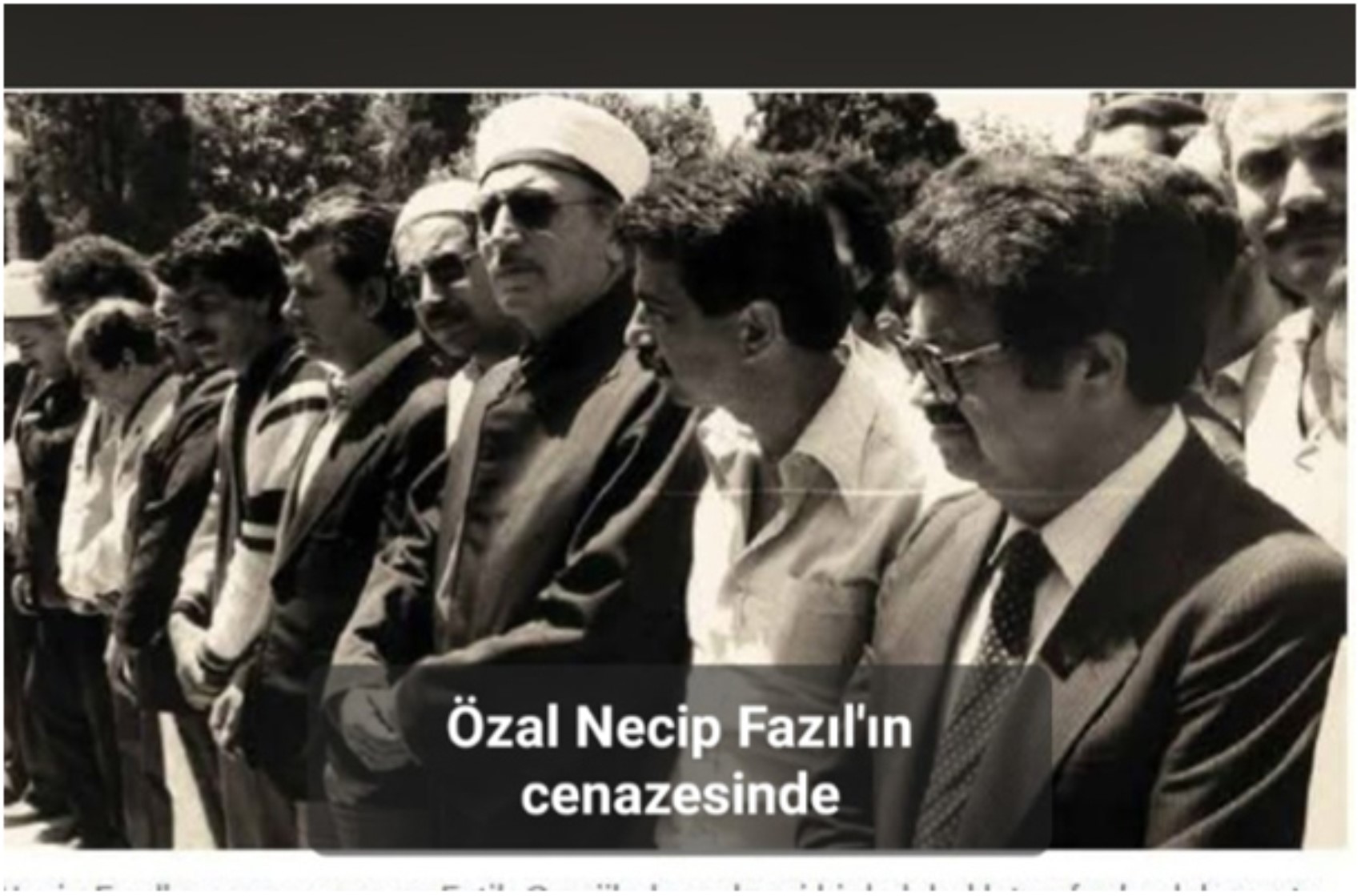
The National Security Council allowed the establishment of political parties in the spring of 1983. According to Kenan Evren, there had to be brand new parties. Turgut Özal, who was presented as the founder of Turkish liberalism on the right wing, rolled up his sleeves to establish the ANAP. In my opinion, Turgut Özal is the founder of alaturka capitalism, not liberalism. There is a tradition of seeking permission on the right. Turgut Bey visited Necip Fazıl at his home in Erenköy. He listened to his advice. After September 12, he had been invited by the National Security Council and appointed as the “deputy prime minister responsible for the economy.” After serving for two years in the Bülent Ulusu government, he had moved away from the public eye and gone to the USA. Upon his return, he established the Motherland Party with the approval of Kenan Evren. It was time to take power. For the party to come to power, it needed to receive support from different segments of society. One of these, of course, could be none other than Necip Fazıl, the symbol name of the Turkish-Islamic synthesis.
WHAT DID THEY SAY ABOUT NECİP FAZIL? WHAT DID THEY WRITE?
In this distinction, I would like to refer to the views of some of today’s writers.
My first reference will be Ahmet Hakan. As is known, he is a writer who emerged from the Necip Fazıl thought platform. He has benefited quite a bit from Islamism since 1994. We have all seen the process. At the end of 30 years, Ahmet Hakan has reached the point of saying, “Do not try to extract a guiding great mentor from Necip Fazıl, who begged for money from Menderes.”
Hasan Cemal, in an article he wrote in T24, writes that Erdoğan’s world of thought was formed entirely on the axis of Necip Fazıl. He says that both individuals see democracy as a station that can be gotten off at when conditions mature. (Hasan Cemal, T24, December 2017)
Hasan Cemal says that the AKP chairman, whom he once thought would make Turkey a full member of the European Union, has his hair stand on end when democracy is mentioned, and his chemistry is disrupted when he hears concepts such as independent judiciary, separation of powers, and the rule of law.
He says that Erdoğan is walking on the path of the “Great Eastern Order” that Necip Fazıl dreamed of. As of 2026, let the reader decide for themselves where we are on this march.
It would be correct to include a finding by Kemal Can here. Can uses the expression that there is almost no difference left between the AKP and the MHP regarding the ideological-political order. In my opinion, this result means that the two parties have met on a common denominator. This common denominator is “The Great Master’s Great Eastern Order.” According to Özgür Mumcu, this order is: local and national fascism.
NECİP FAZIL’S COUNTER-HISTORY NARRATIVE
A violent anti-secularism immediately draws attention in Necip Fazıl’s writings. There is a sultanist-Islamist-totalitarian perspective. His view of the post-Republican revolution is revisionist-counter-revolutionary. He always looks for Zionist conspiracies in the background of events such as the National Struggle, the Lausanne peace negotiations, and the abolition of the caliphate. There is a violent enmity toward İsmet Pasha in his writings.
Necip Fazıl had written articles in Hakimiyet-i Milliye during the Atatürk era. While accusing the government of not taking sufficiently harsh measures in an article where he addressed the Menemen incident (1931), he was able to be contradictory enough to claim in the 1960s that “the incident was a plot by the CHP government.”
The “Master” writes that March 31 was a plot carried out with Jewish-Masonic cooperation, and sees the Army of Action as a “herd of the unconscious.”
He interprets the Sheikh Said uprising not as a rebellion but as the resistance of a religious scholar against the Kemalist administration. The reason for the resistance is the abolition of the caliphate.
The great master writes that İskilipli Atıf Hoca was executed by the Independence Tribunal for opposing the “law on the wearing of hats.” However, the Court based its decision on the justification of “being against the national war of liberation.”
In his book “Religious Victims of the Last Era,” he commemorates Sheikh Said and İskilipli as martyrs, and in his book “Sultan Vahdettin, Not a Traitor but a Friend of the Homeland,” he mentions that the sultan gave 40 thousand gold coins to Mustafa Kemal and sent him to Anatolia. In his book “The Great Khan Abdülhamit,” he mentions that the Unionists isolated the deposed sultan by calling him mentally ill.
WHAT KIND OF STATE IS THE STATE OF SUPREME PRESIDENCY?
The State of Supreme Presidency is explained at length in Necip Fazıl’s book “Ideolocya Örgüsü.” The book defines the ideal state of the conservative utopia.
If one were to express this state with public law concepts; the state is “organized around the Supreme President; it is connected to the executive. There is an Assembly called the Supreme Presidency Council. But it is not possible to speak of a real legislative assembly. The members of the Council are not elected by general vote.
According to Necip Fazıl, it is not right to give the common people the right to elect state administrators. This reminds me of the conservative wing, which saw “all kinds of harm in the freedom of the public” during the 1876 Constitution discussions, saying to the innovators, “Guardianship over the Muslim public is established by the consensus of the community.” This means rule by the elite.
It is possible for the Council to dismiss the Supreme President, but the quorum is very high. The dismissal of the Supreme President is practically impossible. The Supreme President is the commander-in-chief and a leader who gathers all the executive means of the state in his person. The most important institution that the Supreme President consults is the High Council of Religious Affairs.
In the end, Necip Fazıl’s State of Supreme Presidency is a version of Plato’s “Republic” interpreted according to Islamic rules. It is an anti-democratic, authoritarian state that does not derive its legitimacy from the “general vote.” It is a closed regime whose official ideology is Sunnism.
Would you like to get notifications about new developments and save news?
- NotificationsNew developments and breaking news
- SaveNews is stored in the app
Most Read
Statement from Nihat Zeybekci on the fund investigation

New 75,000-seat stadium plan for Fenerbahçe
Fistfight at the Istanbul Bar Association elections!
Interpol and MIT tracking yields results in Izmir

ID convenience for KPSS candidates

2027 Budget: Taxes for the people, tax exemptions for capital

To whom and how was the Petition of Intellectuals submitted? Who accepted the petition?

The reality of Akkuyu and the longing for national nuclear power

The Çanakkale robbery -1- How was the Troy treasure smuggled out?

Artificial intelligence and the new imperialism