


Reactionism, counter-revolution, capitalism



WHY DID I WRITE THIS ARTICLE?
Turkey has undergone major transformations in the last quarter-century. The rule of law, equality before the law, judicial guarantees, the right to organize, and the right to vote and be elected—which our country achieved at the end of a 200-year development process—have been degenerated.
Fundamental rights and freedoms, such as equal opportunity in entering public service, have been effectively abolished.
Turkey seems to have lost its compass for reaching the level of contemporary civilization—despite all its shortcomings and criticisms—regarding the democratic institutions built by the Republican Revolution. The reason for this is the policy pursued by the ruling party.
The ruling party has transformed democracy into a plebiscite regime through fraudulent elections.
The ill intentions regarding the foundations of the regime, which the government tried to hide with "taqiya" (dissimulation) at the beginning of the 2000s, are now clear. The saying, "Those days are gone... 'The one who took the horse has already passed Üsküdar'" was not said in vain.
With the constitutional amendments it has made, the government has completely moved away from the principles of secularism and the rule of law.
However, Turkey was not brought to this point by the party in power in the last quarter-century alone. There is also a historical background to this. In this article, I wanted to address this process with examples.
In Turkish history, it is possible to trace reactionary actions back to the Tulip Era.
The trial of Mithat Pasha and the reformist wing (Hizb-i Cedid) in a sham court at Yıldız (1881) and their subsequent strangulation in Taif (1884), who led the 1876 Kanun-ı Esasi (Basic Law), constitute an important threshold in our political history. For this reason, it would not be wrong to start the history of counter-revolutions in Turkey with the massacre of Mithat Pasha.
After this murder in Taif, Turkey followed a struggle that fluctuated between the line of national sovereignty and democratic representation and the supporters of an essentially theocratic-monarchist state.
Reactionism, which suffered a heavy defeat against the Turkish Revolution brought to success under the leadership of the Great Atatürk, maintained its angry silence until the establishment of multi-party political life.
Although counter-revolutionary organizations, which began with infiltrations into the Democrat Party in the 50s, experienced occasional pauses, they have now come to power by taking advantage of the regime's weak points in the last three-quarters of a century.
As of today, it is impossible to speak of the Turkish State as a secular, democratic state of law that respects human rights.
In this article, I wanted to address how we got to these days by recalling the arguments of the regime's opponents.
VAHDETTIN GAVE ATATÜRK 40,000 GOLD COINS
In reactionary literature, it is frequently mentioned that Atatürk took 40,000 gold coins with him when he went to Anatolia (which Vahdettin allegedly gave him to "save the homeland"). This is a product of imagination.
Atatürk set out with an amount of money earmarked to cover the three-month salaries of the officers in the army inspectorate headquarters and the ration needs of the troops in his entourage. This is quite normal. This amount was given to him by the government.
The financial difficulties experienced by the leaders of the Defense of Rights (Müdafaa-i Hukuk) after being dismissed from the military invalidate the claim that he went to Anatolia with such money. There is also no document indicating that such an amount of money was paid to the army inspector.
THE PROMISE THAT THE CALIPHATE WOULD BE ABOLISHED WAS GIVEN AT LAUSANNE
At the Lausanne Peace Conference, a 200-year reckoning was made. The victors of the First World War were facing the Turkish delegation (Heyet-i murahhasa). In February 1923, the negotiations were deadlocked on the issues of financial matters, capitulations, and full independence (istiklal-i tamme). The Turkish delegation left the negotiating table. They returned to Ankara. The talks were interrupted.
At the negotiating table, our delegation continued the talks uncompromisingly in line with the political aspect given to it by the Grand National Assembly of Turkey (TBMM).
The allies, led by Great Britain, wanted to keep the rights of non-Muslim minorities in Turkey constantly on the agenda.
Their argument was: You are a theocratic state. Therefore, Christian communities must be under the protection of the West. They constantly kept the thesis on the agenda that this must be guaranteed in the peace treaty.
Against this, Chief Delegate İsmet Pasha and other delegates (Rıza Nur and Hasan Saka) stated that the TBMM Government was a new state based on national sovereignty and the equality of citizens, and that the state would be structured according to contemporary principles with the regulations to be made after the peace (in the field of Civil Law). This promise actually meant "The State of Turkey will be a secular state."
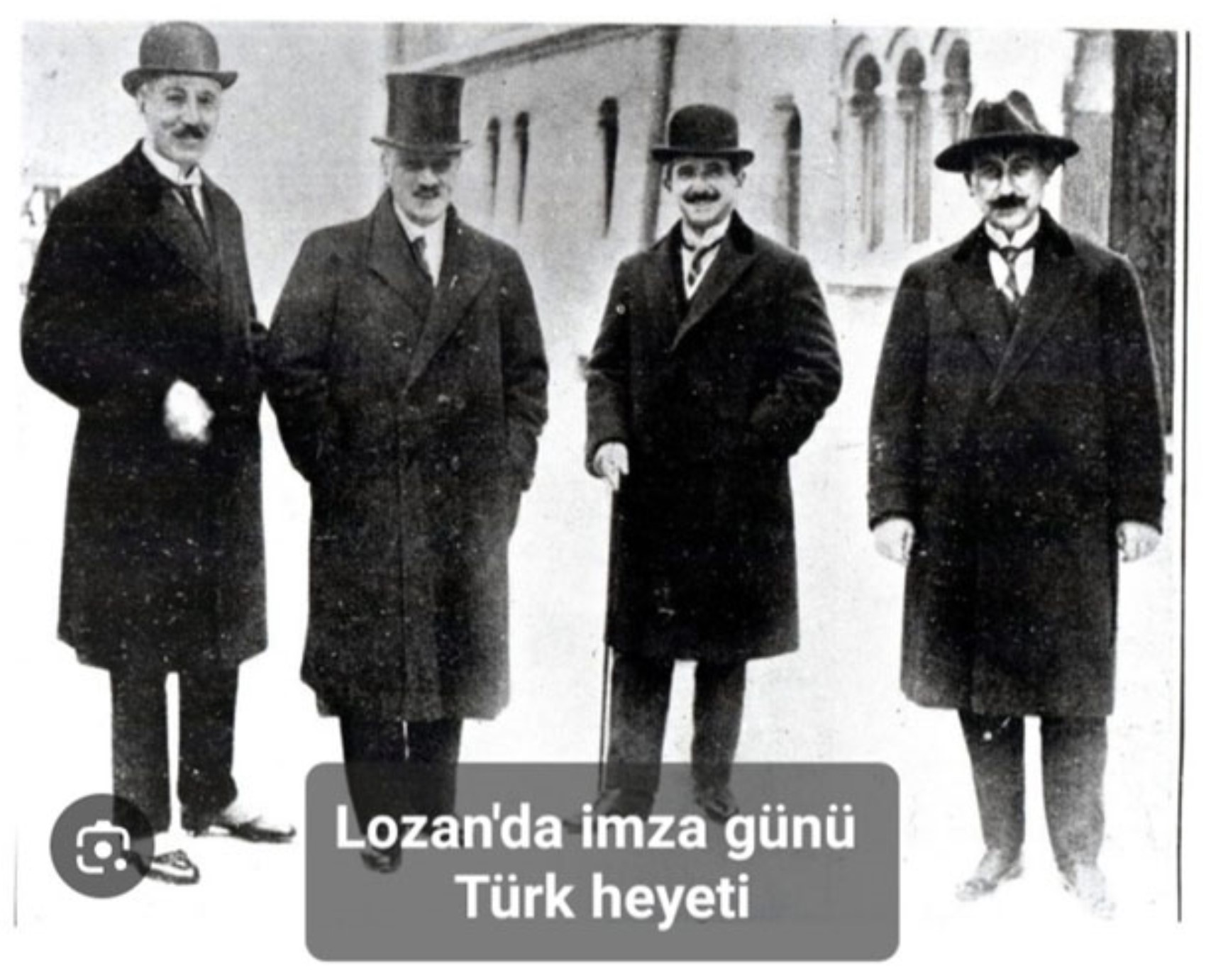
In a modern state where the principle of national sovereignty is in force, it was out of the question to preserve the caliphate, which is a medieval institution and functions to legitimize the monarchy at its core.
It was meaningless for the caliphate to be separated from the sultanate and represented by the dynasty. Furthermore, it was inevitable that counter-revolutionary forces would gather around Abdülmecid Efendi, who was elected caliph by the TBMM, and that a political role would be attributed to the caliph. Because, by the nature of things, the caliphate meant government.
In the face of these developments, the abolition of the caliphate was necessary and legitimate.
The abolition of the caliphate, which was maintained as a non-political office by the decision of the TBMM between 1922 and 1924, was to get rid of the outward appearance of the sultanate.
With Law No. 431, the caliph, who played the role of sultan in Istanbul, and the Ottoman dynasty were sent abroad. The leaders who founded the Turkish State took a radical step in the direction required by a contemporary state.
Contrary to what is claimed, Great Britain was the state that benefited most from the existence of the caliphate. The abolition of the caliphate is the final result of the republican revolution. The caliphate means sultanate. And this is incompatible with the republic.
WHAT DID THEY DO IN 80 YEARS OTHER THAN STATUES?
At the popular level, counter-revolutionary ideology feeds on the Middle Ages. This points to the living conditions of the 6th-century Arabs. Islam was born as a monotheistic religion in the polytheistic Arabian Peninsula. Let us remember that during the conquest of Mecca, the Kaaba was full of hundreds of god figurines.
Islam is a religion that has receptions from the other two monotheistic Abrahamic religions. It sees them as corrupted. The argument that "the Sharia is the same Sharia" is frequently voiced.
Prophet Muhammad's first act in Mecca was to personally destroy the god statues and turn the Kaaba (as an abstraction) into the house of Allah (eloah-el ilah). This act is one of the most important turning points in Islamic history.
In Islam, there is a prohibition on painting, sculpture, and music (teganni). The prohibition on sculpture has to do with the idols (god figurines) in the Kaaba. Islam became the dominant religion by destroying statues. This is why ISIS destroyed the Nineveh-Assyrian statues, which are a civilizational heritage. DAESH (ISIS) bombed 4,000-year-old artifacts. Since painting is also seen as associating partners with Allah's creative power, the art of painting did not develop in Islamic countries. There is miniature in Islam. There is no perspective in miniature. In this regard, there is also the concern of depicting the prophet.
In miniatures, Prophet Muhammad is depicted with his face covered with a veil.
It is also possible to see that music is haram in various catechisms. These prohibitions were reinforced by the fatwas given by the Umayyads and Sunni scholars. However, over the centuries, prohibitions on other fine arts, except for sculpture, began to be ignored. Scholars do not encourage painting and music. They ignore them.
Despite this entire taboo regime, a magnificent Arab and Persian music was born. It should not be forgotten that the pre-Islamic centuries lie at the root of this.
With modernization, painting and music became an area of pursuit, especially among the Ottoman elite. Like the Western aristocracy and bourgeoisie.
There are Ottoman sultans who composed in the Western sense. But the sensitivity (taboo) towards sculpture never changed. It continued.
The executed and accepted Damat Ibrahim Pasha brought three statues as spoils while returning from the Buda campaign: Hercules, Apollo, Artemis. Pargalı Ibrahim Pasha erected the statues in front of his palace in Sultanahmet. He received a great reaction from the public and the scholars. Poems were even written about the statues he brought being idols. After Damat Pasha was executed politically, his property was confiscated. The statues were removed. They were probably broken.
In front of Hagia Sophia, there was a Justinian statue on a giant column. The statue was a horseman pointing to the East. The column was erected in 543.
This statue of enormous dimensions was made of bronze.
After the conquest, this bronze statue was broken into pieces and melted down. It was used as material in the armory. (There are different rumors about when this event happened.) In short, sculpture falls into the taboo group in the Islamic World. Despite this, there is an interest in fine arts other than sculpture among the Ottoman elite.
This is the meaning underlying the anger in the words "What did they do other than statues?" that we frequently hear from our citizens who support the ruling party in street interviews. They mean to say that Kemalism has been making statues (idols) for 80 years.
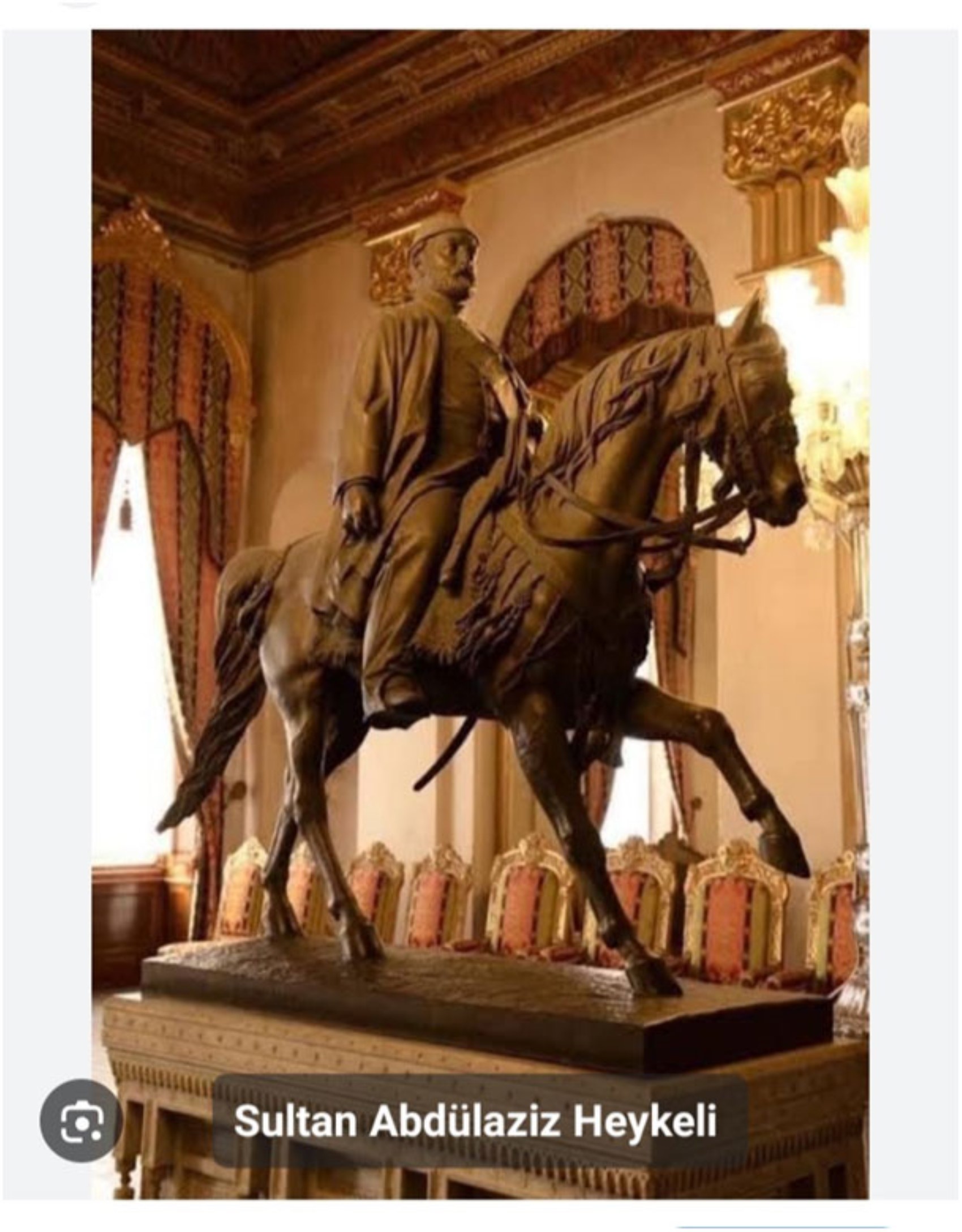
This is the reason why Atatürk busts are called "Concrete Mustafa, idol man" in the small towns of Anatolia. Those who utter these words are living in the Middle Ages 1,500 years later.
However, Sultan Abdülaziz wanted to decorate the Ottoman Palaces like those in the West after his long trip to Europe. He was impressed by the palace gardens enriched with landscaping and containing statues.
He wanted to see the same in his own palaces. Thus, a period in which Europe was imitated began. Statues were ordered from sculptors. They were brought. These are essentially animal statues. And they were placed in remote points where the public could not see them.
The painting taboo was a weak taboo starting from Sultan Mehmed II. The palace always had salaried painters brought from Europe. Such as Joseph Warnia Zarzecki, Antuan Melling, Fausto Zonaro, Ivan Aivazovsky.
II. Abdülhamid had taken Fausto Zonaro into the palace staff; he had allocated a three-story house in Akaretler. Master Zonaro also had a title: Ressam-ı hazreti şehriyari (Painter of His Majesty). Some of the photographs taken by Zonaro's wife Eliza had turned into paintings.
In fact, when Kaiser Wilhelm II came to Istanbul, oil paintings were ordered for the Chalet Pavilion where he would be hosted.
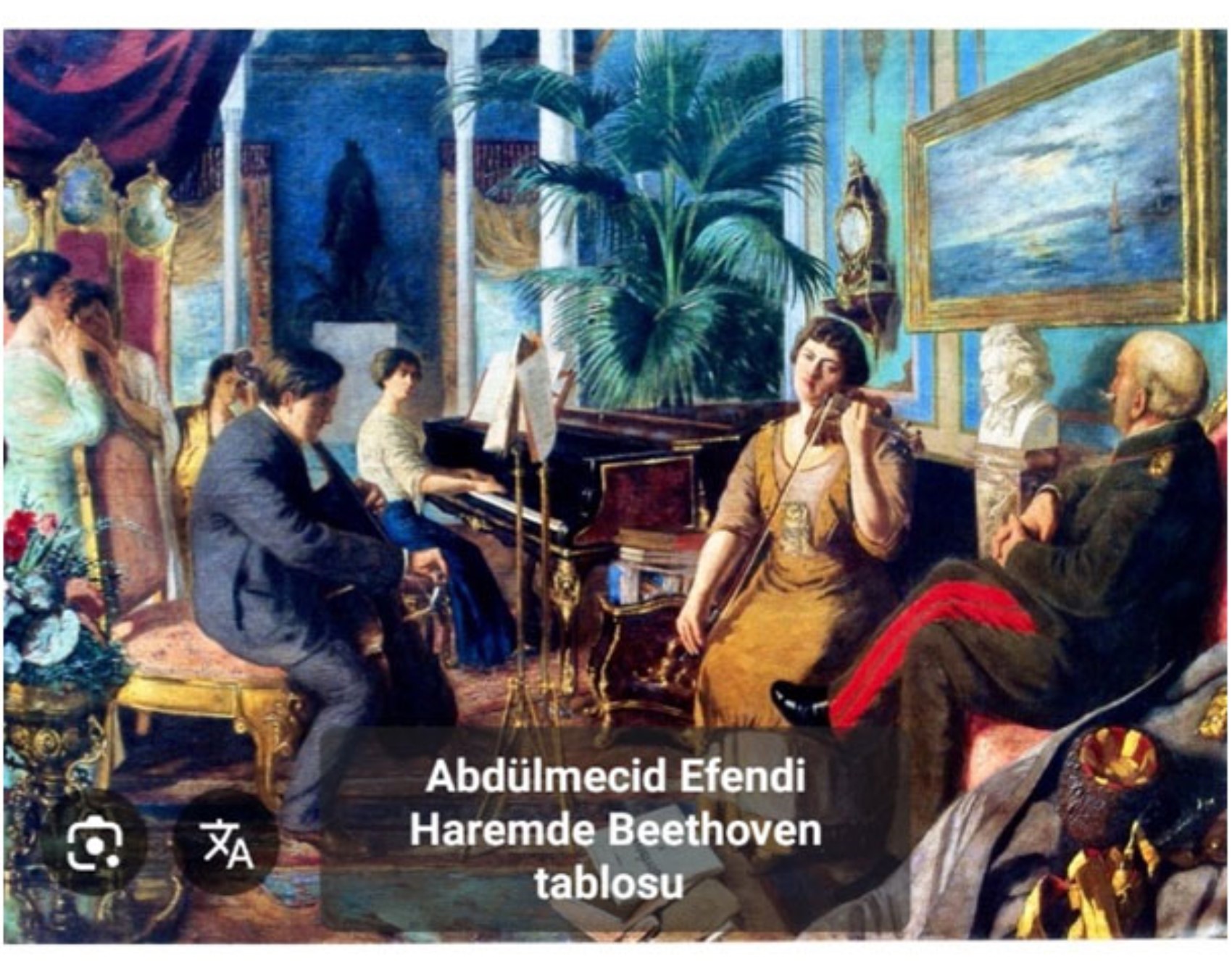
The last caliph, Abdülmecid Efendi, was also a painter who could produce works worthy of consideration in European art exhibitions, just as he was proficient enough in piano to compose.
VAHDETTIN SENT MUSTAFA KEMAL PASHA TO ANATOLIA TO SAVE THE COUNTRY
Mustafa Kemal Pasha was sent to Anatolia by the Damat Ferit Pasha government. The appointment decree was published in Takvim-i Vakayi. (May 5, 1919) The assigned task included broad military and civil powers. For this reason, approval was obtained from the Minister of War and the Minister of the Interior before the government decree. Of course, it included the signatures of Grand Vizier Ferit Pasha and Sultan Vahdettin as the head of the executive.
The reason for granting these broad powers was the complaints of the allied headquarters. According to the claim, the Turks were massacring the Pontic Greeks in the Eastern Black Sea. What they wanted from the government was the maintenance of public order in the region.
Mirliva (Brigadier General) Mustafa Kemal Pasha, who had been excluded by the Enver Pasha wing of the Committee of Union and Progress throughout the war, was sent to Anatolia as a competent general to protect the Pontic Greeks and ensure security and public order in the region.
The allies were claiming—according to the terms of the armistice—that if security could not be ensured in the region, they had the right to intervene directly, as in Cilicia (Çukurova) and Ionia (Izmir).
Mustafa Kemal Pasha's visit to Sultan Vahdettin after being appointed to the post was a requirement of the state customs and etiquette of the period. It was a visit by a general appointed to an important post to the sultan.
His participation in the Friday Procession at the Beşiktaş Sinan Pasha Mosque is due to his title of "Fahri yaveri hazreti şehriyari." The expansion is: it means honorary aide-de-camp to the sultan.
The words attributed to Vahdettin, "Pasha... Pasha—pointing to a history book in front of him—what you have done so far has entered this book. From now on, you can save this nation," do not mean organizing a national resistance movement in Anatolia.
It is true that the Gazi used the powers he received from Istanbul from his landing in Samsun until the Erzurum Congress to establish a Defense of Rights Front. Because he needed political power.
The goal of the Ferit Pasha government was to manage the situation with minimal intervention until the peace conference by strictly implementing the terms of the armistice (disarming the army).
The developments from the spring of 1919 to the Sivas Congress and the Gazi's dismissal from the inspectorate, and his being sentenced to death after the opening of the TBMM, show that the way the counter-revolutionary literature interprets the event is a product of imagination.
 THE REMOVAL OF THE REPUBLIC OF TURKEY INSCRIPTION AT THE ENTRANCE OF ISTANBUL UNIVERSITY
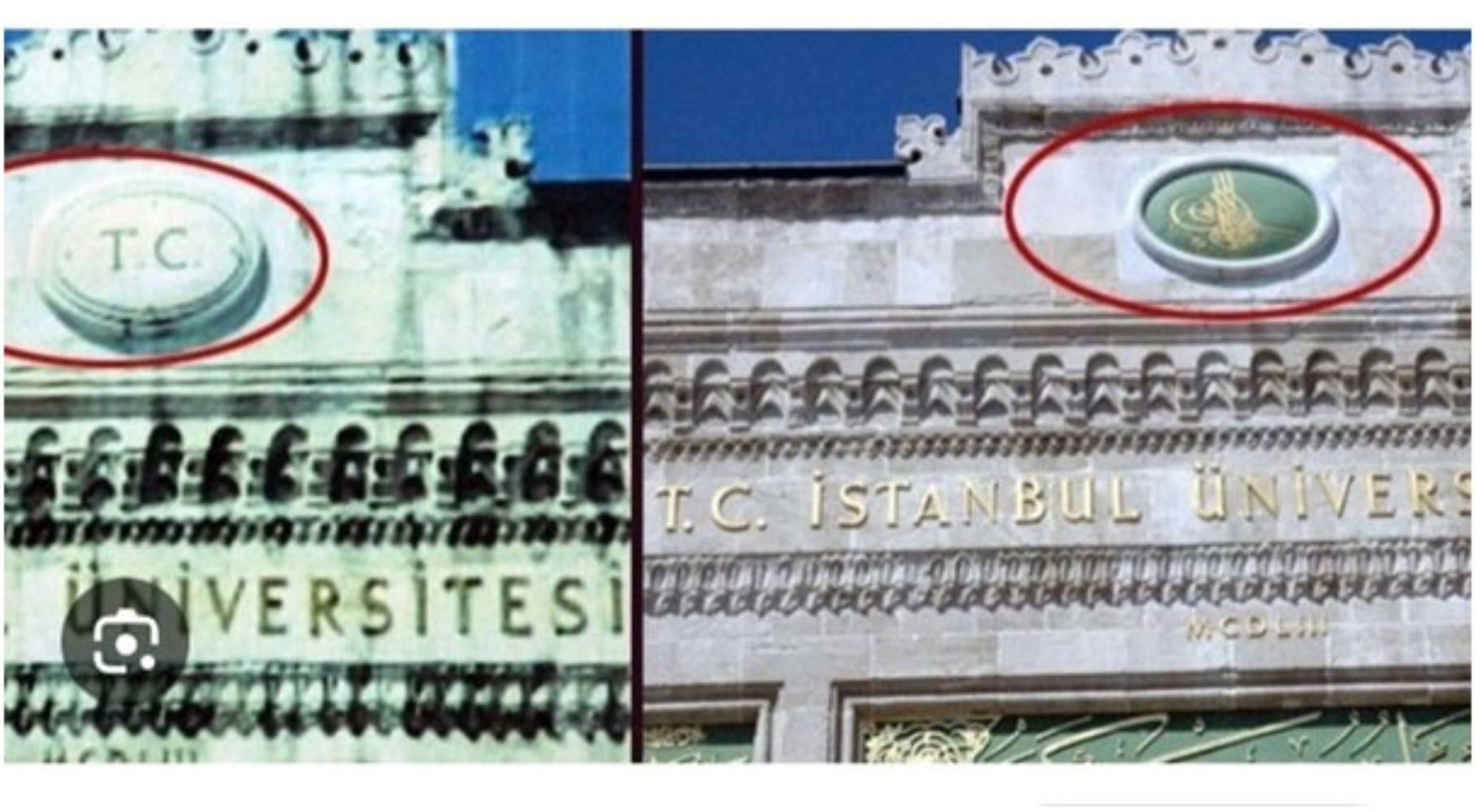
Those who studied at Istanbul University know very well. There was a Republic of Turkey inscription above the main gate. On a marble plaque. It had been placed there after the 1933 University Reform. This plaque is no longer there. In its place is the tughra (monogram) of the Ottoman sultan Sultan Abdülaziz.
I would like to explain the event as follows: In 1924, the Ministry of War building (IU central campus) was given to the Istanbul Darülfünun (University). This was a great gesture of the Republic to the university. The Feriye Palaces were also given to the Mekteb-i Sultani (Galatasaray High School) and Kabataş High School. The Galatasaray University Ortaköy campus is the Prince Tevfik Efendi Palace. The Republican administration gave this building to Galatasaray High School.
The Ministry of War had been built as the Babı Seraskeri (Office of the Commander-in-Chief) in the last quarter of the 19th century. Sultan Abdülaziz had an entrance gate built inspired by the architectural style dominant in the West at that time. Its architect is the Frenchman Bourgeois.
Let me remind you that Sultan Aziz went on a long European tour. The first and only one. Abdülaziz, who was welcomed with great interest in European palaces, wanted to apply what he saw in Europe to his country when he returned. Especially in the fields of architecture, painting, and sculpture. He had also taken Prince Abdülhamid with him.
The gate is still the symbol of Istanbul University. It says "Daire-i Umur-ı Askeriye" (Department of Military Affairs) on its facade. The 1933 University Reform abolished the Darülfünun. It established Istanbul University in its place. With a very important symbolic design, Abdülaziz's tughra was covered with the T.C. (Republic of Turkey) plaque. There was now an institution called Istanbul University. This was a "Republican" institution.
The rector appointed by the AKP had the T.C. inscription removed under the pretext of restoration. The Sultan Aziz tughra, which was revealed from underneath, was polished and brought out. As if giving the message that the Ottoman State was re-established.
The T.C. inscription was squeezed into a place lower down. I recommend you go and see the event. The meaning of this is to put the Republic under the Ottoman.
This design is one of the most striking examples of the Islamist-Ottomanist ideology's actions to hollow out the republic.
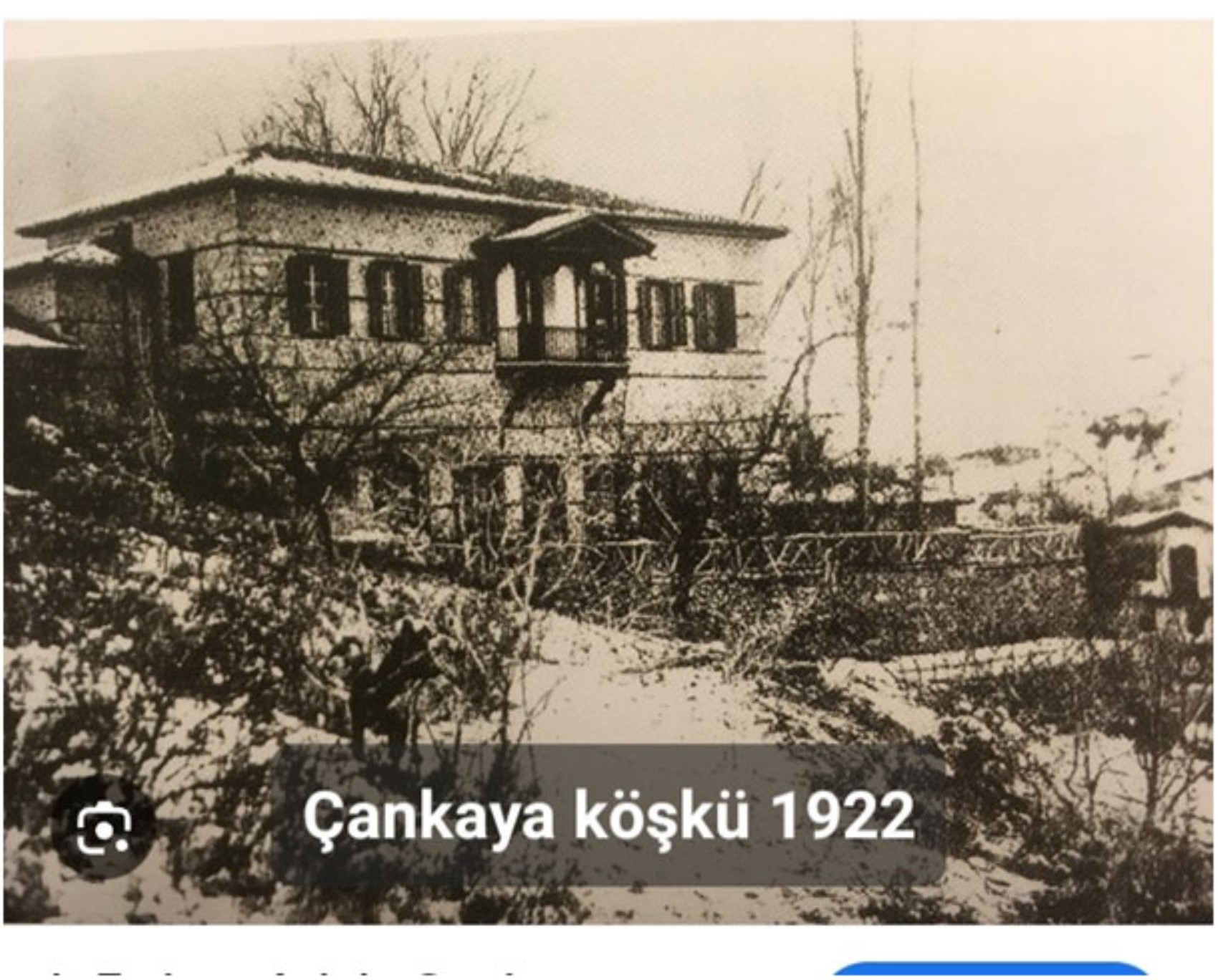
THE REMOVAL OF ÇANKAYA MANSION AS THE PRESIDENTIAL RESIDENCE
Çankaya Mansion, which has become identified with our national war of liberation and the great Atatürk, has been removed as the presidential residence.
Çankaya Mansion is the symbol of the republic. When Atatürk and the leaders of the Defense of Rights came to Ankara, the number of places that could be used as a residence was extremely limited. Public buildings around the station were tried to be used rationally. Mustafa Kemal Pasha, the Speaker of the TBMM and the natural head of the Council of Ministers, was staying in the Steering (Direksiyon) building of the station. Steering building: means the railway route and traffic timing building. The building was the meeting place of the government and Atatürk's residence.
When Fikriye Hanım came to Ankara, the Gazi was living here. Fikriye's arrival in Ankara: It was in November 1920. There are many pictures of her in the Steering building. She had great efforts in making Çankaya livable.
The notables of Ankara bought the abandoned mansion, which was in an idle state in a place called the priest's vineyard in Çankaya, for Mustafa Kemal Pasha. The first owner of the mansion was an Armenian family native to Ankara: Ohannes Kasapyan. At that time, it was the property of Bulgurluzade Tevfik Efendi. The people of Ankara bought the mansion for 4,500 liras with the mediation of Mufti Börekçizade and gifted it to TBMM Speaker Mustafa Kemal Pasha. (May 30, 1921) The mansion became the residence of all presidents starting from 1923. Going up to Çankaya was used synonymously with being elected president. In this sense, Çankaya was the symbol of the highest office of the State.
The mansion was used by Atatürk, İnönü, Bayar, Gürsel, Sunay, Korutürk, Evren, Özal, Demirel, Sezer, and Gül.
After the 2017 presidential election, the new building, which was being built as the Prime Ministry working office within the Atatürk Forest Farm, assumed the function of Çankaya by being named the Presidential Complex. (Beştepe) Such changes are synonymous with founding a new state in Turkish history (since Central Asia). Çankaya Mansion is a political symbol identified with the state, like Downing Street No. 10, the White House, Buckingham Palace, the Reichstag, and the Kremlin.
Making Çankaya a museum means considering the republican administration between 1923 and 2017 as a period that has passed into history, a closed chapter.
Çankaya means the Turkish Revolution, the Republic of Turkey, and Atatürk.
THE AUDACITY TO CURSE THE GREAT ATATÜRK FROM THE PULPIT OF HAGIA SOPHIA
Hagia Sophia was opened for worship on July 24, 2020, in an environment where the Covid-19 pandemic was raging. The date is meaningful: The day the TBMM Government signed the Treaty of Lausanne. I don't know if it's a coincidence.
The museum status of Hagia Sophia was a subject that had been exploited to the fullest by the religious right. Reactionary circles had been processing a theme very intensely since the 50s, such as Hagia Sophia being taken out of the hands of Islam and given back to Christianity.
The conversion to a museum had taken place with a Council of Ministers Decision (President Atatürk) in 1934.
Until that date, Hagia Sophia had remained the largest church of Eastern Christianity for 1,000 years. It still has a special importance for the Orthodox world today. Its conversion into a mosque after the conquest of Istanbul is presented as a great victory (gala) in the Muslim world.
In popular Islam, it is perceived as the success of the ghaza (holy war).
The fact that the Ottoman Empire, which lagged behind the West, held Hagia Sophia creates a surrogate psychological effect. Even though we were defeated in the siege of Vienna and the Balkan War, Hagia Sophia was in the hands of the Ottoman Empire, the "standard-bearer of Islam."
Hagia Sophia's dome had collapsed three times and had suffered major fires. Thanks to the buttresses built by Mimar Sinan, it has reached the present day. It had undergone a serious restoration by the Fossati brothers during the time of Sultan Abdülmecid. (1847-1849) Atatürk saw Hagia Sophia as a very valuable part of world cultural heritage. It is the same for me. It is a unique civilizational heritage that has reached the 21st century thanks to careful restorations. Of course, a contemporary mind can understand this thought.
Hagia Sophia is of course ours. Its frescoes, depictions of Mary and Jesus, Justinian and Theodora, the "Halfdan was here" inscription carved by a Viking soldier into the upper gallery, the calligraphy plates of Kazasker Mustafa Izzet Efendi, the candlesticks standing on both sides of the mihrab brought by Suleiman the Magnificent from the Battle of Mohács are all a whole. This heritage is entrusted to us.
There could have been another way to share this common heritage. But the counter-revolutionary ideology needed a new conquest. In the middle of the pandemic, the economy had collapsed. An ideological buttress was desperately needed. This need was met by humiliating Atatürk's memory.
First of all, there can be no superiority of Fatih's endowment (vakfiye) over the republican revolution and its laws. The law of the revolution comes before the endowment. The sultanate was abolished on November 1, 1922, and the caliphate on March 3, 1924. Beyond that, there is no special curse for Hagia Sophia in Mehmed II's endowment.
Meanwhile, the way the Council of State decision, which ensured the transfer of Hagia Sophia to the Directorate of Religious Affairs under the name of Hagia Sophia Grand Mosque by removing its museum status, was taken is an example of "getting around" the law.
The administrative judiciary acted unlawfully by accepting a lawsuit filed by a foundation that was incompetent in terms of legal standing. By canceling the Council of Ministers decree bearing Atatürk's signature, his moral memory was trampled upon.
The scenes at the opening of Hagia Sophia showed that the Republic's goal of contemporary civilization does not mean anything to a segment of the public.
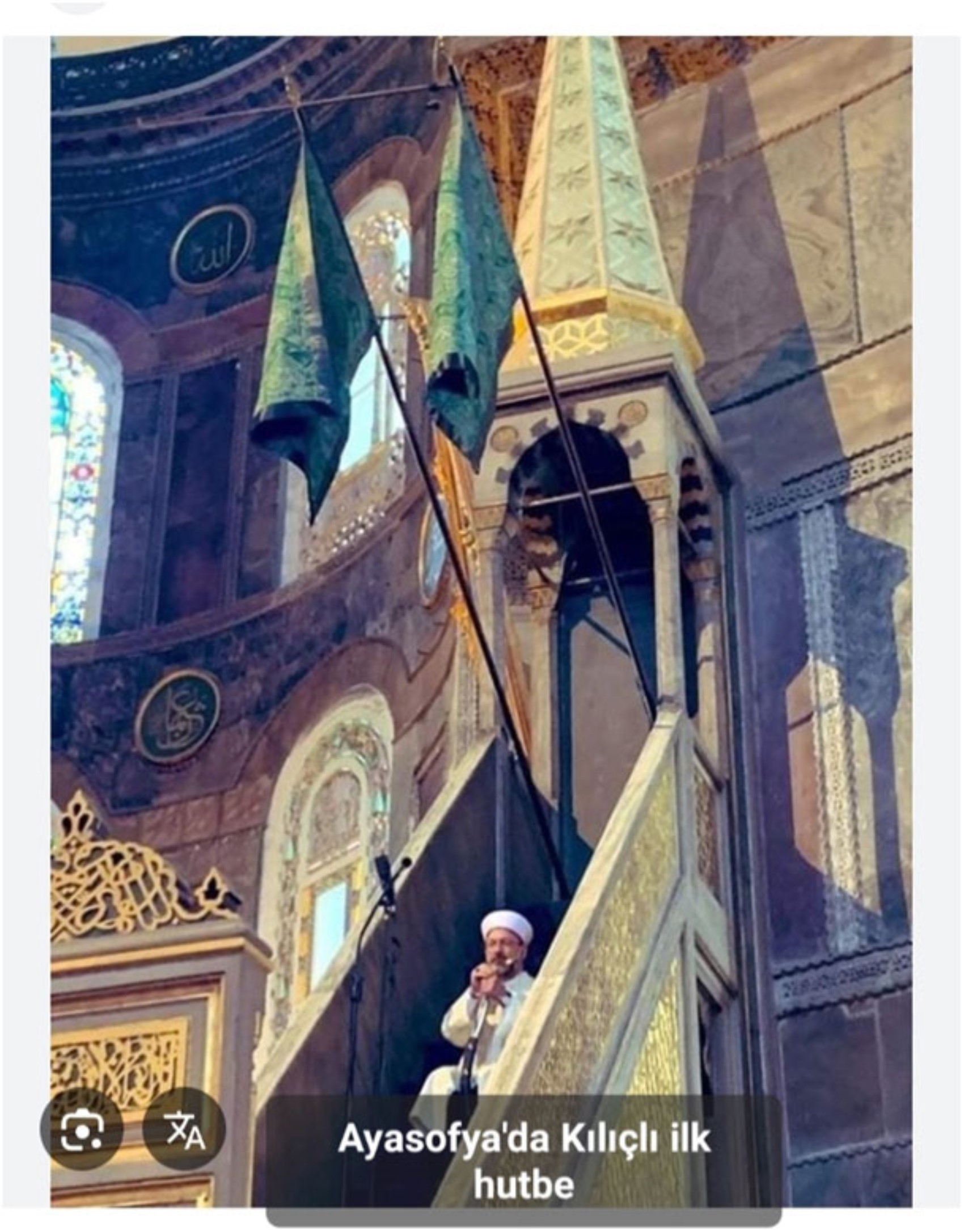
The government's way of opening Hagia Sophia with green caliphate banners and swords, and the head of the Directorate of Religious Affairs cursing the savior of our homeland, was turned into a show of taking revenge on Gazi Mustafa Kemal Atatürk. The attack on the Great Atatürk was later continued with the words of head imam Boynukalın: "It is not permissible to pray for mercy for a non-Muslim."
These spiteful circles, who owe the position they are in to the republic founded by Atatürk, are increasing their audacity under the protection of the government.
Today, Hagia Sophia's mosaics and frescoes cannot, of course, be covered with plaster as they were after the conquest. For this reason, the dome, ceiling, and upper galleries where Jesus and Mary, the apostles, angels, and other Christian saints are depicted are covered with large curtains.
This situation provokes the feeling that a place of worship built by Christians was taken away from them by Muslims.
The Directorate of Religious Affairs has reached the image of the Babı Meşihat (Office of the Sheikh ul-Islam) by having more extensive resources in every budget year.
The financial resources they have obtained through their foundations have reached enormous dimensions. The Directorate of Religious Affairs is benefiting from capitalism to the maximum extent.
The opening of Hagia Sophia for worship has served to overshadow the government's increasingly worsening performance.
Turkey's decline in terms of human rights and rule of law criteria, and the economy hitting rock bottom, were somewhat distracted by the reconquest of Hagia Sophia.
SHEIKH SAID, ISKILIPLI ATIF, AND SAIDI NURSI ARE RELIGIOUS SCHOLARS WHO ARE VICTIMS OF KEMALISM
Sheikh Said is a dervish sheikh who caused a major internal security problem in the founding years of the Republic of Turkey. He is a Naqshbandi. He was the one with the greatest influence among the sheikhs affiliated with this order.
After 1924, with the enactment of the revolutionary laws, the construction of a nation-state was initiated by eliminating the hegemony of feudal religious authorities that had been going on since ancient times.
There are enough publications about the Sheikh Said rebellion. The details can be examined. In my opinion, the real reason for the Sheikh Said rebellion is the resistance of the local religious-political authority affiliated with the caliphate to the republican revolution.
When the rebellion broke out, Fethi Bey was the prime minister. The government resigned. İsmet Pasha formed the government. The Law on the Maintenance of Order (Takriri Sükun) was enacted. The rebellion spread to cover the provinces of Elazığ, Bingöl, and Diyarbakır between February 13 and March 31.
The demographic infrastructure of the rebellion was formed by Kurmanji Kurdish tribes and Sunni Zazas.
The Republic's three armies were sent to the rebellion region. Thousands of rebels were killed. Hundreds of soldiers lost their lives in the clashes. The civil war ended with the victory of the government forces.
The archaic status quo represented by Sheikh Said was cleared from the region. The Republic established its sovereignty.
But interestingly, the legitimacy the government gave to Kurdish separatism in the referendum with posters saying "every yes is a Fatiha for the soul of Sheikh Said" was carried to the extreme point with the naming of a boulevard in Diyarbakır.
This means the restoration of reputation by the government for a figure who led the greatest separatist uprising in our republican history. This event constitutes a flagrant example of counter-revolutionary discourse.
Another important name of the counter-revolutionary front is Saidi Nursi.
Saidi Nursi is the basic thought and action reference for the Nur students or the Nurculuk circle.
His transcribed speeches are known as the Risale-i Nur. The Nurists who grow up around Saidi Nursi see him at the level of "sainthood." In fact, it is understood from Saidi Nursi's words that he sees himself as a semi-prophetic person.
During the Constitutional Monarchy period, he came face to face with the Committee of Union and Progress and was sent into exile. (31 March incident) During the World War years, a regiment consisting of Nur students was assigned to the Russian front by Enver Pasha. The Nurists fought against the Russians under the command of their sheikh, Saidi Nursi. I could not obtain information about the size of the regiment and Nursi's command performance.
Saidi Nursi had fallen captive to the Russians and was kept in a prisoner-of-war camp on the banks of the Volga. Duration: two years.
In all likelihood, he was able to return to the country after the October revolution. One of the reasons for his fierce Russian and Bolshevik enmity may be his years of captivity.
We see Saidi Nursi in the Naqshbandi Lodge in Çamlıca during the armistice years. Before the Great Victory, he had gone to Ankara and received a warm welcome.
He had made suggestions to the deputies and TBMM Speaker Mustafa Kemal Pasha regarding alcohol and prayer, tried to argue with the Gazi on the concepts of apostasy and apostate, and angered our great savior.
The Antichrist (Deccal) and Sufyan mentioned in the Nur treatises are in all likelihood Gazi Mustafa Kemal Atatürk.
Fethullahism, which calls itself the "Service Movement," was born from Nurculuk. I am sure that Saidi Nursi was treated as a preacher whose mental balance was questionable in the early Republican period.
Saidi Nursi re-emerged with the Democrat Party government. Throughout the 50s, he was a missionary whom Menderes favored against İsmet Pasha. It is known to all of us that Necip Fazıl was also within this regime of favor.
He was touring for propaganda against the CHP in a luxury car gifted by Menderes in Anatolia and was being supported by the prime minister from the secret fund.
Saidi Nursi had remained in exile in the village of Barla in Isparta for a long time. (1926-1934) But this exile had caused the number of Nur students around him to increase.
I think Süleyman Demirel, a villager from Isparta Islam, had also taken Quran recitation lessons from Nur students for a while during his primary school years.
Risale-i Nur and Nurculuk were seen as a harmful religious movement monitored by the police during the single-party period. This situation changed during the Democrat era. It began to be treated as a "mission" that the government benefited from.
Professor Ali Fuat Başgil saw the Nurists as a civil society movement. He remained in custody in the Balmumcu Barracks for a while due to the articles he wrote against the National Unity Committee in 1961. He was tried.
Meanwhile, he was heard as a witness in the Yassıada trials (in the case of violating the constitution). During his Balmumcu detention, he was warned by the investigating judge, "Don't you know that Nurculuk is a crime?"
My teacher Tarık Zafer Tunaya had also been appointed as an expert witness in a case related to the Risale-i Nur and had defined the community as an anti-secular criminal organization in his report. He told me that he had received threats for this reason.
Saidi Nursi passed away in Urfa just before May 27 (March 1960) and was buried in the courtyard of the Halilürrahman Lodge.
The NUC (National Unity Committee) government moved Nursi's grave, which had become a place of intense visitation, to an unknown location. It is probably in Isparta Barla. Its location is known by a few Nur students.
At this very point, I would like to tell a memory of mine.
During a period when I had just moved to the Galatasaray University Faculty of Law, I had witnessed the sectarian attitudes of one of my students in class. The course was: History of the Turkish Revolution.
I am not in favor of reacting to the student or acting harshly in such cases. I brushed off the situation. But the student had excessive self-confidence.
Then I saw that student of mine on TV. Namely, it was a time when the AKP's propaganda of "We are entering the European Union. We need to change the constitution. They won't take us into the EU without getting rid of the tutelage regime" was very popular. The year was 2012.
The Constitutional Commission requested opinions from non-governmental organizations. One day on TV, I saw my overly self-confident student presenting a report to the commission. He was telling the commission chairman that the Risale-i Nur should be utilized during the new constitution studies. (date: April 3, 2012 reference: risalehaber.com) The Nurist delegation consisted of law students studying at Bilkent, Galatasaray, and Marmara universities. Looking from today, I can say that I understand better what happened to Turkey.
As a result, Nurculuk continues to receive patronage today as a counter-revolutionary movement.
The figure I want to address as a final example is İskilipli Atıf Hoca. He is a scholar whom the current government presents as a victimized religious scholar.
Exile and prison sentences had been given to him due to his opposition activities during the periods of II. Abdülhamid and the Committee of Union and Progress (31 March). Atıf Hoca was one of the names the Unionists sent into exile to Sinop.
During the armistice, he was one of the founders of the Cemiyet-i Müderrisin (Society of Teachers) and the Teali-i İslam Cemiyeti (Society for the Elevation of Islam). (1919) He maintained his opposition to the national war of liberation until the end. He was not one of the clergymen who supported the struggle for liberation.
He was tried in the case related to the dropping of the Teali-i İslam Cemiyeti's declarations against the Anatolian movement by Greek planes.
İskilipli Atıf Hoca published the treatise "Frenk Mukallitliği ve Şapka" (Western Imitation and the Hat) in 1924. At that time, the "Law on the Wearing of Hats" had not yet been enacted. He was sentenced to death by the Ankara Independence Tribunal, being seen as related to the events that broke out in Anatolia after the hat law. (December 7, 1925) Atıf Hoca was executed together with Babeski Mufti Ali Rıza Efendi on the grounds that he was involved in the events that broke out in Of, Erzurum, and Rize.
Conservative-counter-revolutionary circles say that Atıf Hoca was punished in a way contrary to the general principles of law due to a book he published before the law was enacted.
However, the punishment was not given for this reason. Atıf Hoca was executed by being seen as related to the actions in question. Not because he didn't wear a hat or published a book.
Independence Tribunals are extraordinary regime courts. Their judges and prosecutors are members of the TBMM. They do not follow the procedures of ordinary judicial courts.
I would like to state my opinion regarding the sentence given to İskilipli. İskilipli's actions had been questioned since the reign of Sultan Hamid and had been suspicious. All governments have seen an opposition attitude—more or less—in his state and actions.
İskilipli was not among the scholars who supported the National War of Liberation. He was not a nationalist. He was a supporter of the sultanate. After the republic, he continued his anti-revolution line. The TBMM government had given him a civil service position in the Ministry of Sharia. Despite this, he did not change his line.
As for the crime committed, I do not believe that Atıf Hoca was directly involved in the uprising in the mentioned provinces. However, it is clear that he was an opponent of the regime with what the Hodja Efendi wrote and said.
The issue has nothing to do with "laws not being retroactive." It has to do with the Hodja Efendi being a counter-revolutionary.
What is strange is that his name has been given to a state hospital and student dormitories in Çorum, and he has been sanctified by the city's governor.
Atıf Hoca has been sanctified as a victim of Kemalist revolutions since the first years of the political government. He has been elevated to the rank of a scholar who is a victim of the revolution.
The fact that his grave has become a place of visitation for civil administrators, ministers, and deputies means that we are against the republic founded by Kemal Atatürk. This attitude is clearly counter-revolutionary.
THE CLASS PARADOX OF THE TURKISH REVOLUTION
The Turkish Revolution is a delayed democratic revolution. It is a bourgeois revolution that contains contradictions different from those in the West. The reason for the delay is class-based and conjunctural. Its internal contradictions also lie in its class structure.
The leading class of the revolution is the petty-bourgeois class. Its leader is Mustafa Kemal. In clearer terms, it is the progressive wing of the civil and military bureaucracy.
The bourgeoisie, which should have been the essential element of the revolution, was positioned in cities and economically developed regions, and did not have enough consciousness to defend secularism—the foundation of the republican revolution—sincerely (it is more accurate to say with class consciousness).
THE CLASS BASIS AND IDEOLOGY OF THE COUNTER-REVOLUTION
In Turkey, the class basis of the counter-revolution is the carriers of the periphery economy. In the past, these were the ruling elites and the scholars (ulema). The scholars are the class of clergymen who are the carriers of the state ideological apparatus (SIA) that reproduces hegemony. This class corresponds to the clergy in the West.
The dominant characteristic of the Turkish bourgeoisie is that, while holding economic power, it has remained on the border of becoming bourgeois (politically and culturally). For historical and social reasons.
Atatürk had marginalized the dervish order structures by taking religion under state monopoly through the Directorate of Religious Affairs. While making the decision to close the lodges and zawiyas, he aimed to eliminate the human and material foundations of the community structures that could resist the march of the revolution.
But they continued their existence under the guise of a mosque congregation. Example: Like the İskenderpaşa Lodge.
In history—especially—the Naqshbandi and its branches have been the most powerful orders. The de facto existence of a few lodges was also turned a blind eye to by the administration.
For example, Fevzi Pasha being a follower of the Naqshbandi-Khalidi Sheikh Küçük Hüseyin Efendi lodge, and Hasan Ali Yücel being a follower of the Yenikapı Mevlevi Lodge.
The most important issue of the counter-revolution is that Atatürk wanted to end the sovereignty of religion and make the principles of science, art, and enlightenment dominant. Atatürk took religion down from power and put science in its place.
The natural result of this would be the decline of the social status of the class of clergymen. I would like to remember how angry he was at the students of the Konya Dar-ül hilafet-ül aliyye (High School of the Caliphate) madrasas who did not want to go to the army before the Great Offensive. (April 1, 1922)
HOW DID THE COUNTER-REVOLUTIONARY IDEOLOGY COME TO POWER?
Multi-party political life pushed the Democrat Party and its successors to seek allies against the opposition. The DP and the Justice Party needed populism. Both parties pursued a policy that satisfied conservative-reactionary circles without sharing power. They kept them on the border of benefiting from power without cutting contact with reactionism.
The executors of this policy are Bayar and Demirel. Menderes's sensitivity to secularism is behind both of them. I can even say it doesn't exist. Since he could say to the DP group that raised a rebellion against him, "You can even bring back the caliphate if you want.”
From 1950 to 1975, when the First Nationalist Front Government was established, the green capital where the counter-revolution found growth developed and flourished in Anatolia.
After 1991, the center-right, which received the support of the big city bourgeoisie, collapsed. This void facilitated the Islamist right's candidacy for power.
In my opinion, what enabled the party of green capital (AKP) to come to power is its seizure of the hegemony area held by secular capital in the past. The AKP was able to become a candidate after giving sufficient guarantees to international capital, and it was allowed to come to power.
These guarantees went through fully satisfying the demands of international finance capital. This was the liquidation of public enterprise and the presentation of the republican accumulation—for next to nothing—to savage capitalism on a golden platter.
International capitalism had accepted Kemalist Turkey into its own structure with its reservations until the collapse of the Soviet system in 1991. There has been no need for this for 30 years.
For this reason, since the role attributed to Turkey has changed, a Middle East Federation without secularism could be more efficient and functional for global capital.
In Turkey, the most suitable political movement that could meet these demands was Islamism. The economic policy implemented for the last 30 years has clearly shown that the Islamist right has no problem with monopoly capital and international capitalism.
Interestingly, the cadres implementing this have emerged from the segment that has serious problems with Turkey's republican accumulation. Such as the National Turkish Student Union and the Foundation for Service to Science.
Turkey's Islamism has no epistemological issue with the West, especially the USA. Shiite Iran does. Because the state and political tradition of Shia is different.
While the masses are consoled with the nostalgia of the Ottoman conquest centuries, the political delegation brought to the head of Turkey is playing the role assigned to it. This role is the transfer of resources from the periphery and semi-periphery (periphery and semi-periphery economies) to the center of capitalism.
Would you like to get notifications about new developments and save news?
- NotificationsNew developments and breaking news
- SaveNews is stored in the app
Most Read
Statement from Nihat Zeybekci on the fund investigation
New 75,000-seat stadium plan for Fenerbahçe
Fistfight at the Istanbul Bar Association elections!
Interpol and MIT tracking yields results in Izmir
ID convenience for KPSS candidates

2027 Budget: Taxes for the people, tax exemptions for capital
To whom and how was the Petition of Intellectuals submitted? Who accepted the petition?
The reality of Akkuyu and the longing for national nuclear power
The Çanakkale robbery -1- How was the Troy treasure smuggled out?

Artificial intelligence and the new imperialism