


Watching Genco Erkal in the 70s



FIRST TRIP TO BEYOĞLU
I believe I first encountered Beyoğlu in the winter of 1972/73. As a middle school student. Our teachers had taken us to the theater. To see Abdülcanbaz. I don't remember being taken anywhere before that. I use the expression "being taken" specifically. The places we could go on our own were different from the places we were "taken" to. For us, the place we could go was Üsküdar. Or the Grand Bazaar or the Spice Bazaar for shopping with my mother. The answer to the question "Where are you going?" would be "I'm going to Istanbul." In the 70s, in Anadoluhisarı, which still carried the air of a fishing village, one would go down to Istanbul by ferry. On the wooden rectangles showing which piers the ferries would stop at, it said "Bridge." The Bridge meant the Galata Bridge back then.
THE MEANING OF BEYOĞLU
Beyoğlu was not a district spoken of very positively within the family. I understood the reason for this later. To put it in the language of Peyami Safa, Beyoğlu was the Westernized Istanbul; therefore, there must have been unspoken issues within it. The Muslim and Turkish Istanbul was Üsküdar. My father would always go to Üsküdar and bring back things that were not available in our district. The Walled City of Istanbul, on the other hand, was the center of the city's commercial life at that time.
EMBARRASSMENT AT THE TUNNEL TURNSTILES
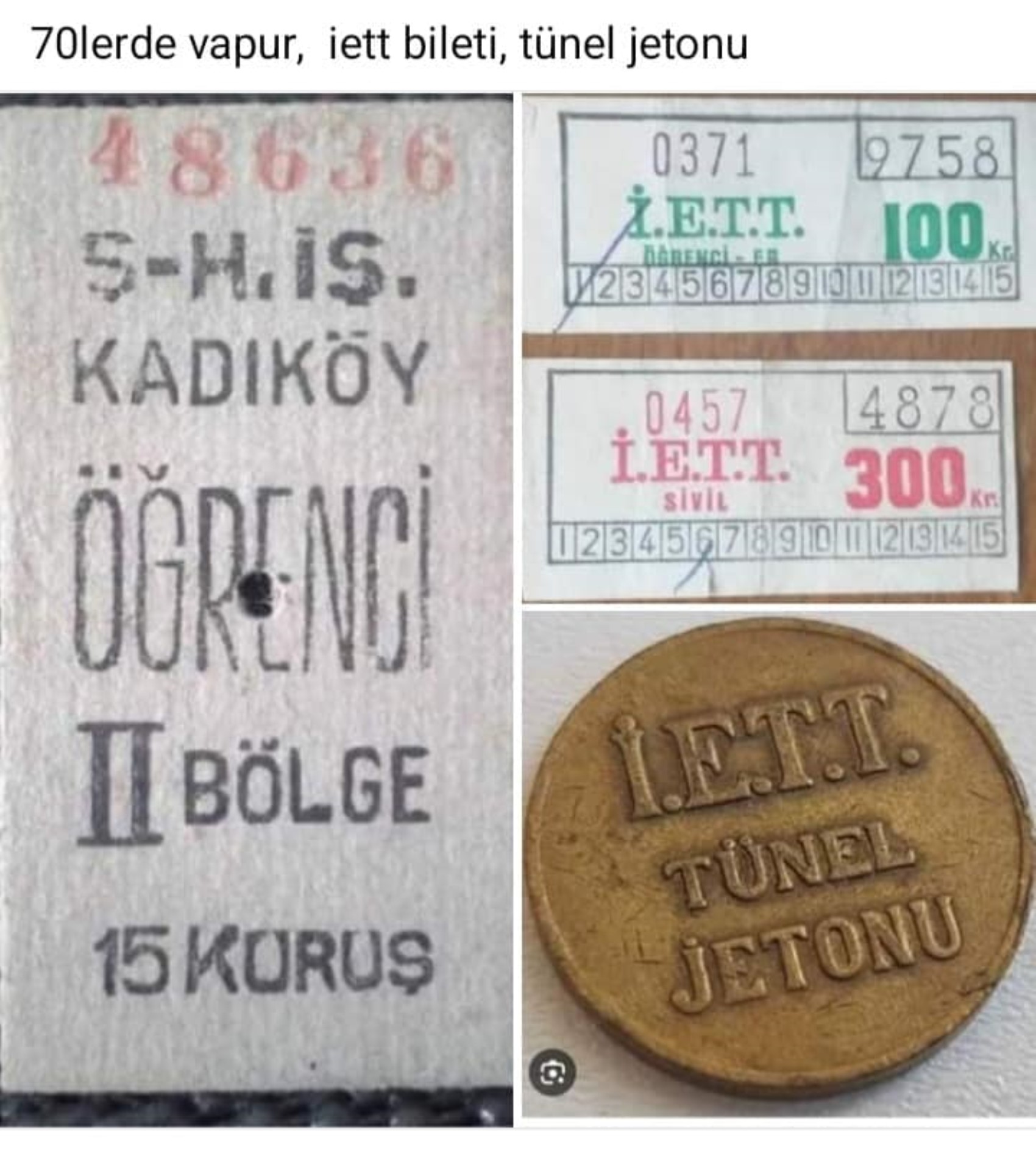
I owe my first trip to Beyoğlu to my teachers. They must have been our Turkish and Social Studies teachers. Now that I think about it, they were truly the teachers of the Republic and Atatürk. The place we were taken to was the Dostlar Theater. We came out to Beyoğlu from the Tunnel. Up until then, there were two things I knew: city bus and ferry tickets. On the bus, the conductor would tear off the tickets with a ballpoint pen attached to a rubber band behind his ear. He also had a wooden box hanging around his neck where he grouped the money he collected. The other was the cardboard-thick ferry tickets, which I found interesting from the moment I first saw them. They had first or second class written on them. In Roman numerals. My father would always buy 2nd Class tickets because he didn't feel comfortable in First Class. He wanted to sit in the lower deck. This preference was based on a class foundation. In other words, the main issue wasn't money.
I must not have understood how we boarded the Tunnel on the way to the theater, because on the way out, I was dragged in front of the turnstile along with the crowd. I didn't understand why I couldn't pass at first. The physical pressure created by those coming from behind and the state of not knowing what to do. Then, as far as I remember, thanks to my friend from Çubuklu, I overcame this brief moment of embarrassment. I think we must have slipped through the crowd and bought tokens from the booth.
Ever since my childhood, I have had a side that cannot grasp new things immediately and gets confused. I associate this with growing up in a closed neighborhood life where there were very few innovations. As I said, I had never been to the Tunnel until middle school.
THE IMPORTANCE OF TURKISH TEACHERS
My Turkish teachers were both very good professionally and people who were aware of the seriousness of teaching. The "Turkish teacher" was the teacher who was feared and most respected for their knowledge. Math teachers, on the other hand, were feared. They had the right to "discipline" when necessary, provided it was limited to "a single slap." In the third year of middle school, our Turkish teacher (it was called Turkish-Composition) came to class with a briefcase full of books. Although the number of books coming out of the bag was enough for the class, I thought the world's greatest treasure of books had come out of that bag. He had distributed a book to each of us to prepare an assignment. I must have never seen so many stories and novels together, so this book-bringing event was a scene that impressed me a lot. Now I remember that grammar lessons created as much tension in me as math. Subjects, predicates, adverbs, prepositions, pronouns, dividing into subordinate clauses.
Ultimately, our teachers had taken us to the theater. Maybe one of the assistant principals was also with us "in accordance with the customs of the Ministry of National Education." But I don't remember anything about them being with us in the theater hall. They were probably members of TÖS. They saw themselves as Atatürkists and did not like the religious crowd at all. They read "Cumhuriyet." The newspaper of which I would later become a loyal reader.
THOSE WHO STAGED ABDÜLCANBAZ
The play was being staged by the Dostlar Theater, which was founded by a group of young theater enthusiasts. The stage was the Alhambra Stage. It was constructed based on the Abdülcanbaz character that Turhan Selçuk had been drawing since 1957, first in Milliyet and then in Cumhuriyet. It was the early 70s; it had attracted as much attention as Ferhan Şensoy's "Şahları da Vururlar" in its first period of staging. It had gathered a lot of interest with the messages it gave and the way it was staged. It would later be staged in different venues. It was set in a context that made references to the current political issues of the time.
Another thing to remember is that Engin Ardıç took part in the staging of Abdülcanbaz. A truly interesting event. In all likelihood, he must have been involved in this business through his connections to Mekteb-i Sultani and Robert College. As is known, Ardıç had studied at both schools. The article he later wrote about Turkish theater shows how Ardıç got involved in this business and how he later broke away from the group.
WHAT I REMEMBER FROM ABDÜLCANBAZ
The character I found strange but remember the most in the play is Tarzan. A figure who jumped onto the stage 50 years ago at the Alhambra, half-naked with a piece of cloth made from a sack. I remember having fun, laughing, and finding many things funny. The most important character is undoubtedly Gözlüklü Sami (Sami with Glasses). A fraud, collaborator, liar, a character who could do anything for his own interests. I watched the person playing Gözlüklü Sami without knowing who he was. That person was Genco Erkal. I remember very well how well he played, his gestures, his mimics, and how I laughed at the maneuvers he made when his lies were revealed.
Abdülcanbaz was staged in 12 parts. With limited decor and costume possibilities. The subject was entirely set in occupied Istanbul. The collaborating Istanbul bourgeoisie was identified with the identity of Gözlüklü Sami. An exaggerated costume had been tried for Gözlüklü to bring it closer to Turhan Selçuk's lines. Genco had a mask on his face for the exaggeration of the nose and glasses. Along with a huge belly.
Apart from the role of Gözlüklü Sami, the main hero was of course Abdülcanbaz. It was played by Ahmet Mekin. Zihni Küçümen was Karanfil Hoca. There was Yavuzer Çetinkaya, who lost his life as a result of a heart attack in the Boğaziçi University pool in 1992; in the roles of Lloyd George, Jack Jackson, and the Tatavla Greek referee Seramidis. Macit Koper was in the roles of the barker and Yengeç Mustafa. Gözlüklü's friend Sürmeli İhsan was played by Sabri Bey (Mehmet Akan) from the TV series Bizimkiler. He also passed away in 2009, as you know. I learned that they were those people much later, naturally.
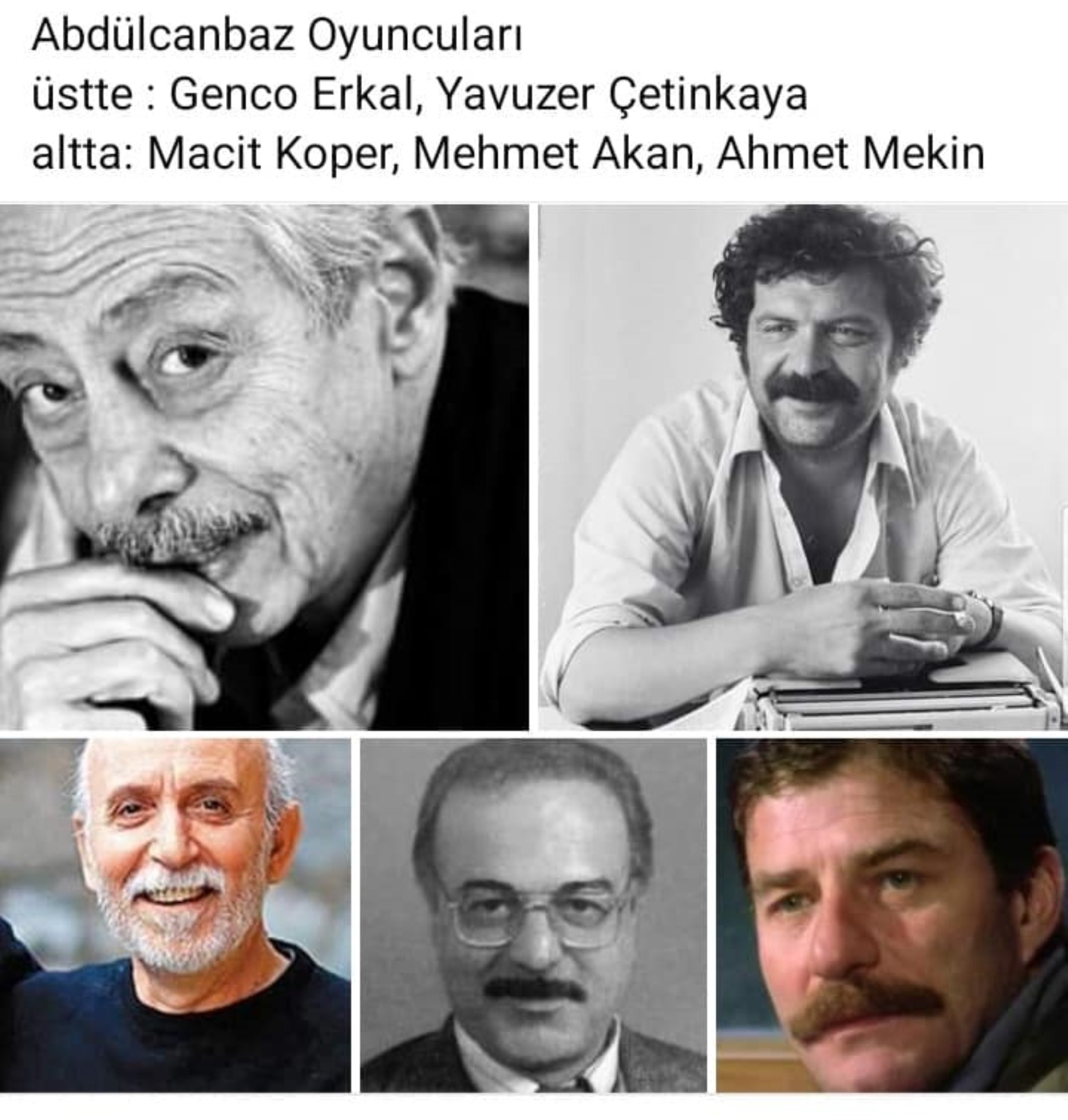
The venues start and end with a tea party in a mansion in Nişantaşı. In the first scene, occupation force officers, and in the last scene, a nationalist commander after the victory were hosted in the same mansion. The main theme of both scenes was that collaborators easily adapt to every situation. Abdülcanbaz would later leave his fiancée, who was Gözlüklü Sami's daughter, with nationalist feelings. The scenes where Abdülcanbaz used revolutionary violence (the Ottoman slap) made everyone laugh quite a bit. Another scene I remember is this: playing a football match with the occupation forces team in the Kuşdili meadow. The name of Abdülcanbaz's team: Tulumbacılar (Firemen). This means nationalists in a sense. Because the referee Seramidis (one of the Tatavla Greeks, the late Yavuzer Çetinkaya) favored the allied team, a brawl broke out and eventually the events quickly turned into a nationalist demonstration.
Also, in the scene where the arms depot under the control of the allies in Beykoz was raided, the name of the French colonial soldier caused laughter: Bomboko. This made-up name must have been chosen as a comedic element, as it has remained in my mind even though half a century has passed. Also, a paint like shoe polish was applied to the face of the colonial soldier to emphasize his blackness. That also caused laughter.
THE PERIOD OF TRULY GETTING TO KNOW GENCO ERKAL
I got to know Genco Erkal as an important theater man through the pictures hanging in the historic theater hall of Boğaziçi University. I also realized that he had studied at Robert College. The theater tradition at Robert College goes back to the armistice era. That is, to the 1920s. The walls of the hall are full of pictures of many Robertian theater enthusiasts. Some of the names that come to my mind immediately are: Haldun Dormen, Cevat Çapan, Engin Cezzar, Genco Erkal. All of them took the stage while they were students in this hall. I had noticed this right at the beginning of my Boğaziçi University years. The pictures pointed to a tradition and continuity. This was one thing that caught my attention. The other was that the original state of the wooden material supporting the roof was still being preserved. Both added a very special atmosphere to the hall. It is still the same. After it was last repaired, I watched Zabel there. This time I looked at the pictures and the wooden ceiling with my own "nostalgia."
Genco Erkal studied psychology at Istanbul University after Robert, but he was always interested in theater. Maybe his studying psychology has something to do with this. He founded the Dostlar Theater in 1969 with his friends. The theater used many venues, we reached that play with a short walk after the tunnel exit, I understood much later that the place where we watched the play was the famous "Alhambra Theater," naturally.
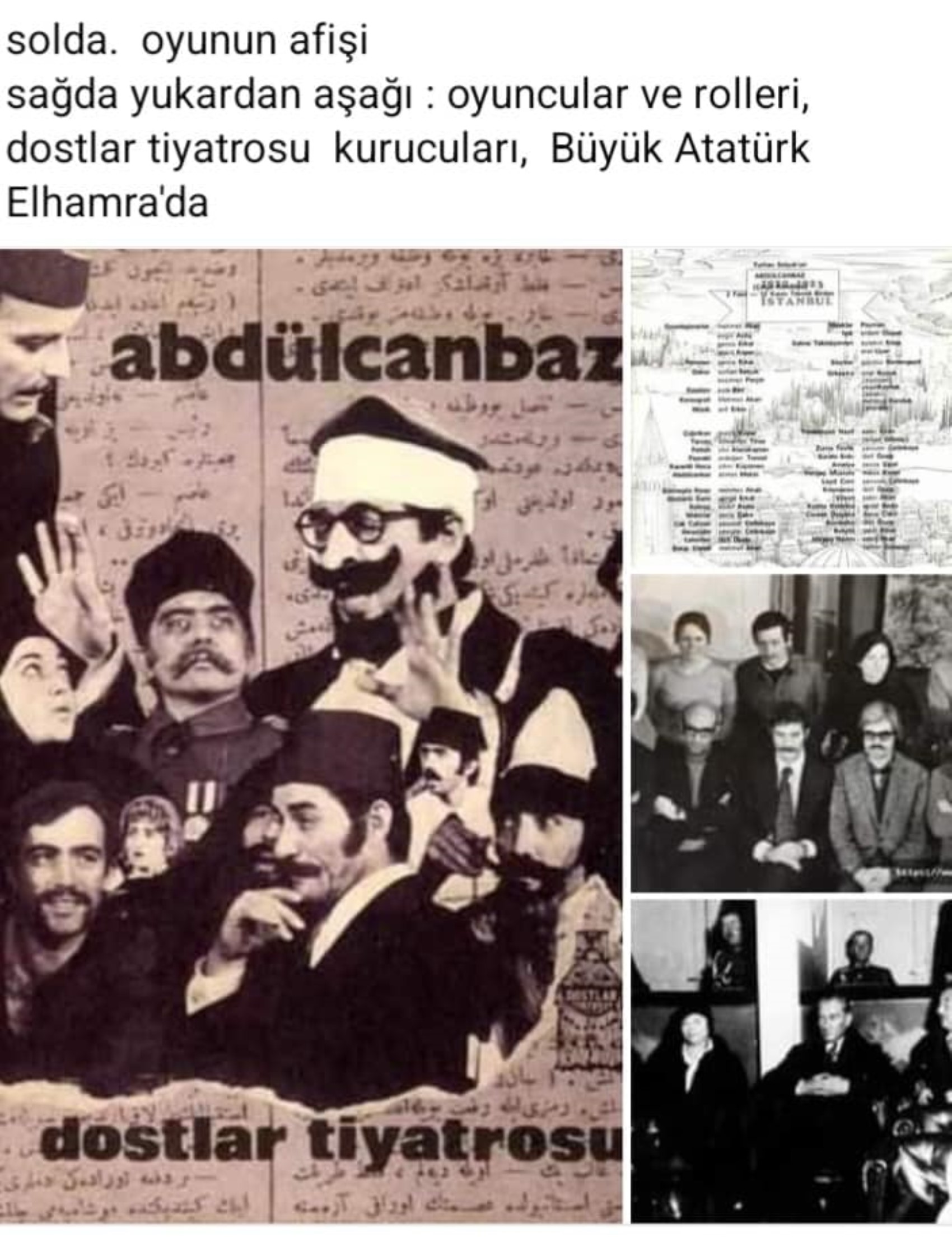
The passage where the Alhambra Theater was located was built in place of the French Crystal Theater. In the 30s, it was one of the most exclusive venues in Istanbul. This was a hall where Atatürk watched films twice. One in 1930 and one in 1932. Alhambra is a historic place that hosted Atatürk.
"ON LIVING" AT ALI PASHA INN
I last watched Genco Erkal in the play "On Living," which he adapted from Nazım, at the Ali Pasha Inn. According to what is told, after the execution of Çorlulu Ali Pasha, it passed to Genco's ancestors; it may have also been purchased. The region where the inn is located is a place where commercial life was experienced very intensely during the Ottoman era. Genco used to go to the inn with his father in his childhood. He would watch the work done in the shops. No one is left from the cousins as an heir, Genco Erkal and his brother currently hold the majority of the shares. Interestingly, Genco's younger brother was offended by his use of the empty space in the middle of the inn as a theater - on the grounds of joint ownership. One night, he had the entire audience platform destroyed. That was where I last watched Genco Erkal.
EXITING THE ALHAMBRA
Since the play started at six in the evening, it must have been night when we came out. I don't remember very clearly how we walked from Cadde-i Kebir to the Tunnel. Nor whether we returned to Anadoluhisarı via Üsküdar or by a Bosphorus ferry. I only remember very well today that moment when I understood that one passed through the turnstile with a "token."
LOOKING BACK 50 YEARS
In the 70s, a primary/middle school student could go to the cinema. But they were taken to the theater. Indoor cinema halls were in the central districts of Istanbul. There were summer cinemas on the Bosphorus. For example, in Anadoluhisarı, there was a summer cinema whose wall-screen is still in place today. At the end of the Göksu creek. Next to the teachers' house. It was said to be run by a retired colonel. There was also a winter cinema hall converted from a coffeehouse opposite the Hisar Pier. But I don't remember it working very efficiently. The first cinema I went to in Beyoğlu is the Dünya Cinema. I remember its dim lights hitting the floor and walls even today.
Going to the theater, however, was seen as a more serious thing. Teachers would take you. I watched the first plays I went to at the Üsküdar Müsahipzade Stage and the Alhambra.
The Abdülcanbaz play, which allowed me to see Genco Erkal for the first time, was staged during a period when Turkey was going through the March 12 interim regime. The Dostlar Theater was doing direct political theater. The political satire aspect of the plays was strong. Genco Erkal later staged and performed many plays adapted from Brecht, Gogol, Shakespeare, Gorki, Yaşar Kemal, Aziz Nesin, and Nazım.
Genco Erkal is a great stage man, a great Nazım Hikmet interpreter. A Renaissance heir. A Turkish intellectual. He is now 86 years old and on stage. He continues to carry the torch of the Turkish Enlightenment revolution started by Atatürk. And I watched him as a middle school student at the Alhambra 50 years ago without knowing or recognizing him.
The subject of the Abdülcanbaz play is set in occupied Istanbul. On one side is Abdülcanbaz. He represents Anatolia, the national liberation, and the pro-independence line. On the other side, there is the Gözlüklü Sami character with Genco Erkal's magnificent performance. Collaborating, cunning, resorting to tricks when necessary.
Abdülcanbaz, born in the 1950s with Turhan Selçuk's lines, also reflected the polarization that left its mark on our political thought life from the 60s to the 80s. On one side is collaborationism, on the other is the idea of national independence. The same distinction continues today.
Would you like to get notifications about new developments and save news?
- NotificationsNew developments and breaking news
- SaveNews is stored in the app
Most Read
Statement from Nihat Zeybekci on the fund investigation
New 75,000-seat stadium plan for Fenerbahçe
Interpol and MIT tracking yields results in Izmir
ID convenience for KPSS candidates

2027 Budget: Taxes for the people, tax exemptions for capital
The Çanakkale robbery -1- How was the Troy treasure smuggled out?
To whom and how was the Petition of Intellectuals submitted? Who accepted the petition?

The reality of Akkuyu and the longing for national nuclear power

Artificial intelligence and the new imperialism

Ministry investigation into unauthorized promotional messages