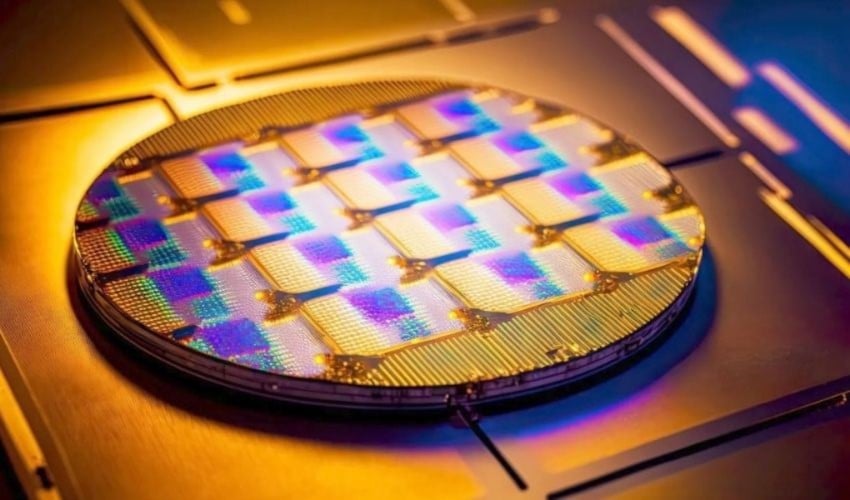
In current conditions, the most critical component in the semiconductor field is undoubtedly silicon. However, intensive efforts have been underway for some time to develop an alternative to silicon. In this context, scientists have discovered that a "superatomic" material is the fastest and most efficient semiconductor to date, and it can also transport energy much faster than silicon.
IT BEHAVES LIKE A SUPER ATOM
According to a report by Donanımhaber, silicon is currently invaluable for semiconductors, which are the heart of electronic devices. These materials lie at the foundation of transistors and integrated circuits, forming the infrastructure for everything from smartphones to supercomputers. Scientists at Columbia University have found a new semiconductor material that performs better than everything else. The material, known as Re6Se8Cl2, consists of a mixture of rhenium, selenium, and chlorine, and its atoms come together to act like a large atom, a "super atom." This is where it gets its speed from.
In any material, the atomic structure emits small vibrations that act as quantum particles called phonons, which can scatter energy-carrying particles such as electrons or excitons. This energy is quickly lost as heat, and managing it is a fundamental problem constantly encountered in the design of electronic chips and systems.
The discovered Re6Se8Cl2 has a little trick. When its excitons are hit by phonons, they do not scatter; they actually bind to them, forming another form called acoustic exciton-polarons. While these can still carry energy, they move much slower than normal excitons. Ultimately, interestingly, this leads to higher speeds than silicon.
We have probably all heard the iconic story of the tortoise and the hare at least once in our lives. Just as the tortoise unexpectedly wins the race between the two, the situation is quite similar in the case of the discovered semiconductor.
Specifically, electrons can move at incredible speeds on silicon, but they tend to jump around unexpectedly like a hare. Naturally, this is not the ideal type of journey. On the other hand, electrons in Re6Se8Cl2 move like a tortoise; they do not jump left or right, are not affected by phonons, and ultimately travel further and more consistently over time.
In light of this, the research team estimates that electronic devices made using this material could be six times faster than existing ones. However, we are still at the very beginning of the road for Re6Se8Cl2, and most things remain at a theoretical level. Milan Delor, one of the authors of the study, says, "Re6Se8Cl2 is, at least as far as we know so far, the best semiconductor in terms of energy transport."
Perhaps we will never see the material called Re6Se8Cl2, but the research team believes that more accessible and cheaper materials that can exhibit similar behaviors can be found.
News Source: 12punto