A "web encyclopedia" prepared under the coordination of the Scientific and Technological Research Council of Türkiye (TÜBİTAK) Science and Society Presidency (BİTO) and the TÜBİTAK Marmara Research Center (MAM) Polar Research Institute (KARE), designed to provide rapid access to information on polar sciences, has been launched.
The "Encyclopedia of Polar Sciences," brought to life through the collaboration of TÜBİTAK BİTO and TÜBİTAK MAM KARE, has been moved to a website in an updated web encyclopedia format.
The encyclopedia, which can be updated with new information, functions as a "living encyclopedia" in this regard.
ENCYCLOPEDIA PREPARED BY 60 AUTHORS IN 567 ENTRIES
The editor-in-chief of the Encyclopedia of Polar Sciences, TÜBİTAK MAM President and TÜBİTAK MAM KARE Director Prof. Dr. Burcu Özsoy, shared evaluations with an AA reporter regarding the purpose of the encyclopedia's preparation and its publication process on the internet.
Prof. Dr. Özsoy explained that the encyclopedia, which contains fundamental information in various scientific disciplines related to Antarctica and the Arctic, was prepared by 60 authors in 567 entries consisting of approximately 300 thousand words.
Stating that the encyclopedia consists of different categories, Özsoy said, "It was very valuable for the polar sciences encyclopedia to consist of different sections covering physical sciences, social and human sciences, earth sciences, and life sciences. Our field studies also take place in these same categories. It was very valuable for us that these sections in our living encyclopedia are both technically distinct and show a complementary effect across a wide spectrum."
VALUABLE SCIENTIFIC OUTPUTS ARE BEING PRODUCED
Burcu Özsoy pointed out that the official process of "National Polar Science Expeditions" began with the first expedition they organized to Antarctica in 2017, and stated that scientists have produced very valuable scientific outputs during these expeditions.
Drawing attention to the fact that the most difficult part of the work is the process of implementing scientific studies in the field, both in the Arctic and Antarctica, Özsoy continued as follows:
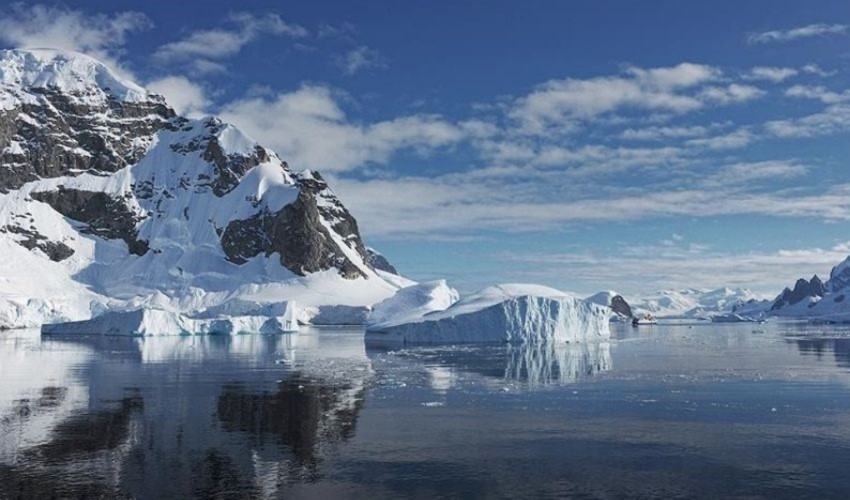
"The Arctic is an ocean, while Antarctica is a landmass. The processes for organizing expeditions in these two regions show great differences from each other. Studies in the Arctic are carried out on the ocean, while in Antarctica, studies are conducted across a wide spectrum including the ocean, terrestrial areas, and the atmosphere. After returning to Türkiye, there is a phase of turning these into scientific publications after a certain period. Preparing scientific publications is a challenging process."
STARTED FROM THE IDEA OF HOW TO TURKIFY FOREIGN TERMS
Providing information on how the idea for these encyclopedias was formed, Özsoy mentioned that since their first expedition to the poles, they had difficulty finding equivalents for technical terms in Turkish publications, as older publications on the subject were in foreign languages.
Prof. Dr. Burcu Özsoy concluded her words as follows:
"The encyclopedia and dictionary were a project we planned since our first polar study in 2017 with the question, 'How can we express foreign terms in Turkish?' I had also experienced difficulties in the subjects related to the science I work in. In my classes, while explaining maritime terms to captains, I had trouble with technical terms, especially when it came to the distinction between sea ice, glaciers, and terrestrial glaciers. Of course, we want to use English terms to master the general international structure, but as a scientist, one of my greatest desires from the beginning was to change the concept of 'sea ice' and its internal variables when we say 'sea ice'."
News Source: AA