


A Stone is Heavy in Its Place - 154. Let Us Not Forget, Let Us Not Let Be Forgotten



Once upon a time, hundreds of years ago, the wealthy lands of Anatolia were adorned with pure white marble monuments.
Slender columns, elegant column capitals, ornate triangular pediments.
Statues that immortalized people and events.
Unique works reflecting the high understanding of art and culture of humanity in those days.
Time and nature, along with the barbaric acts of fanatical Christians hostile to statues and Umayyad-Arab invaders, destroyed some of those magnificent works.
The beauty and meaning that remain provide us and our children with knowledge and inspiration to recognize the present and shape the future.
Naturally, the pieces found in Bergama and the structures and works that have survived to this day carry a great privilege regarding such ancient artifacts.
One of the most spectacular of these is the Temple of Trajan, located on the Acropolis of Pergamon/Bergama, which remains from the period of the Romans who dominated the city after 133 B.C.
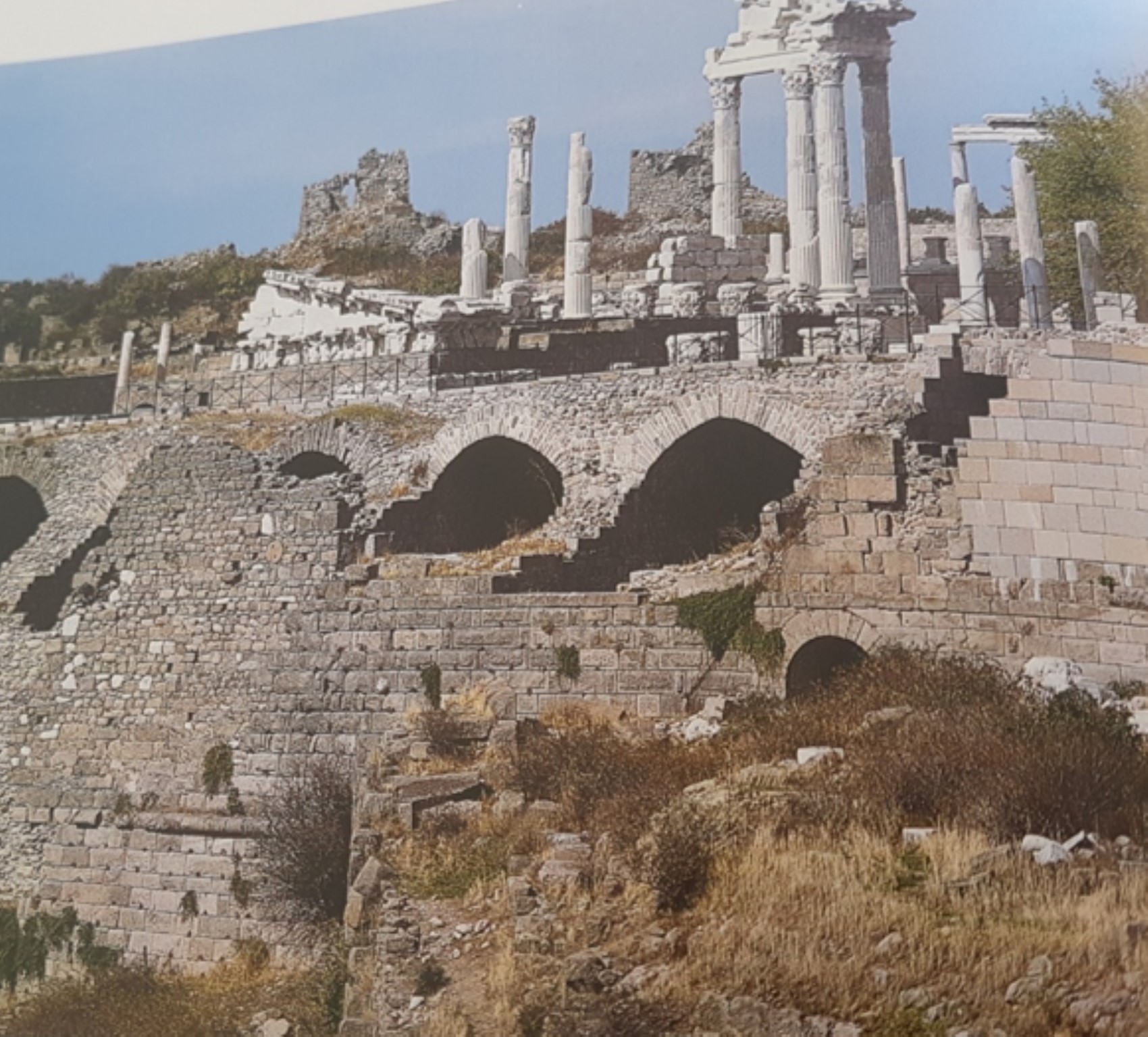
(Pergamon/Bergama Acropolis Temple of Trajan and vaults)
Built on a plateau created at the highest point of the Pergamon/Bergama hill, the restored marble columns of the Temple of Trajan can be seen even today by those coming to the city from the south, all the way from the horizon line.
The Temple of Trajan complex (Traianeum), which spreads over an area of 65*85 meters, is supported on this sloping hill by a 23-meter-high stone wall in an environment provided by substructures such as window-like barrel arches and vaults.
This magnificent structure was completed in the 2nd century A.D. by Hadrian (76-138 A.D.), the successor to the Roman Emperor Trajan (98-117 A.D.).
The work is one of the unique structures remaining from the Roman period in Pergamon/Bergama.
Carl Humann, who smuggled many historical artifacts he seized in Pergamon, including the Altar of Zeus, to Germany during illegal and dubious excavations between 1864 and 1886, also conducted excavations where the Temple of Trajan is located and did not neglect to steal the works he found.
The statues taken from the Temple of Trajan were placed in the Berlin Museum, which had turned into a prison where other artifacts smuggled from Bergama were kept.
***
With East Berlin joining West Berlin on October 3, 1990, today's Germany thus took ownership of this prison held by East Germany.
Before this date, in 1976, at the insistence of Turkish Ministers of Culture Talat Halman and Ahmet Taner Kışlalı, restoration work was initiated by the German Archaeological Institute, which belonged to then-West Germany, at the site of the Temple of Trajan on the Bergama Acropolis.
By raising a portion of the temple with the remaining pieces that could not be stolen, the aim was both to revive history and to present the structure to the view of visitors.
The work was first carried out under the direction of engineer Dr. U. Rombock and was continued and completed by Prof. Dr. Klaus Nohlen.
Furthermore, we have a master craftsman, Selim Baskın, who has been laboring for nearly half a century in the restoration of artifacts unearthed from excavations in the Ancient City of Bergama.
Salim Usta, who began working on the restoration of the Temple of Trajan at the age of 16, has used and continues to use his talent for the raising and preservation of Pergamon's historical artifacts by employing ancient stone-working techniques.
These efforts, of course, add value to the cultural significance of Pergamon/Bergama.
They help historical artifacts bring joy to the lands where they were produced.
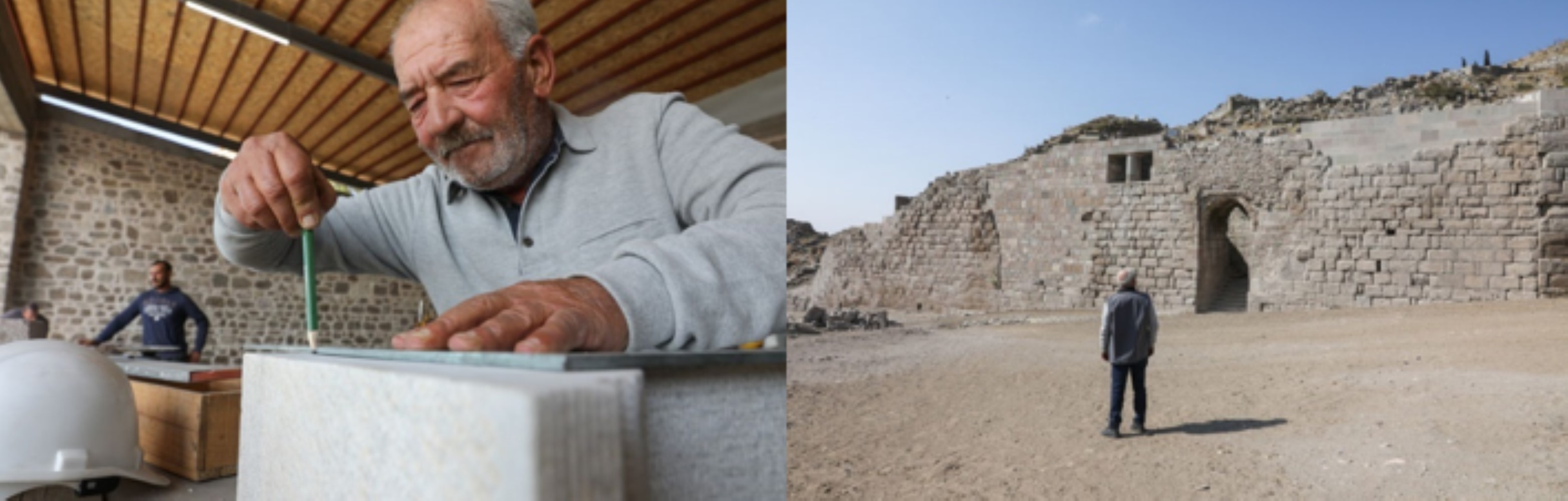
(The tradition continues. Bergama stone master Selim Baskın)
However, there were those who closed their eyes to such positive efforts, and those who did not look at Pergamon/Bergama this way 150 years ago.
Historical artifact thieves plundered our cultural heritage by disguising themselves as archaeologists.
Like road engineer Carl Humann and his gang, they stole the treasures of Bergama under the guise of science, in the context of fallacies as if they were protecting them.
Like them, historical artifact thieves plundered our cultural heritage by disguising themselves as archaeologists and robbed Anatolia.
Smugglers like C. Humann and A. Conze, who had been robbing Bergama since 1864, found two very large statue heads among the collapsed vaults while excavating in 1879 to find artifacts buried underground in the area where the Temple of Trajan is located on the Pergamon Acropolis.
These heads were those of Emperor Hadrian, who had the temple built, and Trajan, to whom it was dedicated.
The height of Trajan's head was 73 cm, its width 42 cm, and its depth 47 cm.
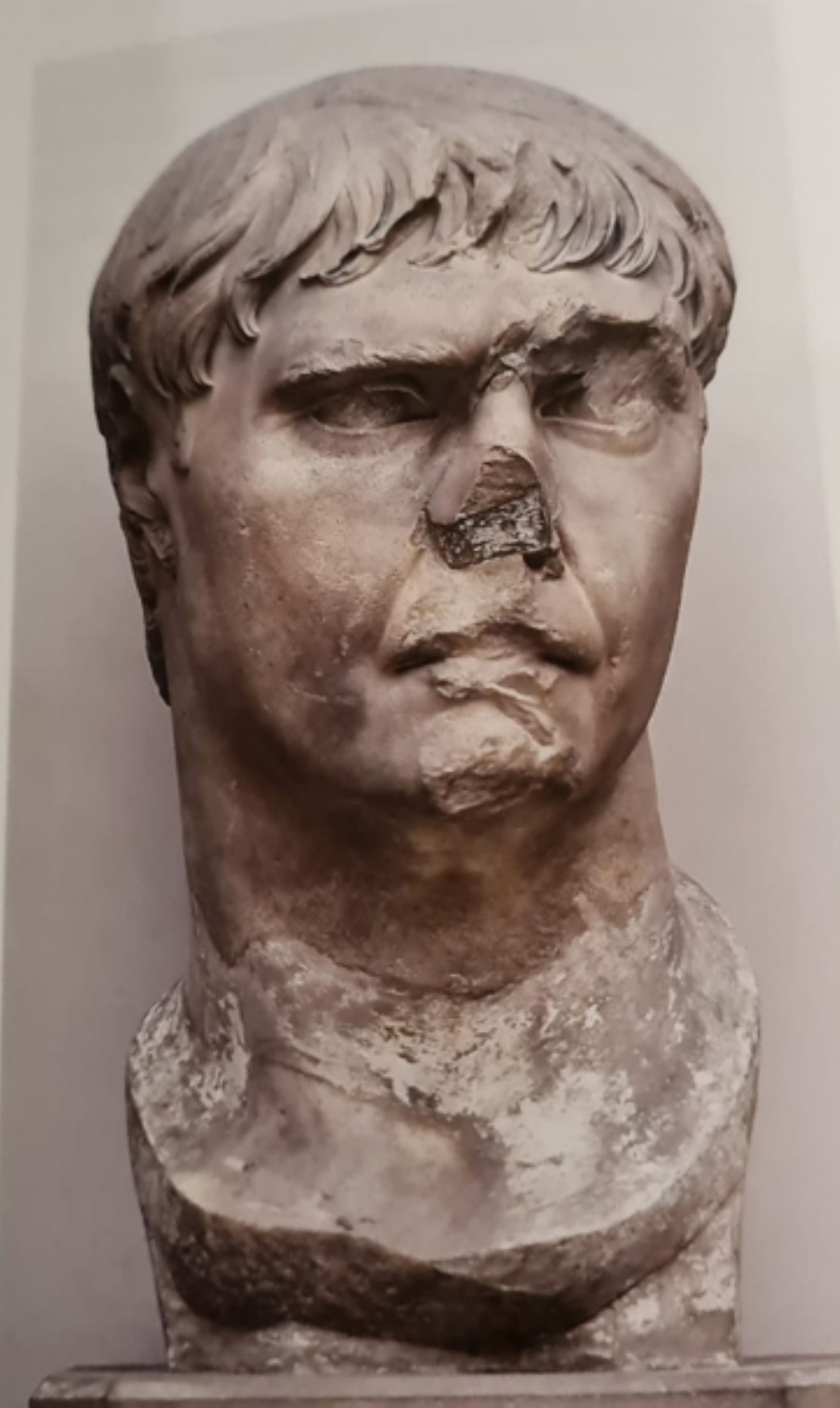
(The giant statue head of Roman Emperor Trajan taken to Berlin)
A giant head nearly 1 meter high.
It is reported that this marble work is the head of the “acrolithic” statue of Trajan.
“Acrolith” was a technique used in ancient sculpture. In this method, important parts of the statue such as the head, hands, and feet were made of marble or stone, while the body was made of wood, bronze, or another material.
This method was developed because marble was hard to find and not easy to work with.
The hair on the large head of the Trajan statue is fine-stranded and sits tightly on the crown.
Along the forehead, the hair is shaped in a sickle-like fashion, with pointed ends, and separated into tufts.
The facial form belongs to a portrait style developed in 108 A.D. on the occasion of the 10th anniversary of Roman Emperor Trajan's reign. This was called the “tenth-year type” in Roman Imperial art.
However, the local style, the characteristics of the “Pergamon School of Sculpture,” is very clearly seen in the statue head.
The entire face reflects a general softness.
The image is as if it were alive!
The hair design is in a form that completely covers the head.
His gaze is forgiving but determined. His posture carries action and seriousness.
These qualities are a style seen in almost every Pergamon statue and used here as well.
This magnificent head must have carried a body 4-5 meters high.
The people of that time deified Emperor Trajan. They raised him beyond greatness!
Trajan's head was found by C. Humann and his gang in 1879 and smuggled to Berlin in 1880. With dubious permits!
In the Berlin Museum Prison, the neck part was rearranged with plaster by a person named Antonio Freres, who was under the command of the smugglers.
***
Trajan's statue head, thought to have been made around 114-117 A.D., is registered in the current Berlin Museum/Prison with the code number “AvP VII 281”.
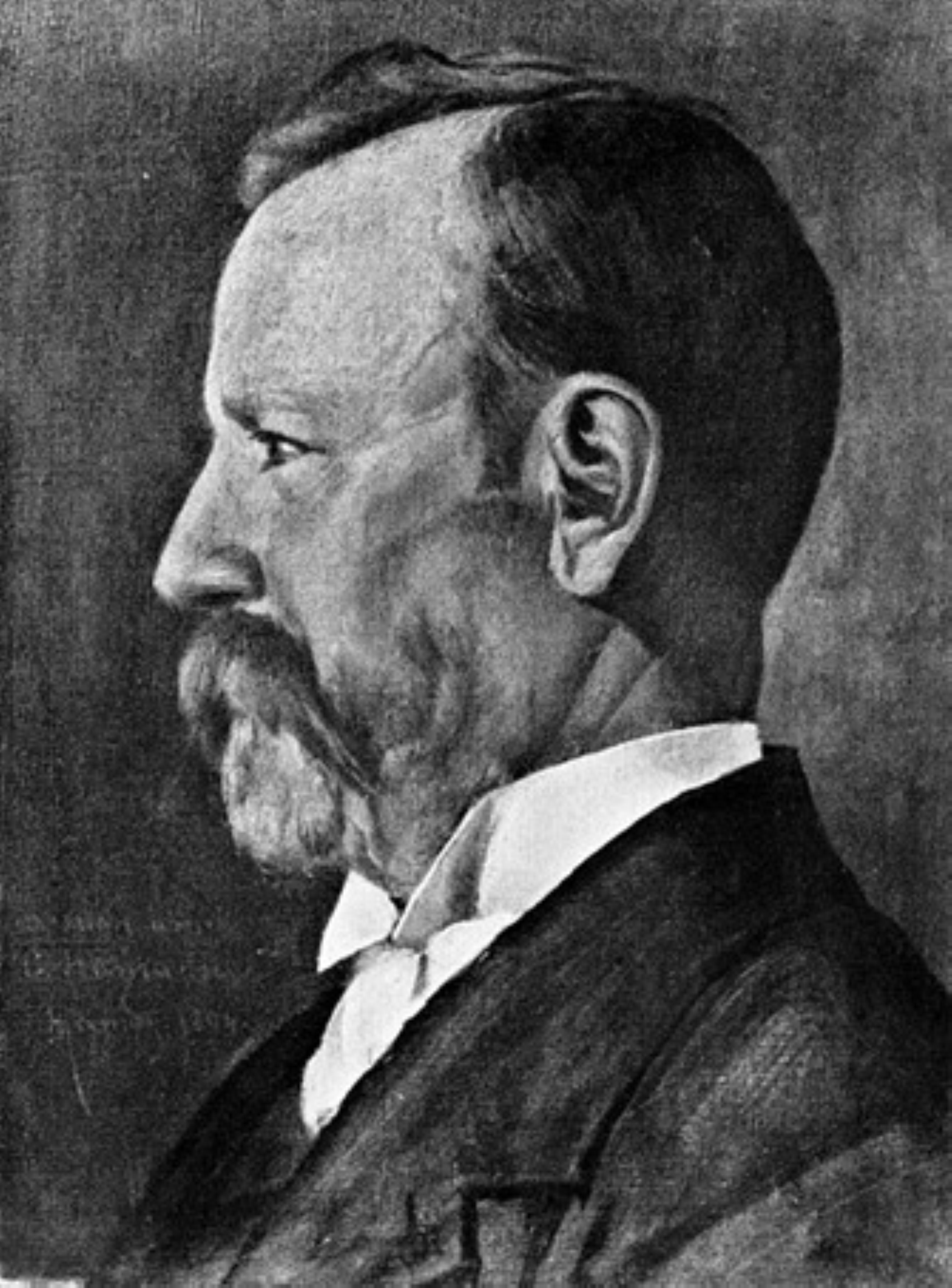
(Historical artifact smuggler German engineer Carl Humann)
As is known, the Museum/Prison on the Spree River, which flows through Berlin, is sinking and collapsing because the ground is muddy.
This large, intimidating structure has been closed since 2017 on the grounds of being restored.
They supposedly say it will open in 2037, but it is unknown how much longer it will remain closed.
Our artifacts are being kept in this collapsing Museum/Prison.
Its metal components are rusting and rotting in the humidity of the river.
By keeping a part of this dilapidated building open and displaying our smuggled artifacts by cramming them into a narrow space, unfair profit is being made, and the continuation of this cultural extortion is being exploited.
Those who earn income from our artifacts are harming both our history and our identity.
If Trajan, the world emperor of that time and one of the greatest leaders the world has ever seen, were to see this situation, that his giant statue head is being kept in an ugly Museum/Prison, he would surely be very angry.
***
Conscience is an inner voice.
Conscience is a moral feeling and concept that enables an individual to evaluate the difference between right and wrong.
Conscience is a moral guide.
Beyond the legal situations regarding the return of historical artifacts that have been taken abroad, smuggled, and stolen, German and European intellectuals and decision-makers must perform a reckoning of conscience.
History is a witness that dirty consciences are not cleansed even as years pass!
THE ALTAR OF ZEUS AND BERGAMA ARTIFACTS DO NOT BELONG TO COLD AND FOGGY BERLIN, BUT TO BEAUTIFUL BERGAMA. THEY MUST DEFINITELY COME BACK, THEY MUST RETURN HOME!
(Sources: (Source: Pergamon Panorama der Antiken Metropole: Eine Ausstellung der Antikensammlung der Staatlichen Museen zu Berlin (2011): Compiled by: Ralf Grussinger, Volker Kastner and Andreas Scholl. p. 573) /// https://kulturelcisi.com/trajaneum/?utm_source=chatgpt.com /// https://www.aa.com.tr/tr/kultur/bergama-antik-kentindeki-2-bin-yillik-eserlere-usta-dokunusu/2714232?utm_source=chatgpt.com)
Sefa Taşkın
02.02.2025
Karşıyaka/İzmir
Would you like to get notifications about new developments and save news?
- NotificationsNew developments and breaking news
- SaveNews is stored in the app
Most Read

Video response to Kim Jong-un claims

Murat Ağırel’s police statement has been revealed
Azerbaijan issues arrest warrants in absentia for 7 people living in Turkey

The Orionid meteor shower will be visible from Turkey!

The penalty for Ronaldo, who left the national team camp, has been announced

Fatoş Seğmen reveals the cause of her daughter's death

Injury shock at Liverpool: He may miss the Fenerbahçe match

Latest status in the race between AKP and YENİ Party revealed

Who authorized the concert held in a parking garage?

From brotherhood to a distant partnership...