


From Referendum to Lefke: No to all evils!



CYANIDE DIARIES FROM BERGAMA-30
Anatolia has now become a cyanide paradise.
From İzmir-Bergama Ovacık and Dikili Çukuralan to Sivas Koyulhisar, from Uşak-Kışladağ to Kayseri-Develi Özsüt, and from Balıkesir-İvrindi to Ağrı-Diyadin-Mollakara, many places that share a common fate have been filled, and continue to be filled, with pits containing cyanide and toxic heavy metals just to obtain a handful of gold.
The gold is extracted from the ore, leaving behind dead nature and poisoned soil.
Famous Turkish companies such as TAMAD/Nurol Holding and Cengiz Holding, as well as foreign companies like TÜPRAG/El Dorado, Canterra, and SSR MINING, are involved in these operations.
Now, a State/Public Company named "Türkiye Altın İşletmeleri AŞ" (Turkish Gold Enterprises Inc.) is also in the game.
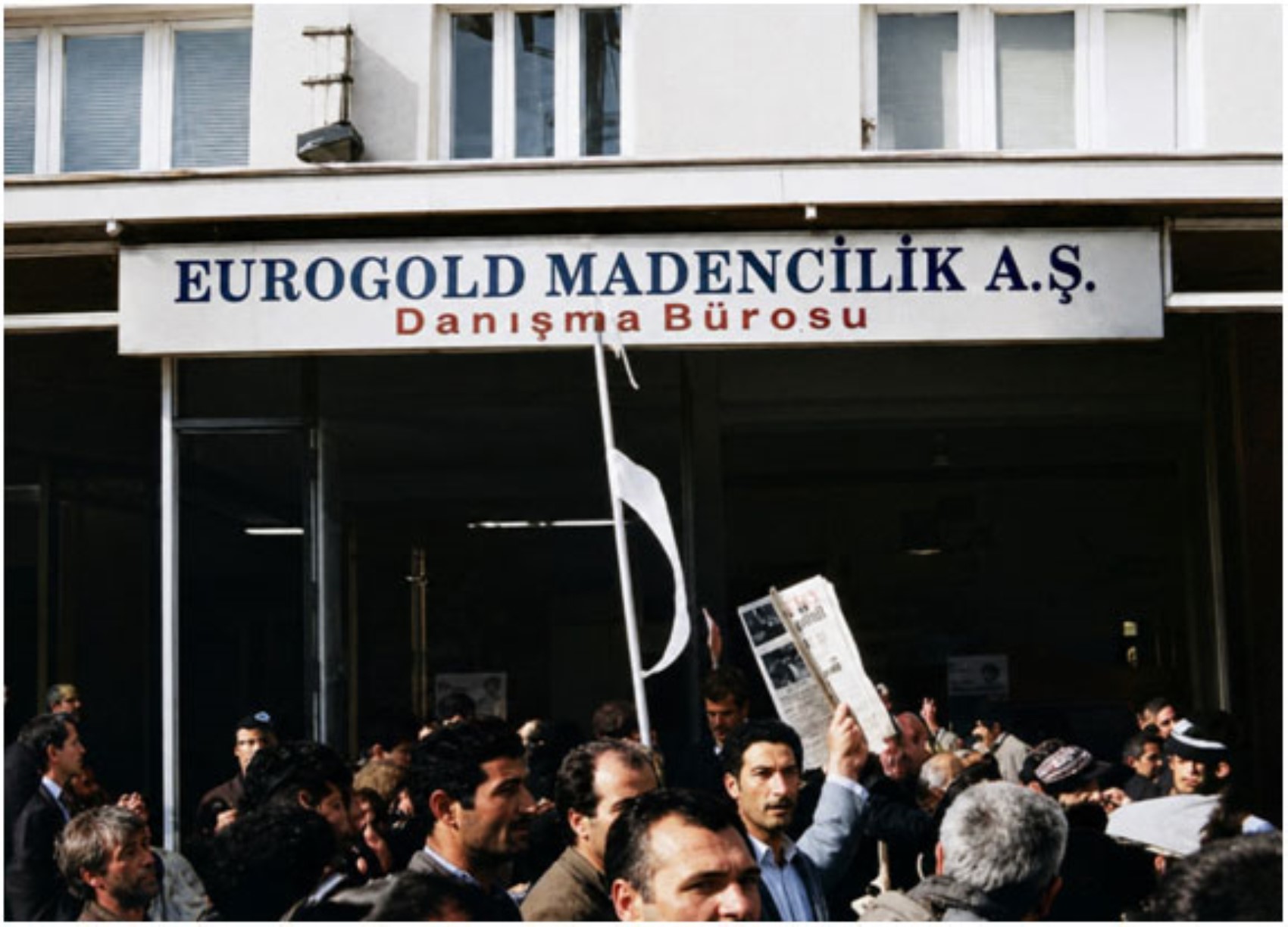
This company, which was previously called the multinational Eurogold, then sold to the American Newmont, and later passed into the hands of KOZA—owned by Akın İpek, who was alleged to be a member of FETÖ—took its current form after KOZA was brought under state control through the Turkey Wealth Fund (TVF).
This technology, which first entered the country through the German/Canadian, French, and Australian/US-capitalized Eurogold company, was later learned by domestic companies that partnered and collaborated with foreign firms; it became increasingly widespread with the state's involvement.
The gold disaster in Erzincan-İliç-Çöpler, the death of 8 people, and the environmental pollution caused by the waste dam overflows in Fatsa did not even make this expansion blink.
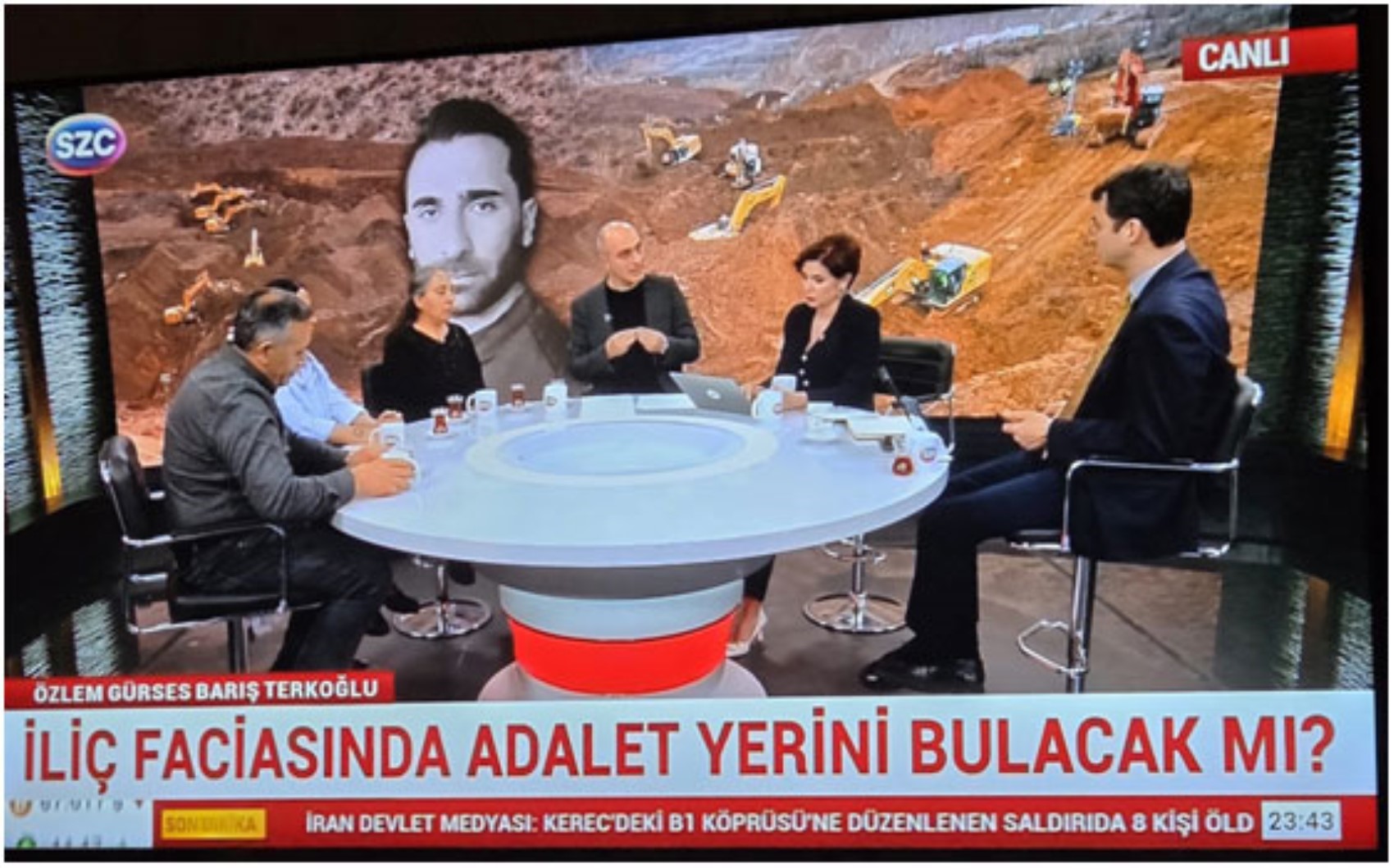
(February 13, 2024. Time: 14.28. The Cyanide Gold Mine disaster in Erzincan-İliç-Çöpler. 8 people, millions of living creatures dead: Should we say we told you so 30 years ago?)
Because, despite all the negativity it causes, the profit of gold is sweet!
In the context of all these developments, people are showing great reactions and have raised, and continue to raise, strong voices across the country and locally out of concern for their lives.
Today, everyone knows that this process became known through the struggle waged by villagers and environmentalists across the country against the cyanide gold mine that was intended to be operated in Bergama.
What didn't happen!
We will continue to tell the story of what happened in Bergama in this series of articles being published on 12 Punto.
Let it be a lesson!
Because these are the incredible struggles of the local people who stood up against imperialist exploitation, the cruel greed for profit of their collaborators, and savage capitalism.
A struggle that continues with knowledge, law, communication, public opinion, and actions!
The type of struggle they created, a form of behavior that scientists call the "Bergama Paradigm," spread to every corner of the country and became an example.
***
(Protest in Bergama city center)
The villagers of Bergama were screaming at the top of their lungs not to be poisoned by cyanide and arsenic, wanting public officials to hear them and take their concerns into account. The officials were not listening, and did not want to listen.
However, this objection was heard not only within the country but even abroad, and voices of solidarity were raised.
The Mayor of Mytilene, Notis Panaiotou, came to Bergama to support the environmentalists, and 300 organizations from Ireland, Germany, and France expressed their solidarity.
Even the United Nations, UNESCO "Man and the Biosphere" division director Prof. Michael Succow described the desire to operate a cyanide gold mine in Bergama as "murder."
As Zülfü Livaneli says in his famous song, "My brother doesn't hear, but the stranger hears."
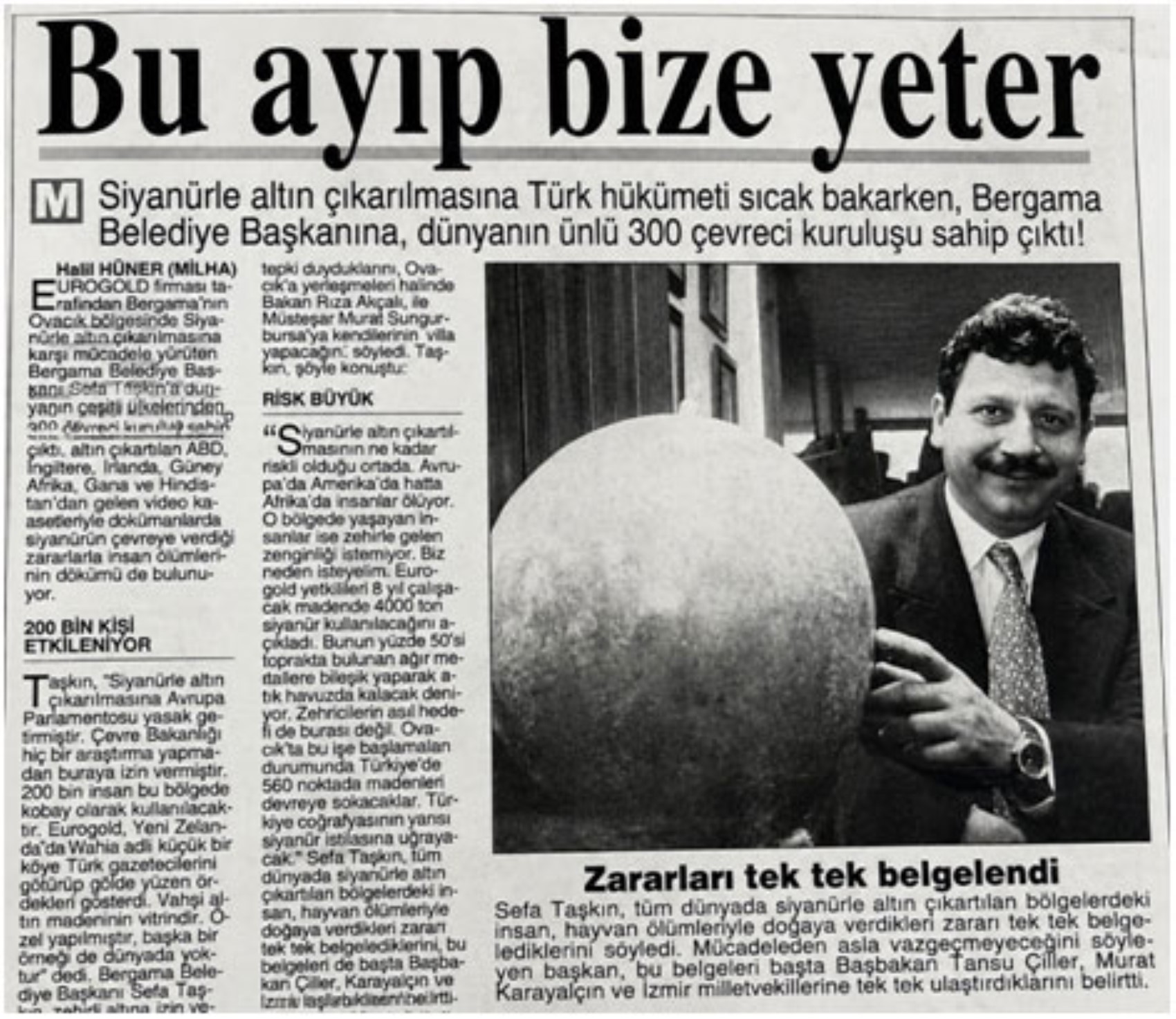
(300 organizations worldwide stand up for Bergama.)
Despite these reactions, the first court in İzmir had ruled against the villagers. The cyanide company was eager to operate the toxic mine. There were many among the public sector decision-makers who helped them.
Cyanide trucks had reached the gate of the wire-fenced mine site, and the olive and pine trees at the edge of the villages had been cut down.
But the Zeybeks and female Efes of Western Anatolia were not silent.
Hearts were burning in Bergama.
Resistance was rising to protect their lives and the environment.
Every decision that made the company's job easier gave birth to a new form of action.
The villagers were no longer just objecting; they were building, and would continue to build, an alternative practice of democracy.
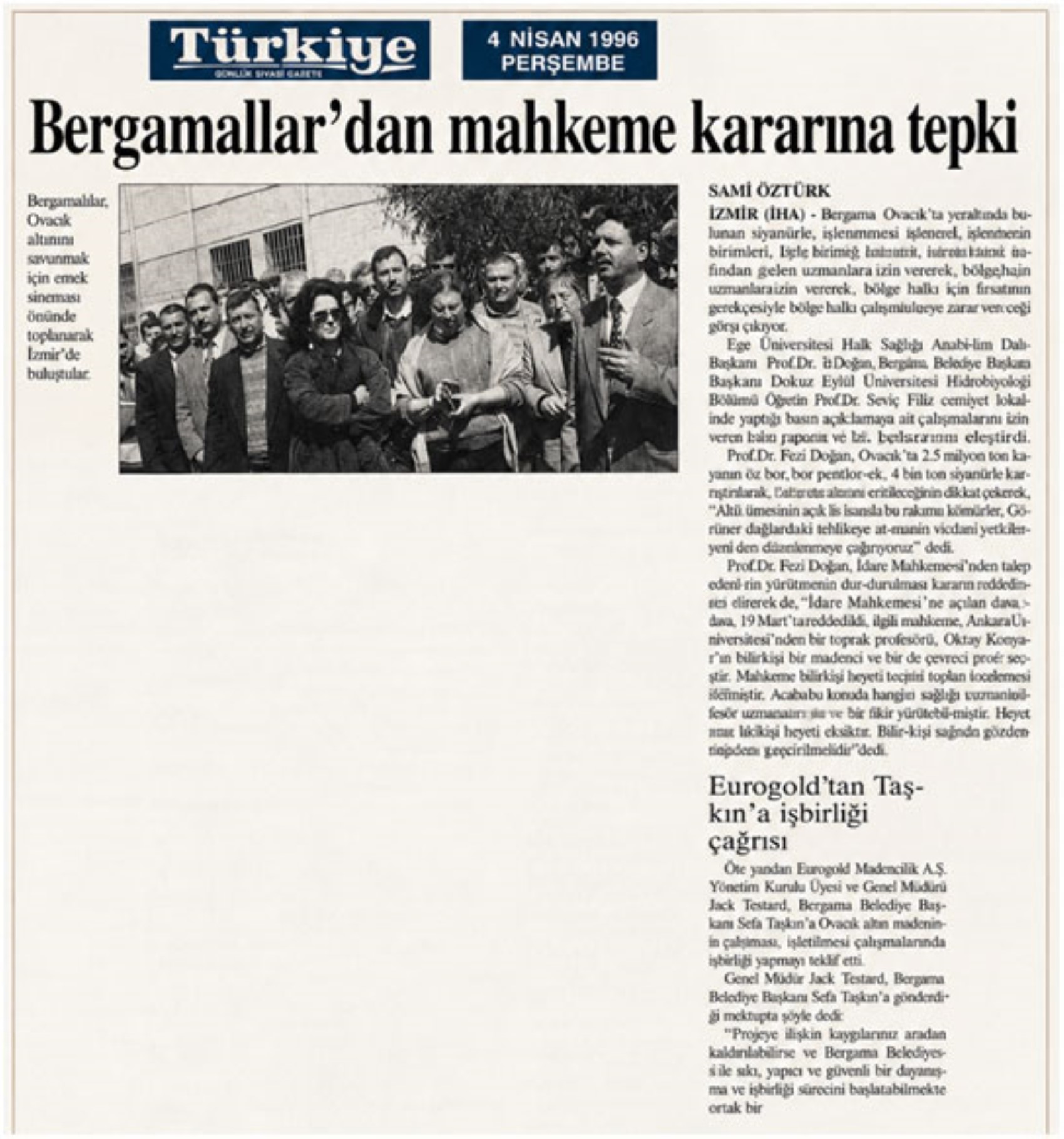
The year was 1996.
In this environment, the multinational cyanide company, Eurogold, continued to explain the benefits of toxic gold through propaganda it conducted both in the public eye and at the Ankara level.
However, Bergama's resistance and actions had frightened them.
The villagers' blocking of the road in response to the tree cutting was quickly heard both in the country and in surrounding cities and villages.
The cyanide gold propaganda in the press and the refusal to meet the villagers' demands were making environmentalists even angrier.
However, a "road-blocking action" was not enough.
Something had to be done, and the determination had to be emphasized once again with a crowd.
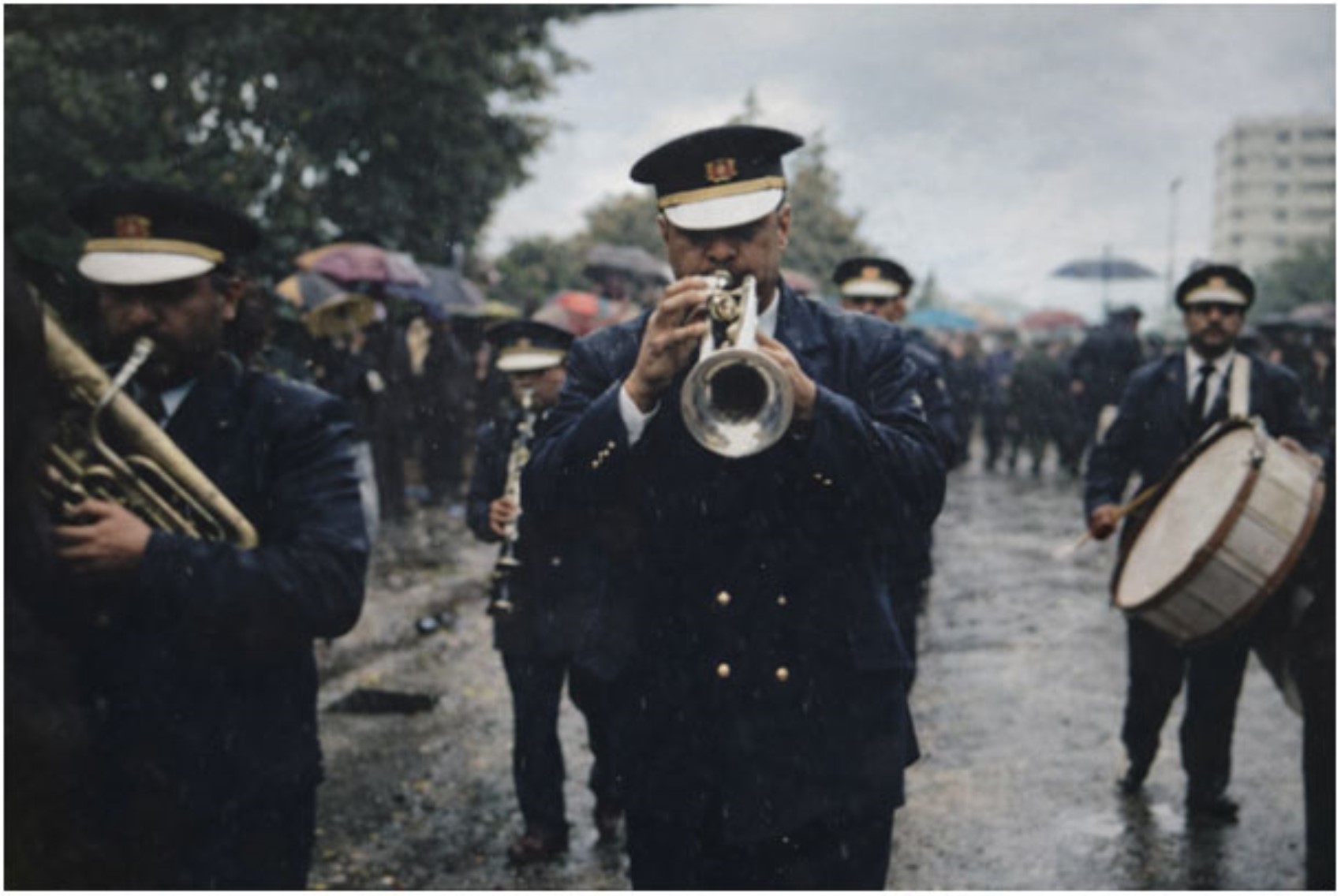
(The band plays a funeral march at the march and rally held in Bergama city center on 25.11.1996. Colorized.)
Municipal officials, village headmen (muhtars), and small groups that had begun to form spontaneously in the villages—which some called committees—consulted among themselves urgently and decided to hold a rally in Bergama city center on 25.11.1996.
Preparations were made at the crisis center established in the Bergama Municipal Council, which was legally tasked with protecting the city against cyanide poisoning. Council members, lawyer Fuat Ateşoğlu and tradesman Mehmet Özöner, took responsibility for this preparation together with 17 village headmen and fulfilled the legal requirements for the rally.
Permission for the rally was obtained from the District Governorship in Bergama.
In the rally organized by the Bergama Municipality, which took place on a rainy and cold day, the protesters entered the Republic Square of Bergama city with interesting costumes, carrying coffins, and accompanied by Chopin's funeral march played by the Municipal band.
With enthusiastic speeches, they shouted once again that they were against cyanide gold.
They were soaked from the rain, but their resistance could be read in their eyes.
Pointing to the coffins, they said, "Do not kill us with cyanide and dig our graves."
With this rally, the resistance was showing itself not only in the villages but also in the Bergama city center. The villages and the city had united.
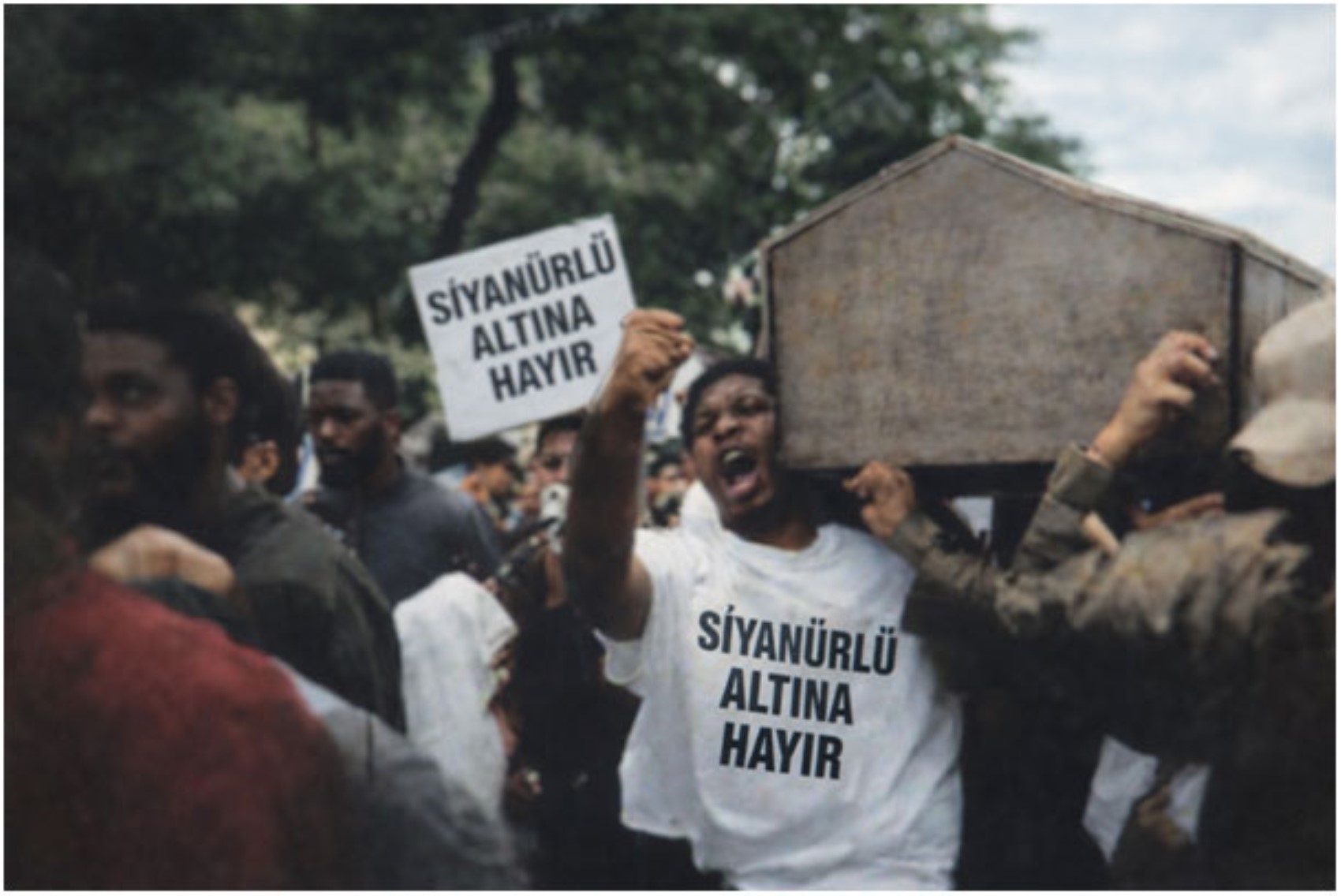
(25.11.1996. Bergama city square-rally with coffins-Colorized.)
***
The same event was repeated a short time later in front of the fences of the toxic mine.
The large crowd gathered at the rally announced to the whole world with their strong voices, shouting against the facility protected by the gendarmerie, that they did not want this mine on their lands.
Villagers, city dwellers, and many environmentally conscious citizens were there.
These meetings were the first mass rallies in Turkish history related to environmental issues. Meetings where villagers attended with their children.
These citizens of this country living in rural areas, who were called "ignorant," "pot-bellied," or "the man who scratches his belly," knew how to seek their rights and stand up when necessary, contrary to the opinions of many know-it-alls.
Weren't they the ones who fought in the "War of Independence" and protected their homeland?
But this time, the enemy was very powerful, and their collaborators were very influential!
They had come from Germany, France, and Australia.
With their banks, insurance companies, and cyanide factories...
With their huge machines and bags of poison...
Global capital was determined to take over Turkey.
The resistance formed in Bergama; peaceful actions and rallies would spread to all four corners of the country in later years and become a kind of tradition.
Women were always at the forefront.
Children were on the roads with cardboard banners in their hands.
They were very careful in their mass marches.
Until recently, they did not allow troublemakers to mix among them for a long time.
They never resorted to violence. They even banned themselves from having a razor blade with them during their actions.
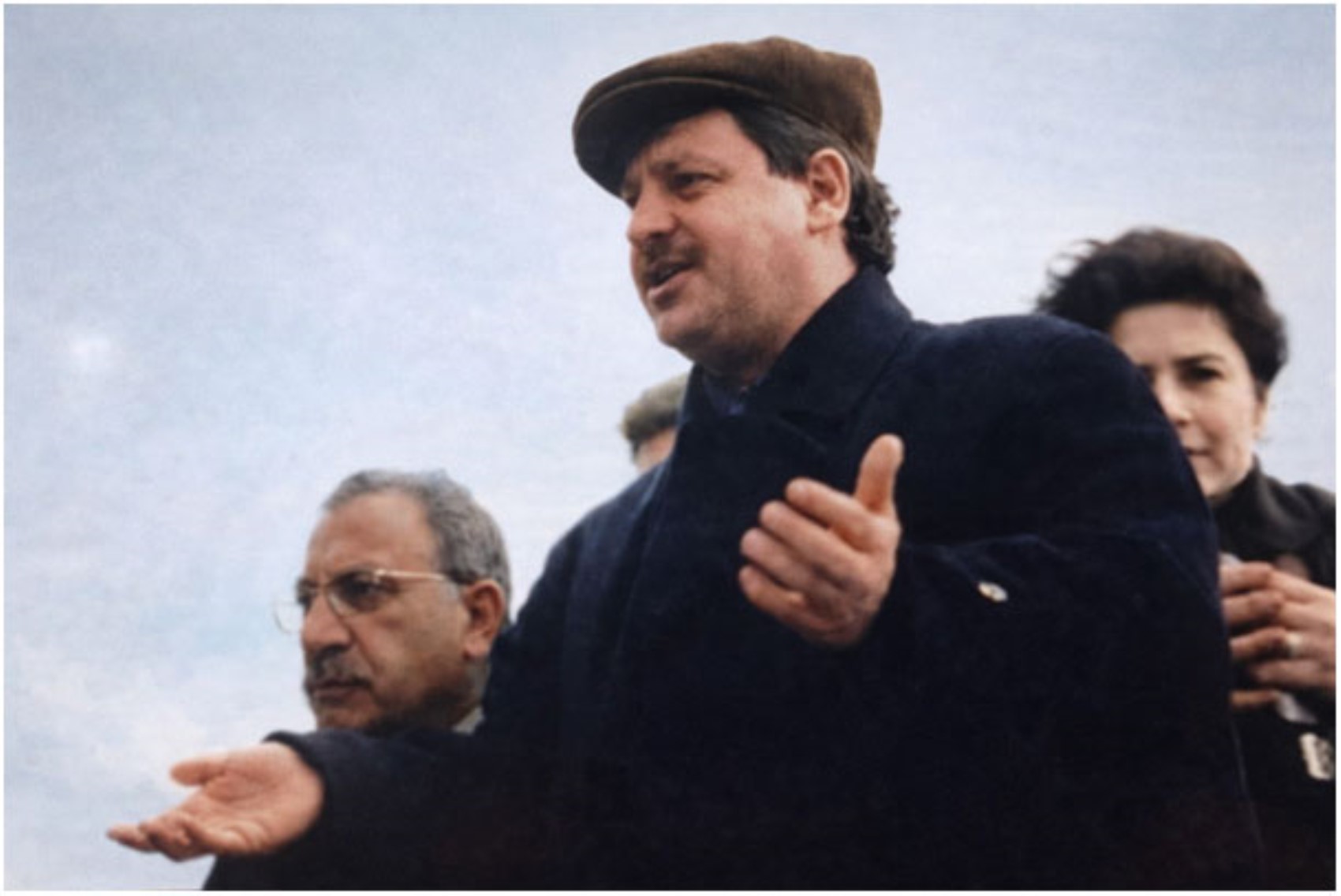
(Rally held in front of the Bergama-Çamköy-Mine site fences. S. Taşkın is speaking. O. Konyar is on his right. Photo colorized.)
***
Bergama environmentalists continued on their path with faith despite all kinds of negativity.
Despite everything, the fire of resistance had never gone out in the hearts of the villagers who were fighting against the cyanide users for their lives.
Activist environmentalists sometimes stripped to the waist to attract public attention, walked long distances, and even went up to the Bosphorus Bridge in Istanbul to demonstrate.
They hit the roads to Ankara by train and bus. They waited at the courthouse door.
The Bergama environmentalists had developed a ritual in the mass meetings they held.
Ritual is one of the oldest traditions in the collective behavior of humanity.
After the speeches were finished, the person managing the meeting would ask the crowd in a loud voice, "Do you want cyanide gold?" and the crowd would respond by shouting "No" with great enthusiasm.
This shout, which became a slogan, was repeated at least three times.
"No, no, no."
Against all evils.
***
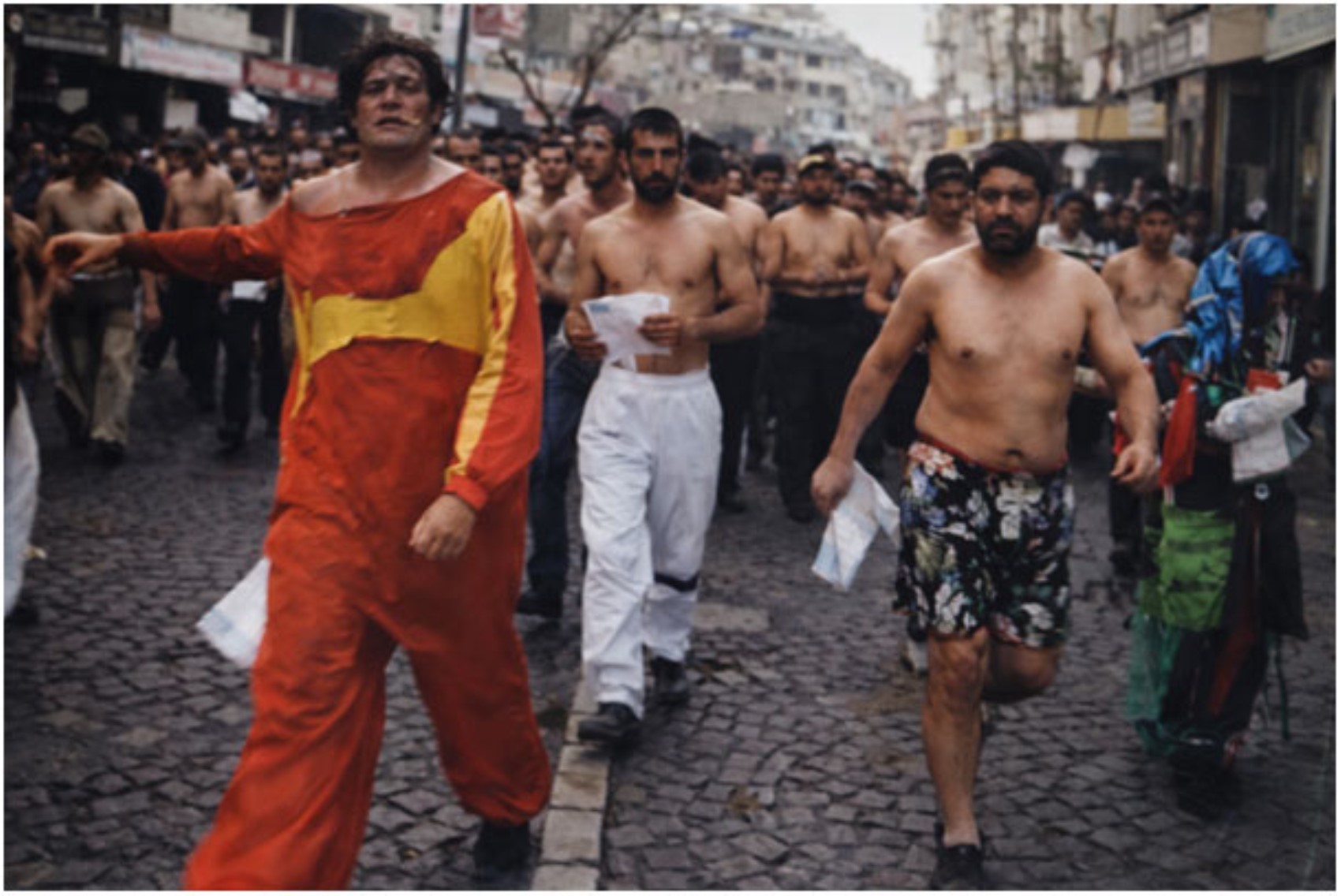
(23.12.1996-Bergama streets)
The villagers had now become accustomed to peaceful activism and expressing their views within the framework of the law.
That mass, which was called silent and stagnant, was in an incredible state of mobility and creativity.
Despite all these actions such as panels, rallies, and distributing leaflets, the poisoner Eurogold was using the same propaganda language, still saying:
"Actually, the villagers want the mine. A handful of people wandering around the municipality are spreading rumors that the public does not want the mine and are provoking the people. Those who participate in the actions are also deceived people."
These slanders touched the honor of those who were fighting tooth and nail to protect their lives and property from cyanide.
What else could be done that was more effective!
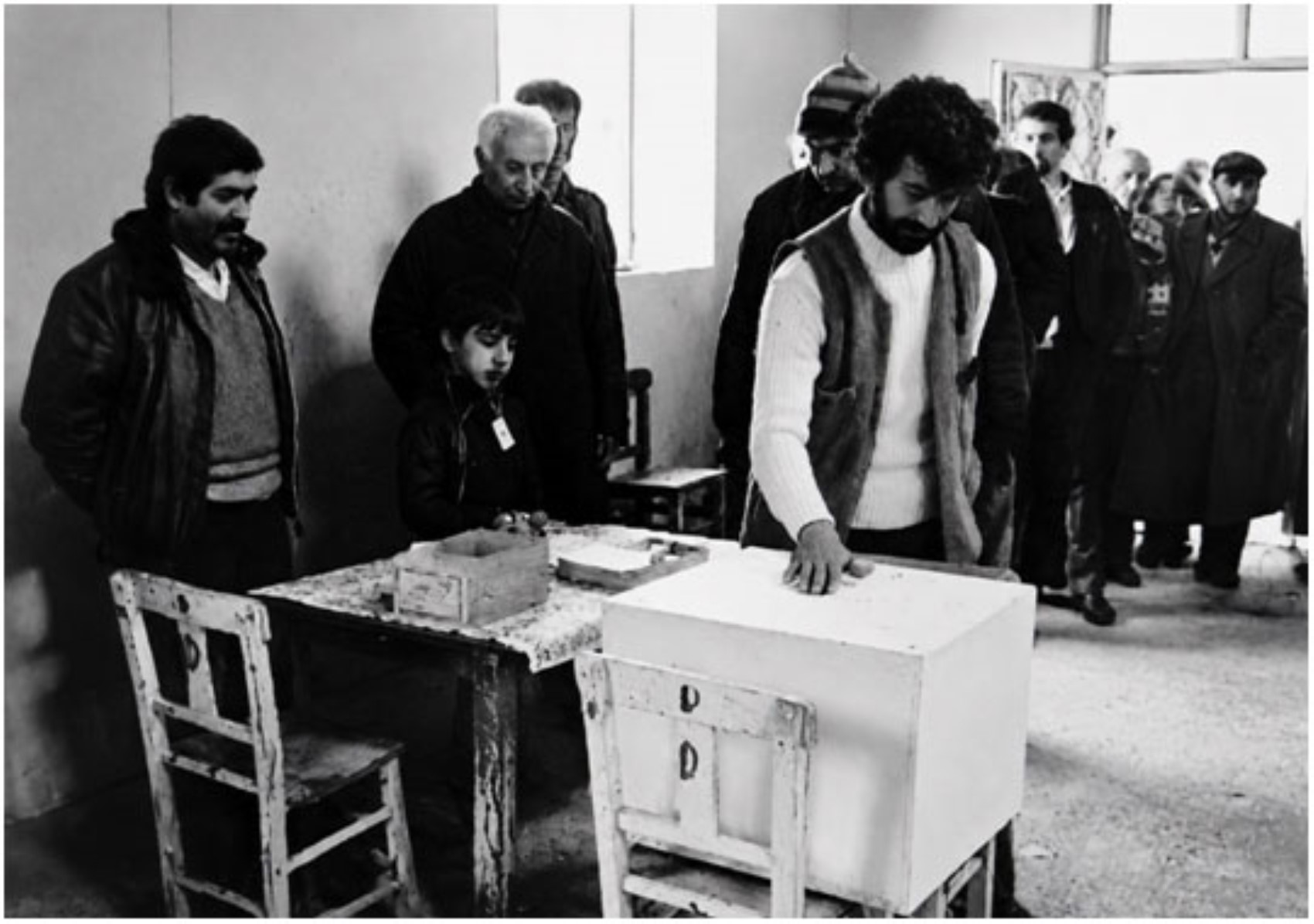 (Referendum under the supervision of the Çamköy Headman. 12.01.1997)
In the meetings held, the headmen of Narlıca and Pınarköy said, "They say we want the mine, let's show them we don't, let's hold a referendum/public vote."
"Let's see if the villagers are in favor of cyanide or against it?"
This proposal by the headmen was also supported by the lawyers who followed the villagers' environmental lawsuits in the courts, together with the İzmir Bar Association. They helped.
Immediately, with feverish activity, preparations were begun with great seriousness in the region as if a legal election or referendum were to be held.
The headmen of 17 villages extracted the voter registers, signature lists were prepared, observers were determined, and it was decided to set up ballot boxes and cast votes in 8 villages, primarily in Çamköy, which was chosen as the center.
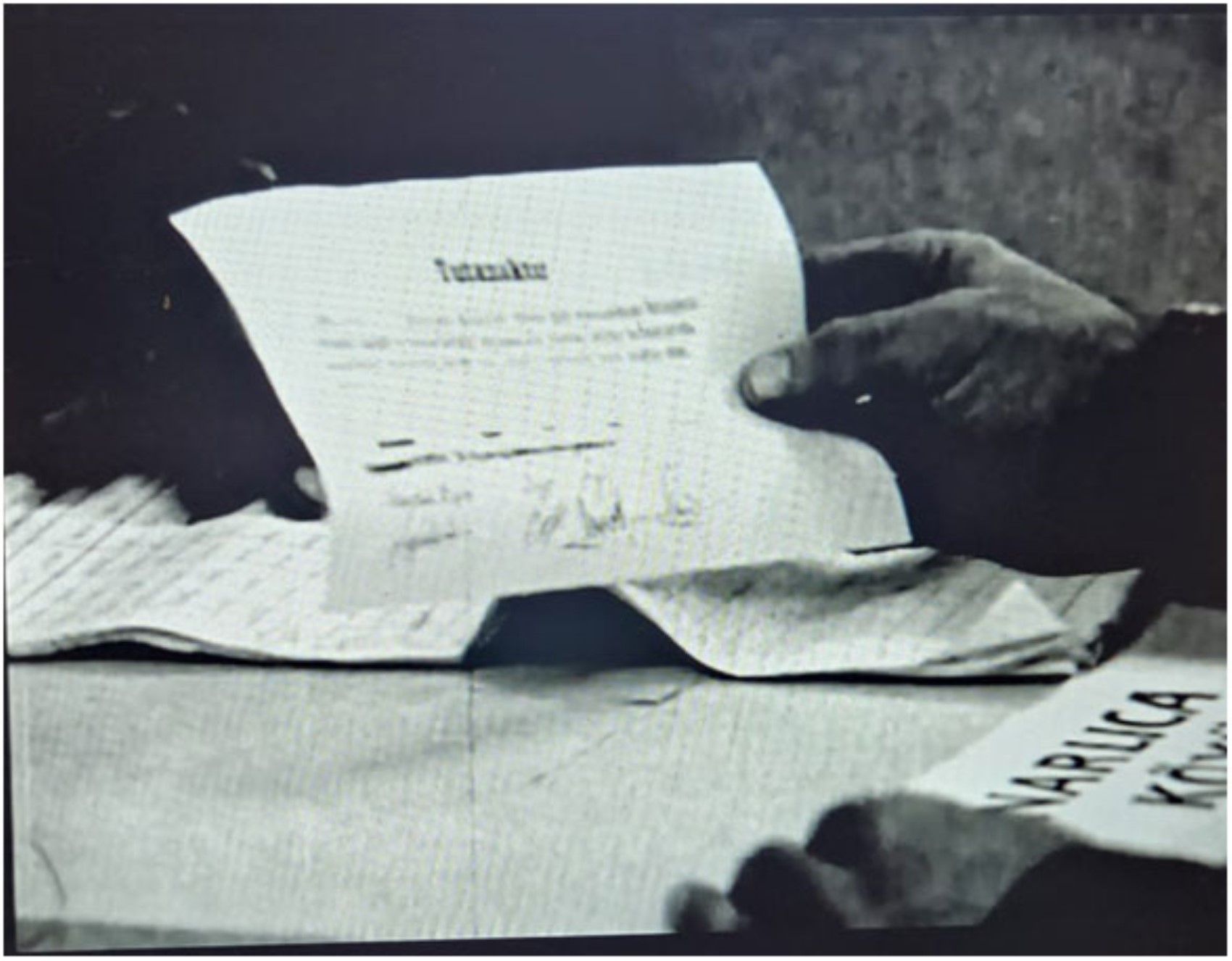
(Narlıca village results report in the unofficial public vote)
Some security officers were whispering in the ears of the headmen not to get involved in this business:
"There is no such thing as holding a referendum in the state tradition or laws."
"The public doesn't understand such subtle matters!"
In fact, the headmen, each of whom was the smallest unit of the state, did not pay attention to these words.
After all, headmen were also state officials according to the law.
What was wrong with the public determining their opinion by voting!
Wasn't electoral democracy and popular sovereignty being tried to be realized in the country by voting, even if it was applied half-heartedly?
Perhaps for the first time in Turkey, and on the subject of "environment," a public vote, which the villagers called a referendum, was going to be held under the supervision of headmen who were civil servants. Of course, unofficially!
Environmentalists knew that at an international conference held in Bergen, Norway, in 1990, which Turkey also attended, it was recommended that the public's opinion be asked for investments dangerous to the environment.
Sabahat Gökçeoğlu, the leader of the women activists from Çamköy, was almost an expert on the "Bergen Declaration," whose decisions Turkey also joined.
On Sunday, 12.01.1997, the referendum was successfully held and completed. 2886 votes were cast.
It was a complete feast of democracy. An excited wait.
All of those who voted (100%) voted "no to cyanide gold."
(https://www.polenekoloji.org/ekoloji-mucadelelerine-devletin-udahalesi-bergama-ornegi/?utm)
This referendum was the first, and perhaps the only, local public vote held within the scope of the environmental struggle in Turkey. Perhaps it was the last! The process was not legally binding.
However, the result of the referendum gave the Bergama movement the opportunity to emphasize: "They want to operate the mine despite the court decision and the public vote."
In front of everyone's eyes!
There can be nothing higher than the decision of a public informed of the pros and cons!
For this reason, the referendum became one of the fundamental symbols of the Bergama resistance's discourse on both democracy and environmental rights.
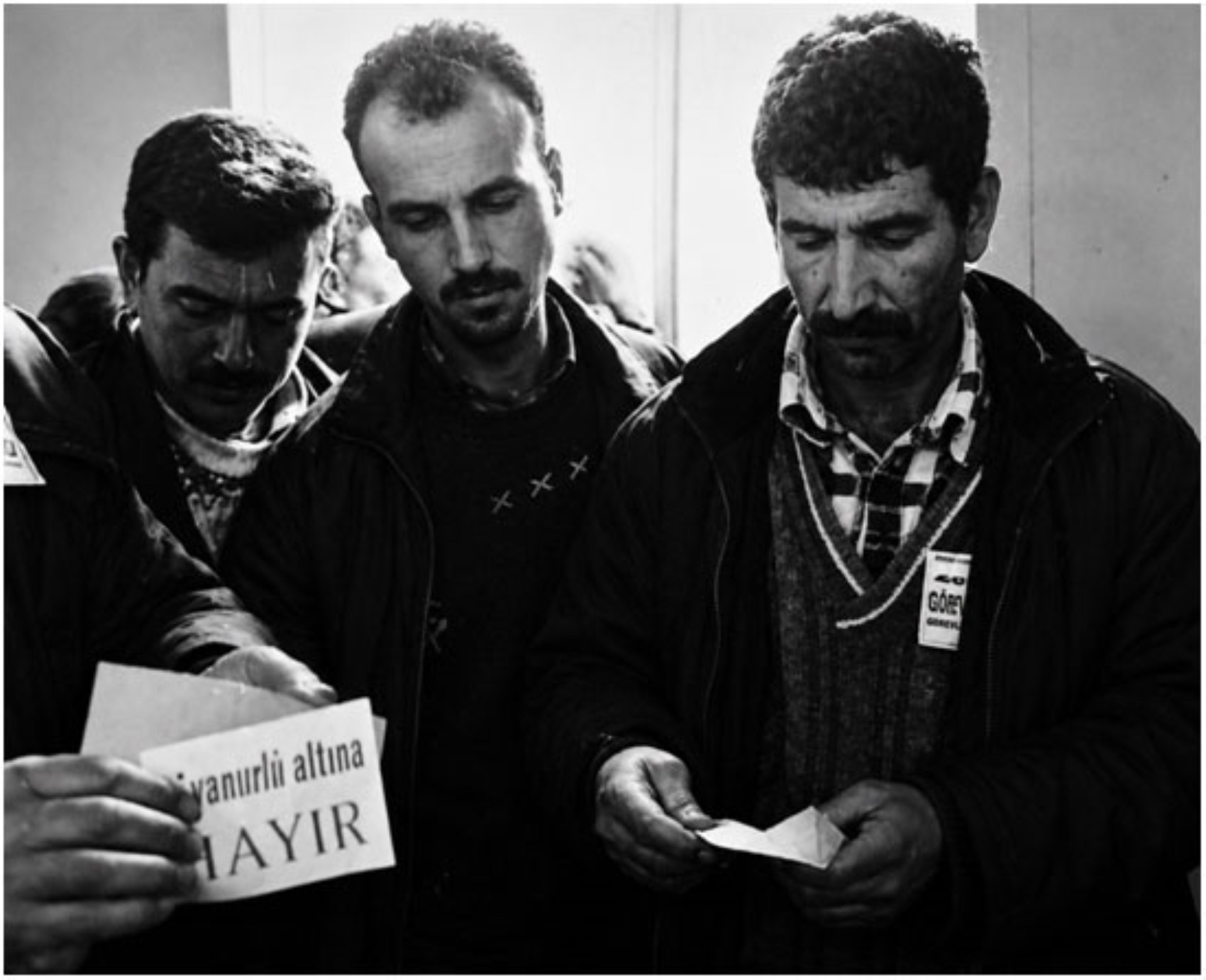
(Referendum in cyanide villages. 12.01.1997)
***
In these heated days, İzmir Governor Kutlu Aktaş and Bergama District Governor Temel Koçaklar, with their gentlemanly personalities, tolerant attitudes, democratic stances, and meticulousness in implementing the laws, successfully managed this chaotic process, and even in environments where actions reached their peak, not a single person's nose bled thanks to the sensitivity of the villagers.
In later years, Temel Koçaklar, a very valuable bureaucrat, would hold high state positions such as Governor of Muğla and Mardin, and member of the Council of State.
Kutlu Aktaş, who was the Governor of İzmir in those years, was also a mature administrator who understood the villagers' troubles. He had ensured that many peaceful villager initiatives, such as road blocking and the Bosphorus Bridge action, were concluded peacefully.
However, after a while, he too would become the implementer of orders coming from above.
***
Of course, the resistance against cyanide was not carried out only through action, legal struggle, and taking the issue to scientific platforms.
It was necessary both to keep the morale of the resisters under so much pressure alive, to reinforce the belief in the struggle, and to create public opinion on a wider scale and spread information.
Demonstrations were coming one after another.
While preparations for the referendum were being made in the villages, in the same days, in January 1997, a phone call from Lefke, Northern Cyprus, raised the situation to a different dimension.
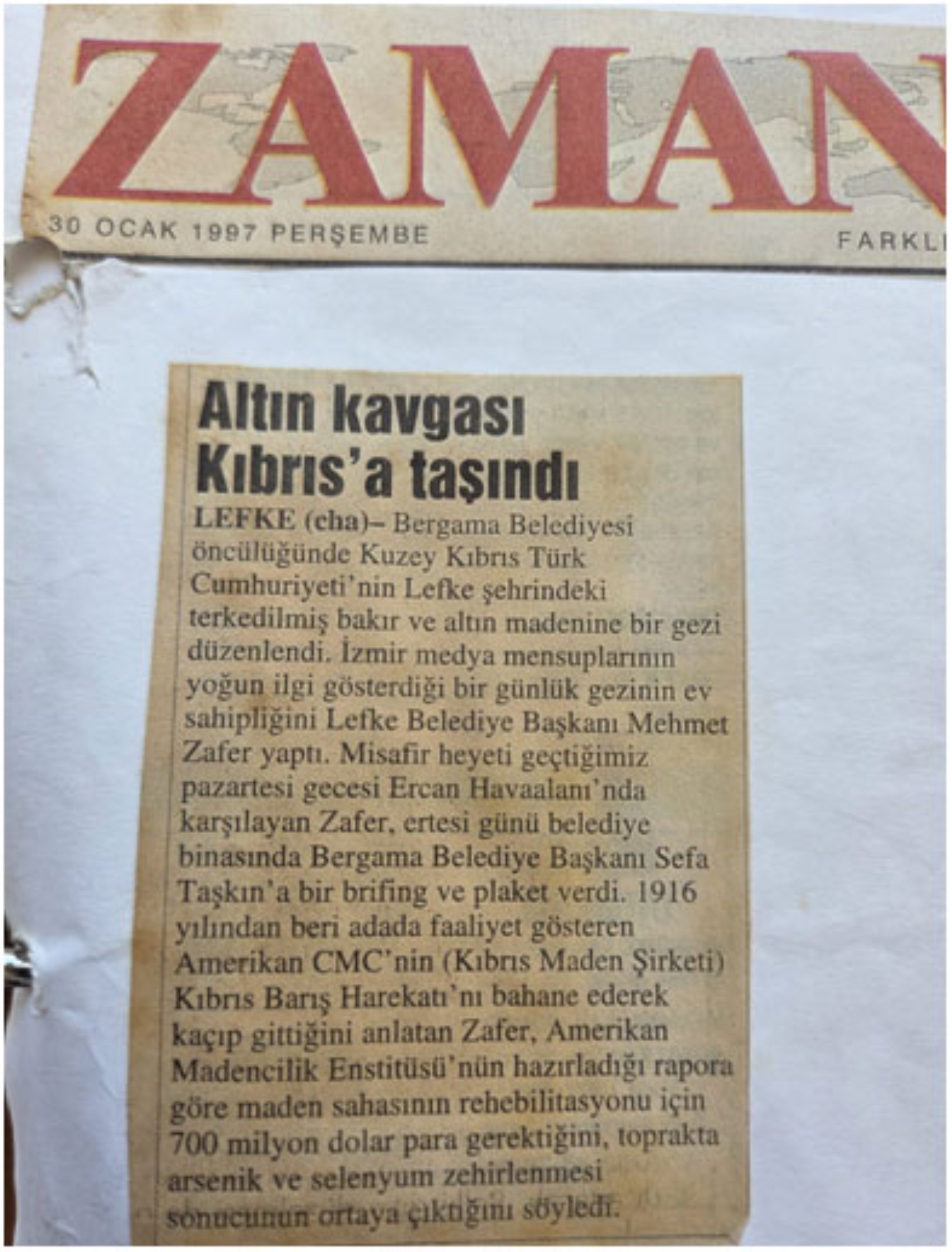
(Environmental Struggle crosses borders)
Lefke Mayor Mehmet Zafer called Bergama Mayor Sefa Taşkın and suggested that they see the traces of an environmental disaster in Lefke similar to Bergama's possible future.
The invitation was thought-provoking: The people of Bergama would be able to see a future that had not yet happened, in another geography, on another people.
The situation was immediately announced to the villages through the headmen. In the meetings held, it was decided to go to Cyprus with a large group and see the situation on the spot. In this way, some existing hesitations could also be resolved.
The expenses would be covered by the collective labor method. It would be shared. The Bergama Municipality would organize the transportation. Members of the press would also be invited to the trip.
The decision had been made quickly; because the villagers had now learned to make decisions.
This time, the Bergama environmentalists hit the road by air!
On January 29, 1997, they flew from İzmir to Nicosia, and from there by bus to Lefke. Mayor Mehmet Zafer welcomed the guests and hosted them with very sincere behavior.
This was the meeting of two Municipalities, two peoples in the baby homeland. This closeness was over a common fate that one was experiencing and the other was resisting not to experience.
Do exploitative imperialist companies recognize borders?
The American CMC (Cyprus Mines Corporation), which had been extracting copper since 1916 from ore that also contained heavy metals in the mine near Lefke, had left the region after the Cyprus Peace Operation; hundreds of acres of land remained behind, where foul odors and colorful toxic waste spread to the environment.
Right next to it, in Gemikonağı–Madendere, they had built an irrigation dam completed in 1995. As if it hadn't changed, surrounded by toxic soil!
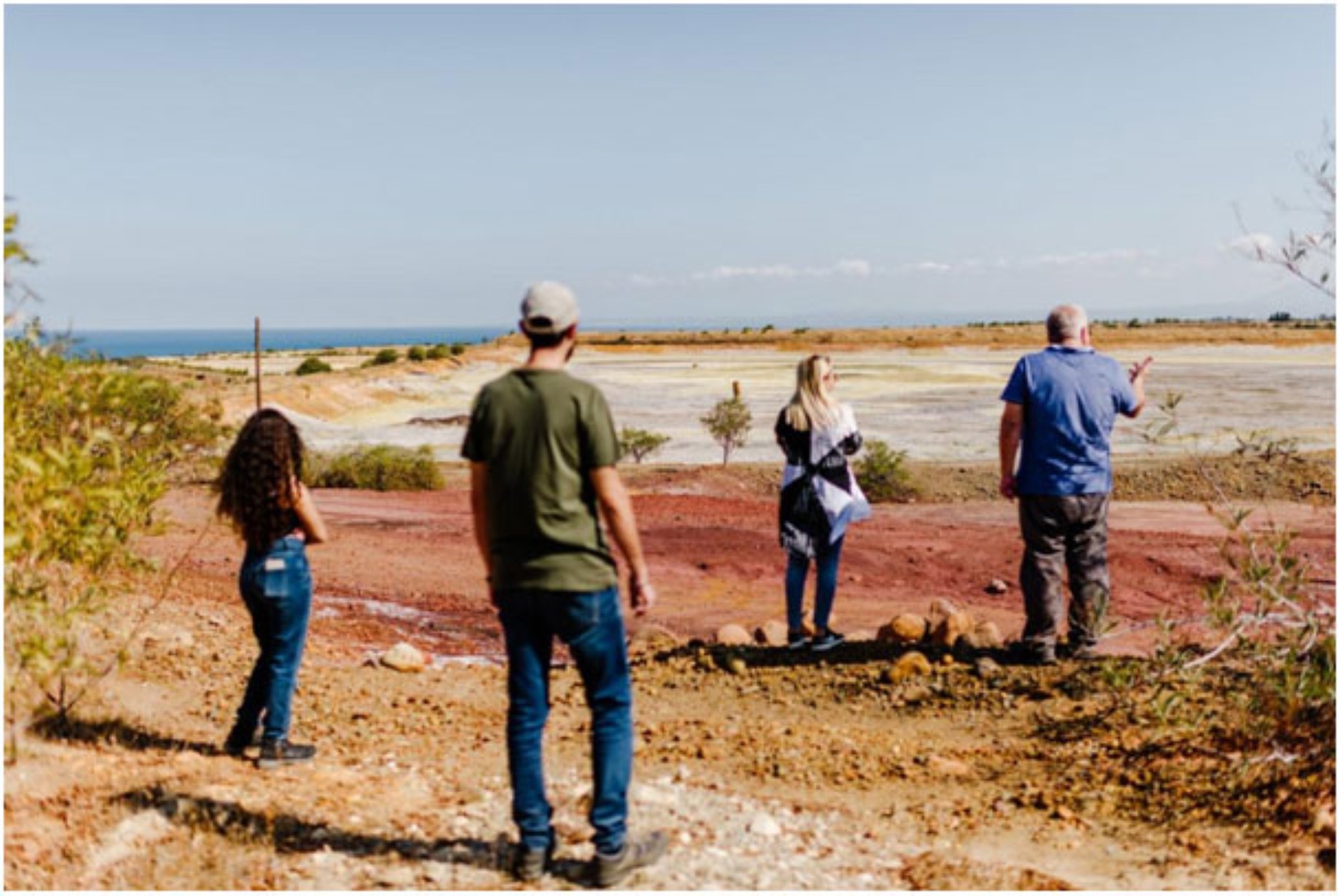
(Environmental disaster at the toxic mine in Cyprus-Lefke and visitors)
The visitors, who encountered a vast land covered with sediments of various colors around the abandoned mine, froze when they saw the landscape.
There was no need for words.
The environment standing before their eyes was as if it were the concrete version of everything they had been expressing for years.
They no longer needed to imagine what could happen to Bergama's soil, water, and olive groves. The example was right in front of them.
Their determination to fight against cyanide gold was silently reinforced once again on that colorful toxic soil.
After the villagers returned to Bergama, the officials of the cyanide company Eurogold, who went to Lefke, claimed that the mine there had nothing to do with the Bergama mine and that the public was being misled.
However, the problem was the harm caused to the environment and humans by heavy metals found together with substances such as gold, silver, and copper in such mines.
The appearance of the soil in Lefke covered with various colors was the colors given to the soil by various heavy metals such as arsenic remaining after copper was extracted from the ore.
Imperialism was leaving the soil they polluted like this after taking its life.
The cyanide company in Bergama was saying "it has nothing to do with it," but the soil was speaking otherwise.
Asuman Abacıoğlu from the Cumhuriyet newspaper, who participated in the Cyprus trip with the villagers, said this when she saw the situation in Lefke:
"At first, I didn't really believe that such mines could be harmful, but when I saw this place, I was scared."
It was no small thing for a journalist to admit that they were scared.
The people of Bergama, on the other hand, already knew. Fear had not stopped them; on the contrary, it had brought them this far.
***
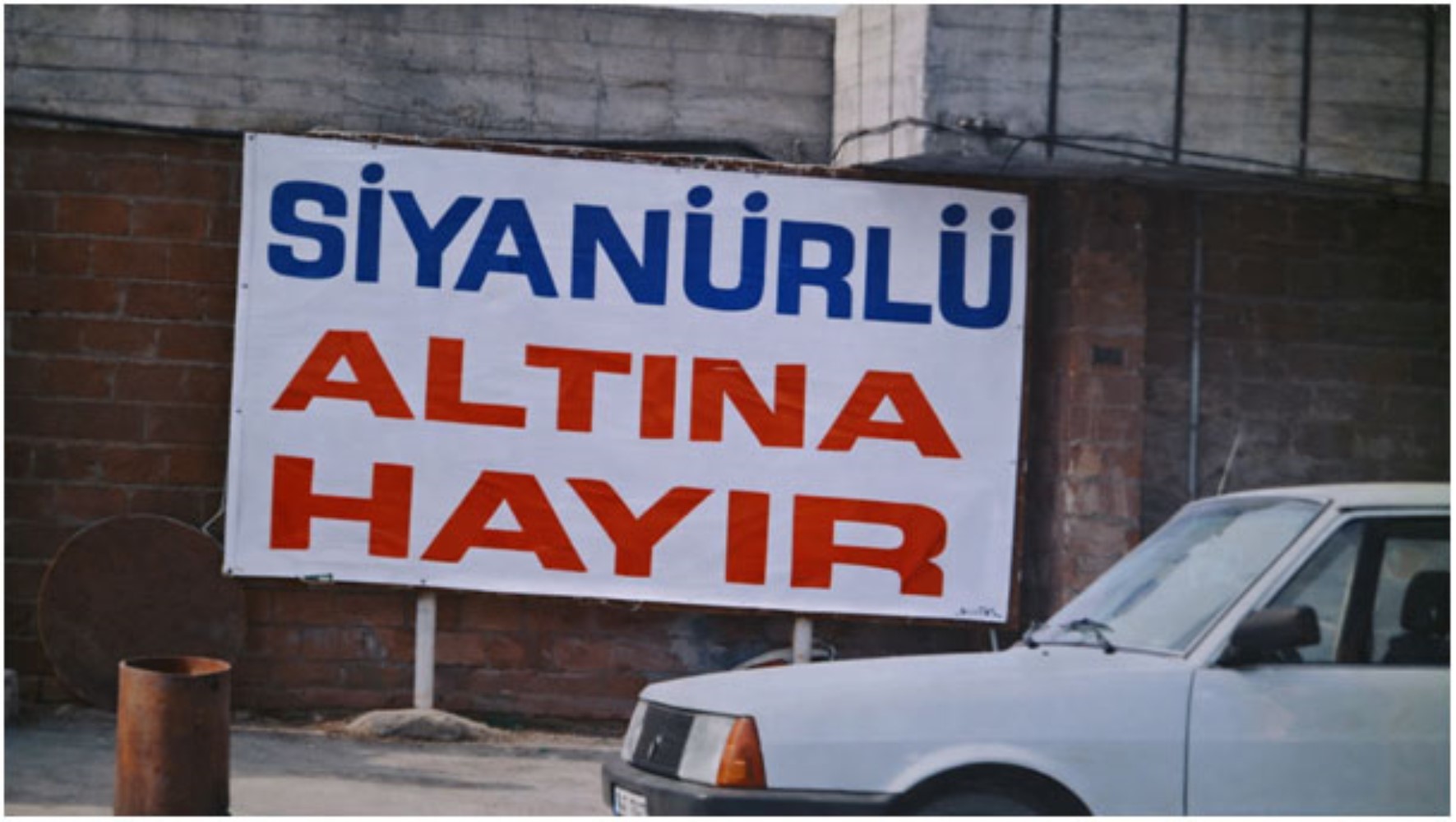
(Signs saying "No to Cyanide Gold" on the streets of Bergama city. Colorized.)
When the people of Bergama returned from Lefke at the beginning of 1997, they now had something concrete in their hands: What they saw.
They no longer needed to imagine what was left behind when a mine was abandoned.
If the mine were operated in Bergama, they might not have encountered such a landscape, but that colorful, toxic soil had told everything.
The voices of "no" rising in the village squares, the votes cast in the ballot boxes, and the leaflets distributed on the streets all repeated a single truth:
The people of Bergama were determined to determine their own destiny. Neither court decisions, nor company propaganda, nor the silence of Ankara could change this.
Who could dare to destroy such a sapling of democracy?
They dared!
Note: Thanks to Ethem Özgüven, from whose documentary "The Long March of the Light People" we took some photos.
Sefa Taşkın
16.08.2026
Bergama/Dikili-İzmir
Would you like to get notifications about new developments and save news?
- NotificationsNew developments and breaking news
- SaveNews is stored in the app
Most Read

Murat Ağırel’s police statement has been revealed

Video response to Kim Jong-un claims
Azerbaijan issues arrest warrants in absentia for 7 people living in Turkey

The Orionid meteor shower will be visible from Turkey!

The penalty for Ronaldo, who left the national team camp, has been announced

Fatoş Seğmen reveals the cause of her daughter's death

Injury shock at Liverpool: He may miss the Fenerbahçe match

Latest status in the race between AKP and YENİ Party revealed

Who authorized the concert held in a parking garage?

From brotherhood to a distant partnership...