


From the soil to 'Museum/Prison' display cases



A STONE IS HEAVY IN ITS PLACE-174. LET US NOT FORGET, LET US NOT LET BE FORGOTTEN
Today, we continue our journey on a different track in our article series, which we have been running for years under the title "A Stone is Heavy in Its Place."
Throughout this journey, we have persistently tried to underline one truth:
The Zeus Altar, the statues, the reliefs, and many other historical artifacts that were taken, carried away, smuggled, and moved to Berlin from Bergama in the late 19th century do not belong in Germany.
Because they cannot be seen merely as works of fine art.
They are the history, the memory, and the identity of the land where they were born.
The fact that they are exhibited in a museum display case, or whether they were taken with or without permission, does not make their presence there correct or legitimate today.
For every artifact, large or small, famous or unknown, we defend the same principle:
A stone is heavy in its place.
This time, we will not talk about a giant altar or a marble statue; we will talk about a small, beautiful ceramic vessel that emerged from the soil of Western Anatolia and the hands of a master from Bergama.
Sometimes, even a tiny vessel tells a grand history.
***
Approximately 2300 years ago, in the 2nd century B.C., the Pergamon civilization, which reached its peak, produced eye-catching works in ceramics, in addition to the creativity it displayed in sculpture, medicine, urban planning, and architecture.
Masters from Pergamon were producing some of the most beautiful ceramic vessels of the Hellenistic world by working the soil of Bergama here.
Some of the remains unearthed during archaeological excavations in these production areas and which have survived to the present day are preserved today in the courtyard of the Red Basilica/Temple of the Egyptian Gods in Bergama.
The unique success that Pergamon art displayed in sculpture also manifested itself in ceramic works.
Beautiful vessels were being produced in the ceramic workshops and kilns established in the Ketios/Kestel Stream Valley, north of the city's Acropolis, the present-day hill of Bergama.
Shaping clay to make vessels was one of the oldest skills humanity learned thousands of years ago.
The wealthy of the Hellenistic world used valuable vessels made of gold, silver, and bronze. Pergamon ceramic masters, on the other hand, managed to produce cheaper but flashy tableware by utilizing the form and decoration concepts of these metal vessels.
The reliefs seen in metalwork were transferred to ceramic surfaces, and the mold technique was used for this.
Such vessels, long called "Megarian bowls," were mostly hemispherical and handleless.
Clay was pressed into a pre-prepared decorated mold, thus creating reliefs on the outer surface of the vessel.
This method also made it possible to produce a large number of vessels with the same decoration.
There is an interesting detail regarding the name of these vessels.
"Megarian bowl" was not a name used in antiquity. It was a traditional naming given by modern archaeologists and did not mean that these vessels were first produced in a city called Megara in Greece.
According to current archaeological data, the earliest known examples of ceramic vessels appear in Athens in the last quarter of the 3rd century B.C. Pergamon, in a short time, became one of the important and original production centers of this type of ceramic.
***
But it did not just produce; it also created a unique ceramic style.
Well-prepared and refined clay was used in Pergamon vessels, and careful and often thin-walled products were obtained. Their paste and surfaces could be in reddish, brownish, and yellowish tones.
In the 2nd century B.C., towards the end of the Pergamon Kingdom, the production of red-slipped and shiny-surfaced vessels also gained increasing importance.
Pergamon masters transformed the mold technique into a rich world of decoration unique to themselves.
In addition to acanthus and lotus leaves, vines, rosettes, flowers, fruits, and geometric borders, human, god, and animal figures were also featured on the vessels.
Dionysos, the god of wine, harvest, and theater, and his world hold an important place in Hellenistic Pergamon art; in ceramics, a rich world of ornamentation was created with floral decorations, human, and animal figures.
The effects of Pergamon's great tradition of sculpture and architecture were also felt in ceramic decorations.
Leaf veins, plants, fruits, and animals were worked in a lively and detailed manner.
The fact that some motifs are related to the city's architectural elements and other works of art shows that the ceramic masters were nourished by the general art environment of Pergamon.
***
Excavations also reveal the scale of production.
More than 5,000 Hellenistic (the name of that period) relief bowl fragments were recovered in Pergamon. In a comprehensive study published in 2021, 976 locally produced vessels were recorded with 126 molds.
The influence of the Pergamon ceramic tradition also exceeded the city's borders.
The close similarities seen in the relief bowls found in Sardis (Salihli-Manisa) with Pergamon examples suggest that Pergamon masters or the mold and decoration repertoire they used may have influenced local production in Sardis.
In short, it is not correct to see Pergamon ceramics only as an imitation of forms that emerged in other centers.
With its rich relief bowls produced with molds, the fine craftsmanship that transfers the aesthetics of metal vessels to ceramics, and its unique world of decoration that formed over time, Pergamon became one of the important ceramic production centers of the Hellenistic Age.
Unfortunately, some of these beauties remaining from that era, just like other works of Bergama, were taken abroad over time.
Today, they decorate the homes and museums of European and American collectors.
One of them is an elegant ceramic goblet that is 15.8 cm tall with a rim diameter of 9.8 cm.
It is understood that the upper half of the goblet was specially darkened to make it look more impressive.
People in long garments performing various movements are seen on the outer surface.
The goblet rises on a delicate foot.
***
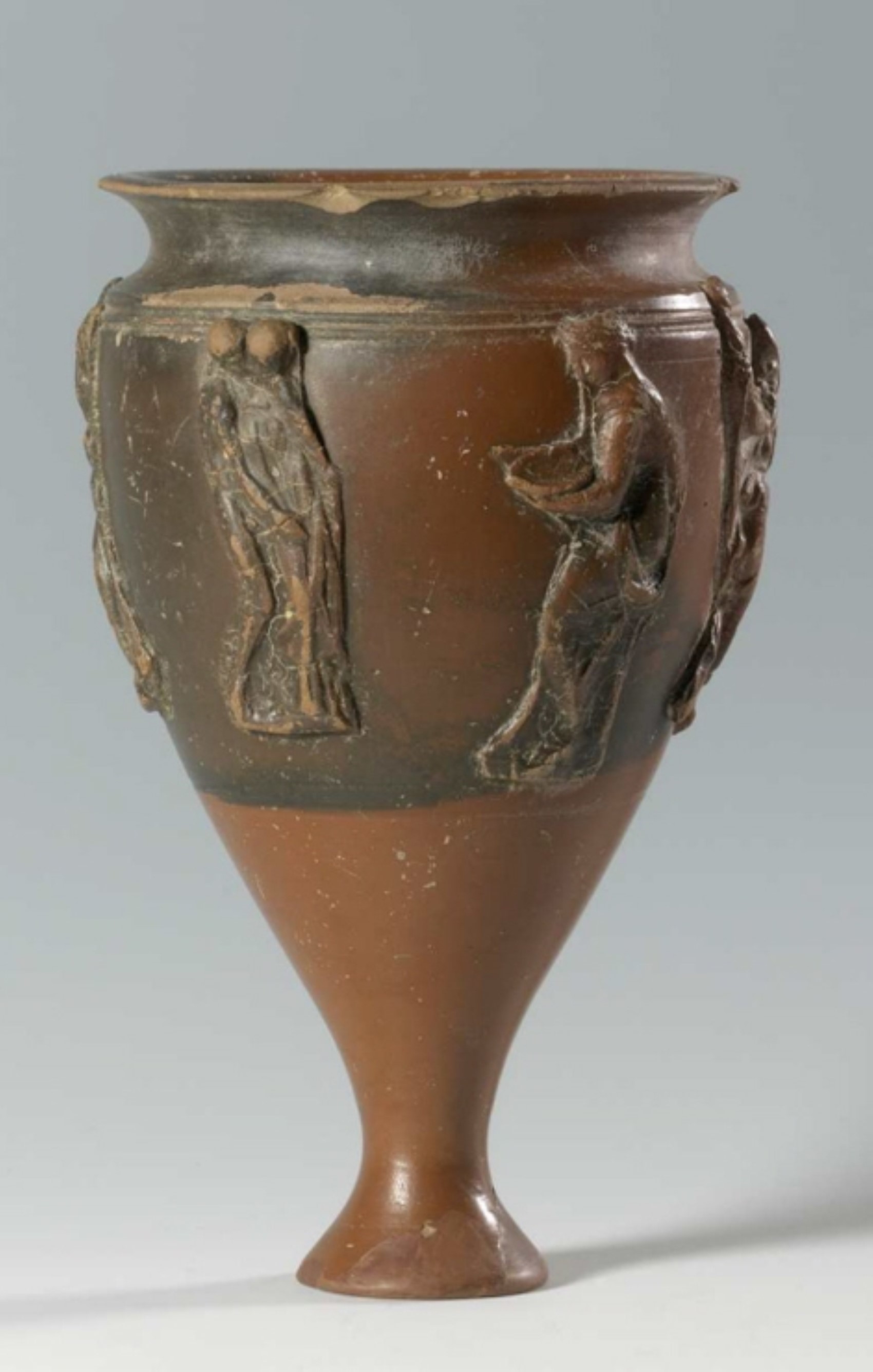
This beautiful work is registered today in the Berlin Museum/Prison under the number "Ident.Nr. 1966.10".
In the Museum/Prison's own records, it is stated that the work was acquired (erworben) in Frankfurt in 1966.
Here, some questions inevitably come to mind:
When did this Pergamon work leave Bergama?
Who took it out?
How did it reach Frankfurt?
From whom was it purchased in 1966?
And most importantly, is there any document regarding the legal removal of the work from Turkey?
These are questions that need to be answered.
Because the transportation of Bergama's works to Europe has a much older and painful history.
Many works unearthed from the excavations carried out in Bergama by the Anatolian robber Carl Humann in the late 19th century were taken to Germany.
Today, many of Bergama's most important works, especially the Zeus Altar, are still in Berlin.
At that time, the removal of Bergama's works to Germany was defended with various justifications.
Especially the excuse that "European museums are full of such historical artifacts" went no further than being an empty robe.
After more than a hundred years, shouldn't the history of a Pergamon work that appeared in Frankfurt in 1966 have been questioned?
Where did it come from?
Who brought it?
On what date did it leave Turkey?
Was it removed legally?
Or was it stolen secretly?
Was a stolen artifact acquired!
Is it too much to ask these?
Surely, it has never crossed the minds of those who keep it in the Berlin Museum/Prison today!
Or perhaps it did, and they chose to be indifferent!
***
It seems that the understanding of seeing historical artifacts as collection objects torn from the lands they belong to does not change easily.
It must change!
A historical artifact is not just a beautiful object.
It carries the knowledge, art, labor, and memory of the land and society on which it was produced.
For this reason, when it is torn from the land it belongs to, not only does the location of an object change; a piece of history is also torn from its context.
This understanding is not correct.
And moreover, beyond legal debates, it is a shame.
In the TDK's Turkish Dictionary, "shame" (ayıp) is defined as "a situation or behavior that is contrary to the moral rules of society and is shameful."
The following sentence by our famous writer Yakup Kadri Karaosmanoğlu is given as an example of the use of this word:
"I cannot bring myself to be one with those who commit this shame."
For those concerned, how sustainable is it to live with this shame?
THE ZEUS ALTAR AND BERGAMA'S WORKS DO NOT BELONG TO COLD AND FOGGY BERLIN, BUT TO BEAUTIFUL BERGAMA. THEY MUST DEFINITELY COME BACK, THEY MUST RETURN HOME.
Sources
Staatliche Museen zu Berlin, SMB-digital / collection database, Ident.Nr. 1966.10.
Gioia de Luca – Patricia Kögler, Hellenistische Reliefbecher aus Pergamon, Pergamenische Forschungen 18, Deutsches Archäologisches Institut, 2021.
Susan I. Rotroff, “The Moldmade Bowls of Pergamon: Origin and Influence”.
Metropolitan Museum of Art, Pergamon and the Hellenistic Kingdoms of the Ancient World.
Sefa Taşkın
23.08.2026
Karşıyaka-Bergama/İzmir
Would you like to get notifications about new developments and save news?
- NotificationsNew developments and breaking news
- SaveNews is stored in the app
Most Read

Murat Ağırel’s police statement has been revealed

Video response to Kim Jong-un claims

Azerbaijan issues arrest warrants in absentia for 7 people living in Turkey

The Orionid meteor shower will be visible from Turkey!

The penalty for Ronaldo, who left the national team camp, has been announced

Fatoş Seğmen reveals the cause of her daughter's death

Injury shock at Liverpool: He may miss the Fenerbahçe match

Latest status in the race between AKP and YENİ Party revealed

Who authorized the concert held in a parking garage?

From brotherhood to a distant partnership...