


A riddle, a riddle!



CYANIDE DIARIES FROM BERGAMA-22
Neither moth nor rust can consume it; yet the human mind is swallowed by it.
What is this object?
It is, of course, gold.
The precious metal that enchants people with its color and rarity, and blinds the eyes of the wealthy with its value.
Chemically, gold is a noble metal; physically, it is a highly durable substance: it neither rusts nor decays. Things that eat organic matter, like moths, cannot harm it. It is resistant to acids and can remain unchanged for thousands of years.
That is why it has been a symbol of value and immortality for centuries.
But the tragic part of the matter is this:
Gold does not decay, but the desire to possess it decays the human soul.
Once the human mind is captivated by the allure of gold: greed increases, and moderation is lost. Greed becomes normalized. Moral values are weighed on the scales of gold. Human relationships become commodities. As the mind fills with gold, the conscience empties.
Humans consume gold; but in the end, gold consumes humans.
Ultimately, the mind does not possess gold; gold possesses the mind.
Gold takes over the mind.
World history is full of countless evils committed for the sake of gold: wars, colonialism, genocides, the destruction of nature, torture, the breaking of friendships, the tearing apart of families…
All of it was done for the sake of this mineral's shine and the power it holds.
Humanity is lost to greed.
Gold is not an external enemy like a moth or rust.
But when it combines with the void inside a person, it turns into a destructive force.
Many wise people have drawn attention to this phenomenon and issued warnings.
Pindar, a poet born in Thebes in Ancient Greece who lived in the 4th century BC, is at the forefront of these.
Humanity carries his cultural fame to this day.
Alexander the Great of Macedon, who conquered and razed Thebes, did not touch his house out of respect.
Pindar said: “Gold is a child of Zeus (the chief god of the ancient Aegean religion); neither moth nor rust can consume it; yet the human mind is swallowed by the superior power of gold”.

(Pindar)
***
The curse of gold also manifests itself in mythology and literature:
The Anatolian King Midas of Phrygia is obsessed with wealth. He wants everything he touches to turn to gold; his wish is granted, but he loses his own health and his beloved daughter in the process.
In Hellenic mythology, a group of warriors led by a hero named Jason set out to find and retrieve the Golden Fleece, which symbolizes wealth and power, located on the shores of the Caucasus (in Colchis) in the Eastern Black Sea. They take it, but they suffer every disaster imaginable.
In a story coming from historical narratives and oral tradition, it is known that thousands of indigenous people were massacred for the sake of the legendary city of gold that the locals said existed, which the Spaniards who invaded South America named “El Dorado”. The real world was plundered by this gold greed of the Spaniards. Those who seek gold seem to have lost their humanity.
In the modern era, the famous protagonist Faust from the great German writer J.W. Goethe’s work sells his soul to Mephisto, the Devil, in a deal for pleasure and gold.
In Jack London’s work “The Call of the Wild”, the savagery of people chasing gold in Alaska increases; they become ruthless toward nature, animals, and each other. For the sake of gold, the mask of civilization falls, and the primitive side emerges.
In J.R.R. Tolkien’s fantasy story “The Lord of the Rings”, Smeagol, an ordinary, good character, becomes an evil being, Gollum, once he gets his hands on a “ring” that is the symbol of gold. His body decays. He is caught between good and evil. The gold ring eats and finishes Gollum’s soul.

(The Lord of the Rings Gollum)
Gold does not physically decay; but the desire for it decays the human.
Today, gold still shines in state treasuries, bank vaults, stock markets, mining companies, and the projects of the “Cyanide Octopus”.
Unfortunately, humanity still cannot break free from its spell.
Yet, if you threw gold to dogs, they wouldn't eat it!
Humanity is still captivated by the shine and losing the truth.
“Neither moth nor rust can eat it; but the human mind is swallowed by it”.
Gold is durable, while humans are fragile.
And the breaking does not start from the outside, but from within.
***
In the 1990s, Eurogold, the flagship multinational—or rather, transnational—company of the cyanide proponents who operated a cyanide gold mine in Bergama-Ovacık and saw this place as a threshold to spread throughout all of Turkey, attempted to open this facility despite the resistance of the people.
While a segment of the state was rapidly facilitating the bureaucratic work of the poison-peddling company, another segment still had hesitations. Moreover, society was very sensitive about this issue.
They were asking the company to convince the public.
When the well-intentioned famous journalists from Istanbul, brought to Bergama by the cyanide company for its own propaganda, encountered the striking resistance of the villagers, they realized that the situation here was not an ordinary event, but an unprecedented mass peaceful resistance, and they began to support the villagers with greater strength.
Seeing that things were getting increasingly difficult, the multinational cyanide company, unable to find the support it expected from the Istanbul press, turned to İzmir.
Most of İzmir’s environment-sensitive press also did not give the time of day to the poison-peddling Eurogold.
Major newspapers of the time such as Yeni Asır, Cumhuriyet, Milliyet, and Hürriyet were behind the villagers.
Gazete Ege, the newspaper of the major İzmir industrialist Durmuş Yaşar, had openly raised its flag on the side of the environmentalist villagers under the management of veteran journalist Ahmet Yazıcıoğlu.
A. Yazıcıoğlu would later recount what inappropriate offers the cyanide proponents made to win the newspaper over to their side!
The late Hamdi Türkmen, an executive who served as both news director and editor-in-chief of the Yeni Asır newspaper, had also become the voice of the villagers against the cyanide proponents.
Young journalists such as Hikmet Çetinkaya, Berkant Kipöz, Hakan Atis, Süleyman Gencel, Asuman Abacıoğlu, Hakan Dirik, Gönül Soyoğul, Çağlayan Bilgen, Mustafa Yılmaz, Ünal Ersözlü, Merih Ak, Turhan Gültekin, Serdar Kızık, Halil Üner, Ali Kayadibi, Birol Keskin, Muzaffer Oktay, Macit Sefiloğlu, and Erdal Çarboğa were excitedly writing and reporting on the villagers' actions.
***
While the İzmir press displayed such a noble stance, after a while, Eurogold (likely thanks to advertiser Betül Mardin) found what it was looking for: supporters for itself.
A TV station, founded in 1994 first under the name Kanal Ege and later renamed Ege TV, was broadcasting terrestrially to the entire Aegean Region.
Its owner belonged to Cem Bakioğlu, who had become wealthy in the packaging industry in İzmir, that is, Bakioğlu Holding.

(Cem Bakioğlu and Erol Yaraş)
C. Bakioğlu had brought the Ankara-based journalist Erol Yaraş to head Ege TV.
Erol Yaraş was a very colorful personality!
He had gotten engaged to the artist Ajda Pekkan at the 1979 İzmir Fair, but they had separated a few days later. He was 28, and A. Pekkan was 33!
In İzmir, where the wealthy multinational Eurogold was seeking support, for some reason, Erol Yaraş and Ege TV suddenly became cyanide gold proponents.
The virtues of “cyanide gold” must have been discovered in a short time!
The failing TV channel had suddenly come to life.
In its broadcasts, “cyanide gold” was praised to the skies, and the protesters were dragged through the mud.
At night in Bergama, trash cans were overturned by unidentified persons, and the Ege TV staff who arrived the next day would film the trash scattered on the ground and broadcast it in their evening programs.
Primitive propaganda was also a method:
“The municipal workers pretend to be environmentalists, but they can't even collect their own trash!”
Once, they even attempted to seize the satellite relay station established by the Municipality so that the public could watch TV better, and tried to broadcast pirated content.
Bullying was also a tactic!
Perhaps due to Ege TV’s “beliefs” in the benefits of gold (!), this ambitious partisanship for the multinational cyanide company Eurogold did not pay off.
The environmentalist villager movement was becoming increasingly massive.
The country’s patriotic scientists, lawyers, intellectuals, and political parties were slowly emerging and declaring their support for the villager movement.
***
The situation was understood: this piece of the homeland would be defended.
The source of the trouble was in Bergama, but these poisoners wanted to carry out this toxic, dirty business all over Anatolia.
The environmentalists of Bergama were struggling and warning. It could not be realized that these cursed cyanide gold operations would spread across the country and become a plague on the nation.
Counter-propaganda and state power were behind the money-grubbing poisoners.
However, as the great leader Mustafa Kemal said, “There is no line of defense, there is a surface of defense. That surface is the whole homeland.”
In this environment, a unique event where science, law, and social activism converged was taking place on the lands of Bergama.
Environmental protection slogans were rising from the skies of Bergama. To Anatolia, to Istanbul, and even to Europe, to neighboring Greece.
“Everywhere is Bergama, we are all Bergamans.”
Of course, the “cyanide octopus” was not idle either. They were spreading like weeds across the country:
To Artvin, to Erzincan, to Eskişehir, to Kırşehir, to Sivas…
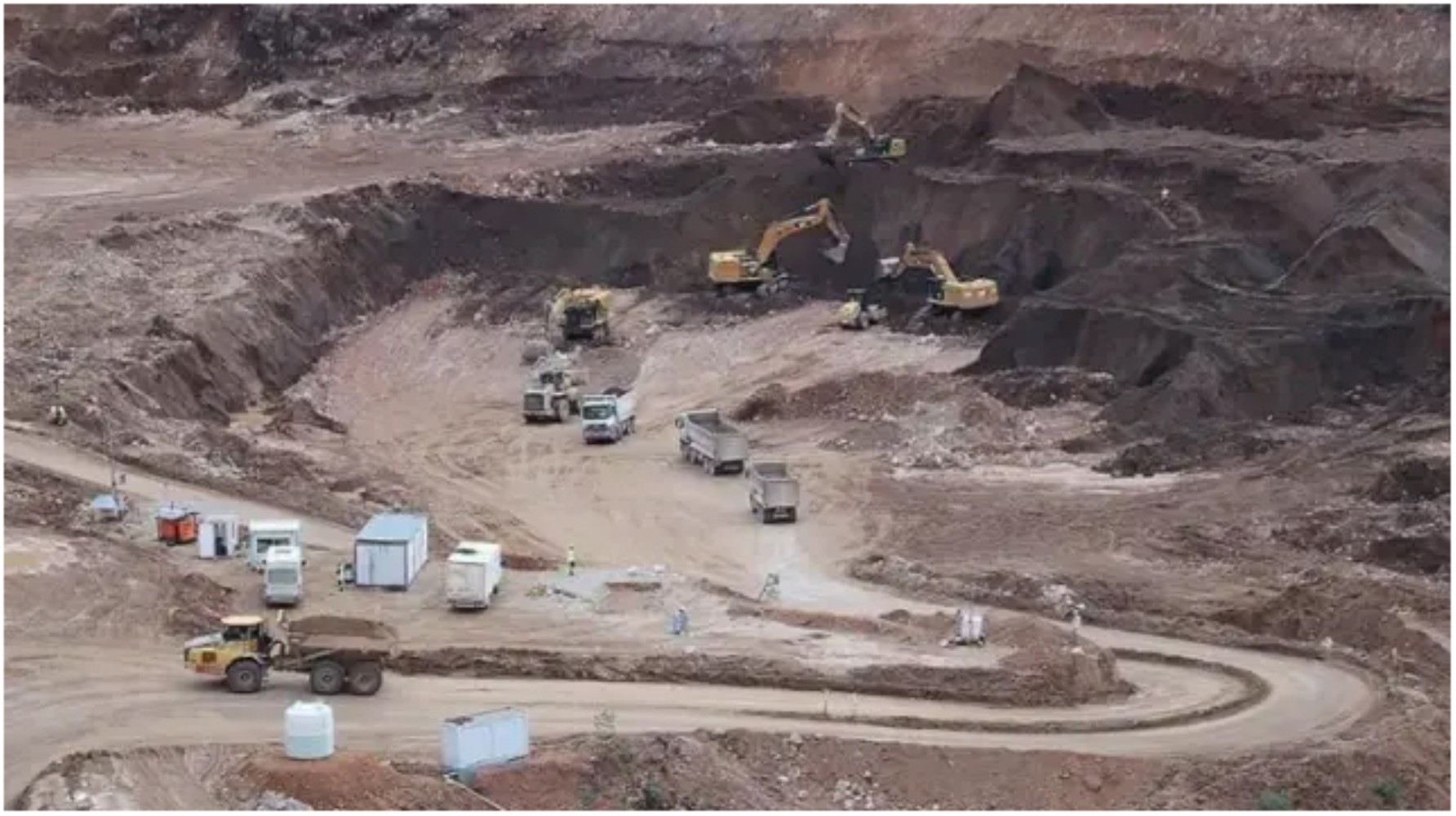
(OYAK-Erdemir’s cyanide gold mine attempt in the Sivas Kangal-Alacahan area. They found 0.89 grams of gold in 1 ton of soil. It is ridiculous and terrifying. They call this a mine. They will cyanide thousands of acres of land to extract gold that is not even 1 gram per ton.)
Indeed, “as you remain silent, your turn will come”!
The opposition and methods in Bergama would be heard in waves throughout the whole country.
Bergama’s slogans would reach as far as Gezi Park in Istanbul.
Even though evil eyes tried to crush the resistance against evil!
Even though gold, which moth and rust cannot consume, swallowed the minds of some!
Humans knew how to stand up against injustice!
That is how humans became human in the first place!
***
Gold went up! Gold went down!
The gram is this much, the ounce is that much!
Quarter gold, half gold, full gold!
Cruel market!
Until when?
………
…………
Sources: Pindar, Fragment 222-209 Sir John Sandys translation // https://www.haberler.com/haberler/sivas-in-kangal-ilcesinde-71-5-milyar-tl-lik-19220114-haberi/ https://www.academia.edu/20658145/BERGAMA_D%C4%B0REN%C4%B0%C5%9E%C4%B0) /// https://alivedatoygurmadencilik.wordpress.com/2018/01/06/ovacik-altin-madeni-bugunlere-nasil-geld i////(https://www.bloomberght.com/turkiye-de-2001-2017-arasinda-toplam-273-ton-altin-uretildi-2098458?page=2))
Sefa Taşkın
09.11.2025
Bergama/İzmir
Would you like to get notifications about new developments and save news?
- NotificationsNew developments and breaking news
- SaveNews is stored in the app
Most Read

Video response to Kim Jong-un claims

Murat Ağırel’s police statement has been revealed
Azerbaijan issues arrest warrants in absentia for 7 people living in Turkey

The Orionid meteor shower will be visible from Turkey!

The penalty for Ronaldo, who left the national team camp, has been announced

Fatoş Seğmen reveals the cause of her daughter's death

Injury shock at Liverpool: He may miss the Fenerbahçe match

Latest status in the race between AKP and YENİ Party revealed

Who authorized the concert held in a parking garage?

From brotherhood to a distant partnership...