


The tears of the marble woman



A STONE IS HEAVY IN ITS PLACE-152. LET US NOT FORGET, LET US NOT LET BE FORGOTTEN.
Humans have created sculptures as a means to express their emotions and thoughts, to commemorate important people and entities, or to reflect their religious beliefs.
Such works continue to be created today.
Sculptures have been produced using different styles and techniques from ancient civilizations to modern times.
Artistic styles emerged in this direction, and art developed through various perspectives.
In the ancient era, Pergamon was a very important center where sculpture flourished.
Talented artists and skilled masters created many unique works with unparalleled creativity.
They breathed life into stone and marble.
These works were destroyed and shattered by fanatical Christians and the Umayyads.
They were buried underground and used as spolia in walls.
These statues, which slept in the arms of time for many years, were stolen by the pawns of German Imperialism, who were seeking a cultural cover for their rootless past, and by thieves disguised as archaeologists.
Between 1864 and 1878, they took the pieces and statues of the Pergamon Altar of Zeus to Berlin, Germany, without obtaining any permission or notifying the Ottoman Empire.
The leader of this smuggling operation, a historical artifact robber disguised as an engineer named Carl Humann, and his network began to ship out the works they had found but could not initially smuggle, using dubious permits they obtained in 1878, and started new excavations.
During this time, in the spring of 1879 (if the date provided is correct), they found a marble statue of a woman, some parts of which were worn, which had been thrown into a cistern southeast of the site where the Altar of Zeus was located.
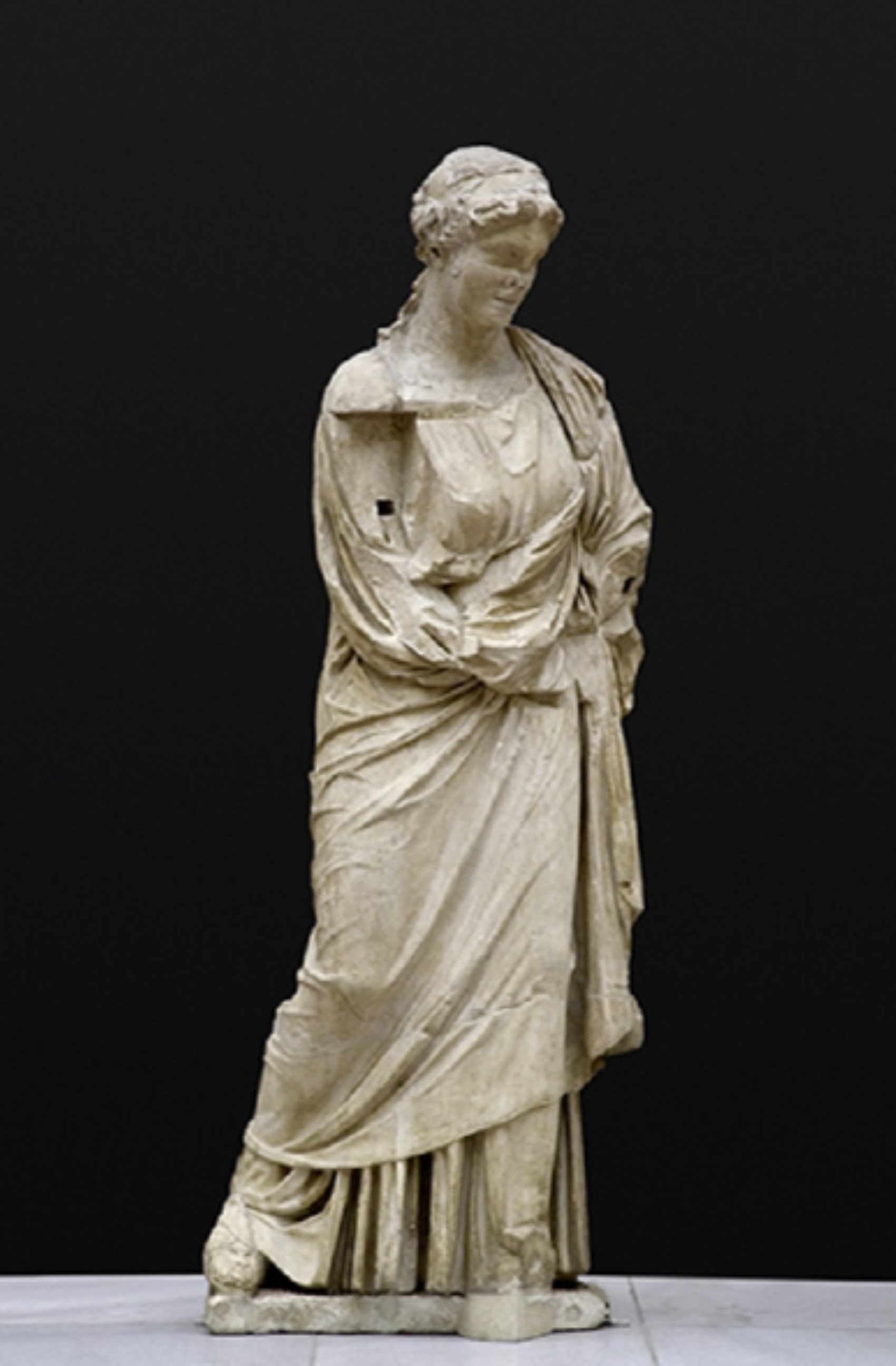
This magnificent statue, which is 218.5 cm tall and has a hip width of 72 cm, is missing its right arm.
The distance between the outer corners of her eyes is 11.9 cm, and the length from forehead to chin is 23 cm.
It is dated to the second quarter of the 2nd century BC, when sculpture in Pergamon reached its peak.
This marble statue is taller than an average human.
It was likely damaged in many places when it was thrown into a nearby cistern, a pit, by fanatical Christians hostile to statues, in an attempt to destroy it.
Nevertheless, it has lost nothing of its integrity and magnificence.
Especially the peaceful appearance of her face has reached us exactly as it was.
Given that it was found near the Altar of Zeus, the simplicity of the cloak she wears on her back, and her dignified and inviting appearance, this woman depicted in the statue was likely an assistant who guided those coming to offer sacrifices at the Altar of Zeus.
In the statue, the woman has clearly pulled her right leg back and to the side, while her left leg is positioned as if she has taken a step forward, showing her as if she is walking or standing ready to walk.
Giving the impression that the woman is about to lunge forward with the reverse positioning of her legs, and creating a sculpture in this style—which is characteristic of the Pergamon school of sculpture—must have been the sculptor's intention.
The head of the statue is tilted slightly to the left and downward. The thick garment she is wearing is fastened to her right shoulder with a brooch. The cape or shawl that wraps around her left shoulder and descends to her left leg is prominent. The sandal on her right foot is crafted in great detail.
Her hair is held by a band above her forehead and styled from the brow. This hair is gathered and twisted above the temples, joined in a two-part knot at the back of the neck, and falls down toward her shoulders.
This statue of the woman, who was likely one of the attendants at the Pergamon Altar of Zeus, is held in the Berlin Museum/Prison under the registration number 'Ident.Nr. AvP VII 69'.
It was being exhibited like a 'strange entity' in the large hall where the massive structure of the Altar of Zeus is kept in the Berlin Museum/Prison.
Now, this hall has been closed for so-called renovations.
It will likely gather moss inside the Museum/Prison, which is sinking into the ground within the river.
Now, it is being shown to visitors in another hall of the Museum/Prison, which has been turned into a performance venue, in exchange for a paid ticket!
This is how those who hold our smuggled artifacts make thousands of Euros.
Even though it has undergone some restorations over time, the statue, which remains as beautiful and magnificent as the day it was seized, greets those who come to see it with sadness alongside the other captives.
It must be a joy for the statue if, even if only rarely, a visitor from Bergama happens to see it.
They bring the sun of the Aegean to this marble woman from Bergama, who is shivering in the cold of Berlin!
How painful it is for historical artifacts to be kept forcibly away from the lands where they were born and the environments in which they were created.
It is more than pain; it is oppression!
An attendant who once served at the Altar of Zeus must be holding back tears, far, far away from Bergama!
The looting of historical artifacts is unacceptable from any perspective. Negativities can never last forever.
THE ZEUS ALTAR AND THE PERGAMON ARTIFACTS BELONG NOT TO COLD AND FOGGY BERLIN, BUT TO BEAUTIFUL PERGAMON. THEY MUST ABSOLUTELY BE RETURNED; THEY MUST COME HOME!
Source: http://www.smb-digital.de/eMuseum, Database ,Antikensammlung,---
Sefa Taşkın
11/22/2024
Karşıyaka/Izmir
Would you like to get notifications about new developments and save news?
- NotificationsNew developments and breaking news
- SaveNews is stored in the app
Most Read

Video response to Kim Jong-un claims

Murat Ağırel’s police statement has been revealed

Azerbaijan issues arrest warrants in absentia for 7 people living in Turkey

The Orionid meteor shower will be visible from Turkey!

The penalty for Ronaldo, who left the national team camp, has been announced

Fatoş Seğmen reveals the cause of her daughter's death
Latest status in the race between AKP and YENİ Party revealed

Injury shock at Liverpool: He may miss the Fenerbahçe match

Who authorized the concert held in a parking garage?

From brotherhood to a distant partnership...